Is Crypto Mining Still Profitable for Individuals in 2026?
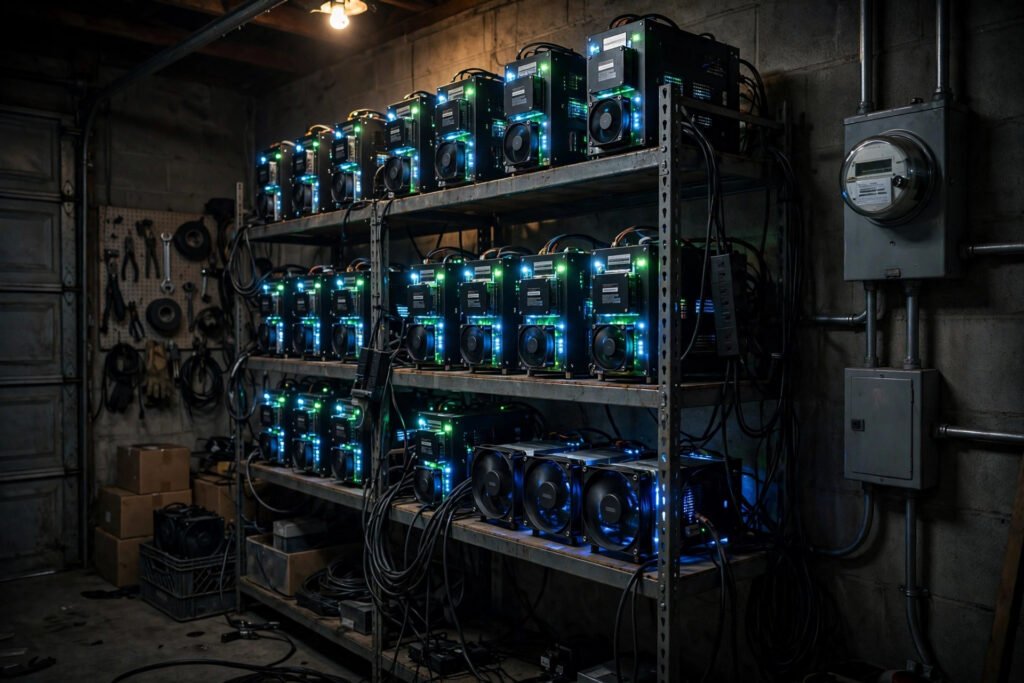
Every few months, a photo of a garage stacked with humming machines goes viral, and the same question pops back up: can an ordinary person still make money mining crypto at home? The honest answer in 2026 is less romantic than the memes — but not entirely discouraging either. A narrow lane still exists for individuals who understand the math before they buy a single machine.
In this guide, you’ll learn what crypto mining actually costs an individual in America in 2026, which coins remain mineable at home, how electricity prices in your state make or break the operation, and IRS tax rules for mined coins. By the end, you’ll be able to run the profitability calculation yourself — the skill that separates people who make money from people who donate money to their power company.
What Changed After the 2024 Halving
The Bitcoin halving of April 2024 cut the block reward from 6.25 to 3.125 BTC, and its aftershocks still shape mining economics in 2026. When the reward halved, every miner on Earth had to produce the same work for half the payout. Industrial miners with cheap power and the newest hardware absorbed the shock. Home miners did not.
That single event is why the “solo miner strikes gold” story is mostly folklore now. Bitcoin’s network difficulty adjusts roughly every two weeks to keep blocks arriving every ten minutes, so as industrial capacity grew through 2025, difficulty climbed and individual miners were squeezed from both sides: smaller rewards per block and harder competition per block.
Does that mean mining is dead for individuals? Not exactly. It means Bitcoin mining on ordinary hardware is. The home-mining conversation in 2026 is really about three different games: mining altcoins with consumer GPUs or ASICs, joining mining pools, and — the increasingly popular option — skipping mining hardware entirely in favor of approaches that earn crypto without the electric bill. Each has a different profit profile.
The Real Cost of Home Mining in 2026
Before touching a calculator, you need to price three things honestly: the hardware, the electricity, and the heat and noise. Most home miners budget for the first and get blindsided by the other two.
Hardware costs and hash rate
A modern Bitcoin ASIC — the only hardware remotely viable for Bitcoin — costs several thousand dollars and becomes obsolete as difficulty rises and newer, more efficient models ship. Consumer GPUs can still mine certain altcoins like Ethereum alternatives or memory-hard coins, but the profit margins are razor-thin and swing with coin prices weekly.
The key metric is efficiency: how much electricity a machine burns per unit of computing work (joules per terahash). A machine that was profitable at 8 cents per kilowatt-hour can bleed money at 15 cents. Always price hardware against its efficiency, not its sticker price.
Electricity: the variable that decides everything
American residential electricity prices vary enormously by state. A miner paying 10 cents per kWh in Louisiana or Washington faces a fundamentally different business than one paying 30+ cents in Hawaii or parts of California. At high residential rates, even the best hardware mines at a loss.
Run the numbers for your own rate before buying anything. A common rule of thumb in 2026: Bitcoin home mining generally needs electricity under roughly 10–12 cents per kWh to have any margin, and the margin stays thin even then. Altcoin GPU mining tolerates slightly higher rates but demands constant attention as coin prices and difficulty shift.
Heat, noise, and your living situation
An ASIC miner sounds like a vacuum cleaner running around the clock and throws off serious heat. If you rent, your lease may prohibit commercial-scale equipment, and your landlord’s electrical panel may not handle the load. This is the hidden cost that kills most home-mining dreams: the machine itself is only half the problem.
Altcoins: Where Home Miners Actually Operate
If you still want to mine at home, the realistic path in 2026 is altcoins. Some coins deliberately use algorithms that resist industrial ASIC dominance, which keeps consumer GPUs competitive. Coins like these can be mined with a desktop PC and a decent graphics card.
The catch is volatility. The coin that’s profitable to mine this month may not be next month, and you must convert mined coins to dollars (or a stablecoin) regularly to lock in profits. Holding everything you mine is not a strategy; it’s a bet. Smart small miners treat mined coins like a paycheck — sell a portion, keep a portion, and never mine a coin they haven’t researched.
Side-hustle-minded miners often do better by treating mining as one income stream among several, not a full-time job. The returns resemble a demanding hobby more than a salary.
Pools, Cloud Mining, and the “Should I Even Bother” Question
Joining a mining pool lets you combine computing power with other miners and split rewards. For individuals, pools are essentially mandatory — solo-mining Bitcoin with home hardware is a lottery ticket, not a plan. Pools charge fees, typically 1–3%, but they turn sporadic luck into a steadier trickle of payouts.
Cloud mining — renting hash power from a distant data center — deserves a hard look. The SEC and investor-protection agencies have repeatedly warned that many cloud-mining operations are scams or operate at margins that quietly guarantee you lose money. The U.S. Securities and Exchange Commission’s investor education site cautions investors to be skeptical of guaranteed mining returns, and for good reason: if someone could reliably profit from mining, they’d keep the profits rather than sell you the contract.
The Tax Bill Nobody Mentions
Here’s the part that surprises new miners: the IRS treats mined cryptocurrency as ordinary income at its fair market value on the day you receive it. Mine $500 worth of coins on a Tuesday, and you owe income tax on $500 — even if the coins crash to $200 before you sell them.
If you later sell at a gain, that’s a separate taxable event. Mining as a business (as opposed to a hobby) opens up deductions for electricity and hardware depreciation, but it also brings self-employment tax and stricter recordkeeping requirements. Freelancers handling their own taxes face similar recordkeeping discipline. Consult the IRS guidance on virtual currency and talk to a tax professional before scaling up — the recordkeeping gets painful fast.
A Realistic 2026 Verdict
So, is crypto mining still profitable for individuals in America in 2026? For Bitcoin, with home hardware and residential electricity: almost certainly not. The math was decided by the halving and the industrialization of mining. For altcoins with a GPU you already own, cheap electricity, and a willingness to tinker weekly: it can be modestly profitable, closer to a side hustle than an investment.
The people who do best in 2026 are the ones who treat mining like running a small business: they calculate electricity costs first, buy efficient hardware second, join reputable pools, pay their taxes, and never invest money they can’t afford to lose. If that sounds like too much work, that’s useful information too — buying a small amount of crypto directly, or directing that cash toward a concrete savings goal, often beats mining on both returns and sleep.
Conclusion
Crypto mining in 2026 is not the gold rush of a decade ago — it’s a niche industrial process that occasionally leaves crumbs for well-prepared individuals. Your electricity rate, hardware efficiency, and tax discipline matter more than which coin you pick. Run the numbers for your specific situation, start small enough that a total loss wouldn’t hurt, and remember that the most profitable move for most Americans is simply to understand mining well enough to decide it isn’t for them.
Frequently Asked Questions
Can I mine Bitcoin with my regular computer in 2026?
No. Bitcoin’s network difficulty requires specialized ASIC hardware; a regular CPU or GPU would spend more on electricity than it could ever earn, by orders of magnitude.
How much electricity does a home mining rig use?
A single modern ASIC miner can draw 3,000+ watts continuously — roughly like running 30 incandescent light bulbs 24/7. GPU rigs vary but commonly pull 500–1,500 watts. Check your residential rate and your breaker panel before anything else.
Do I have to pay taxes on crypto I mine?
Yes. The IRS treats mined coins as ordinary income at fair market value when received, and selling them later triggers a second taxable event on any gain. Keep detailed records of dates, amounts, and values.
Is cloud mining a good alternative to buying hardware?
Usually not. Many cloud-mining services are scams, and legitimate ones often price contracts so the house wins. Be deeply skeptical of any service promising guaranteed returns — no honest investment can guarantee mining profits.
Which coins are most realistic for home miners in 2026?
Certain altcoins with ASIC-resistant algorithms remain mineable on consumer GPUs, but profitability shifts constantly with prices and network difficulty. Research current profitability calculators and treat any coin choice as temporary.