Learn Drums Without Annoying Your Neighbors
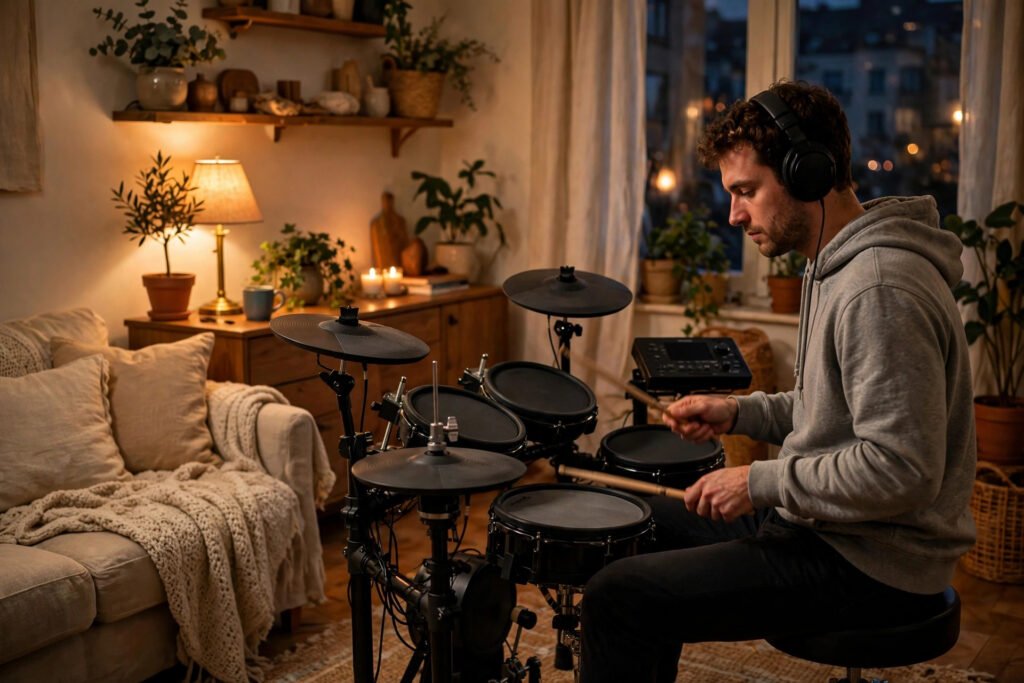
You want to learn drums. Your neighbors want quiet. These desires are not incompatible — they just require strategy. Acoustic drums in an apartment are genuinely antisocial (a snare hit reaches 120 decibels — louder than a chainsaw), but the path from total beginner to competent drummer no longer requires torturing everyone within 50 feet. Between electronic kits, practice pads, and smart scheduling, you can build real drumming skill while staying on speaking terms with your neighbors. Here’s the complete quiet-practice system.
Start With the Right Gear: Electronic vs. Muted Acoustic
Electronic drum kits are the apartment drummer’s best friend. A beginner mesh-head e-kit ($300–$500 for solid starter models) produces roughly 60–70 decibels of stick-on-pad thwack — about conversation level — heard only in your room with headphones. Compare starter models in Sweetwater’s electronic drum buying guides. Technique matters too: Vic Firth’s education resources teach the low-impact strokes that keep apartment sessions neighbor-friendly. Mesh heads (not rubber pads) are essential: they feel like real drums, respond to dynamics, and are dramatically quieter. The kick pedal’s thump through the floor is the main remaining noise — solve it with a tennis-ball riser platform (DIY: plywood on tennis balls) or a purpose-built noise-eating pad, which decouples vibrations from the floor. This single addition prevents 90 percent of downstairs-neighbor complaints.
Muted acoustic kits are the alternative if you already own drums: mesh head replacements ($100–$150 for a full set) plus low-volume cymbals (perforated designs that cut volume ~80% while keeping real cymbal feel). This preserves the acoustic experience at conversation-level volume. The trade-off: muted acoustics still transmit more vibration than e-kits, and the feel differs subtly from real heads.
Whichever route, invest in good headphones — you’ll live in them. Closed-back over-ears protect your hearing (drummers’ hearing damage is cumulative and permanent) and let you play along with tracks, which is both more fun and better practice than metronome-only sessions. For fellow beginners on other instruments, learning guitar as a complete beginner pairs naturally with quiet drum practice — rhythm skills transfer both ways.
The Practice Pad: Your Silent Superpower
Every serious drummer — including touring professionals — practices fundamentals on a $30 practice pad. Rudiments (single strokes, double strokes, paradiddles, flams) are the vocabulary of drumming, and they’re 100 percent learnable in near-silence. Fifteen minutes of daily pad practice builds the hand technique that separates drummers from people who hit things rhythmically. The pad goes anywhere: couch, desk, commute (with restraint).
Structure pad sessions: 5 minutes of single-stroke warm-up with a metronome (start slow — 60 BPM — speed is earned, not taken), 5 minutes of one rudiment (one per week: paradiddle week, flam week…), 5 minutes applying it around an imagined kit. Use a practice app with a metronome and rudiment library; the gamification keeps the repetition tolerable. Pad practice is also the perfect neighbor-friendly late-night session — silent enough for midnight, productive enough to count. After three months of daily pad work, your hands will embarrass drummers who’ve been “playing” (without practicing) for years.
Be a Good Neighbor: The Diplomacy Layer
Gear solves volume; diplomacy solves relationships. Talk to neighbors first — before the first session. “Hey, I’m learning drums on an electronic kit with headphones — you shouldn’t hear much, but please tell me if you do” transforms potential enemies into allies. People tolerate remarkable amounts from considerate neighbors and zero from inconsiderate ones.
Set practice hours and keep them: late morning to early evening is the universal safe window; never before 9am or after 8pm in shared buildings. Invite feedback explicitly — “text me if it’s ever too loud” gives neighbors agency instead of resentment. Consider the room: practice in carpeted interior rooms, away from shared walls; rugs, curtains, and bookshelves absorb meaningful sound. If complaints come despite e-kits and risers, the issue is almost always kick-pedal vibration — double down on isolation (thicker riser, different room) before assuming the situation is hopeless. Most neighbor drum disputes are solvable with the riser platform alone.
Learning Path: From Pad to Kit Without Lessons
Months 1–2: pad fundamentals daily + e-kit exploration. Learn to hold sticks properly (matched grip — both hands the same — is the standard start), basic rock beat (kick-snare-hi-hat coordination), and play along with simple songs. Months 3–4: expand the beat vocabulary (add fills, learn the money beat variations), start recording yourself (phone video reveals timing issues you can’t hear while playing). Months 5–6: play with others — even one guitarist friend transforms your timing and musicality; drumming is a team sport and bedroom-only practice plateaus.
Free resources carry you far: YouTube drum educators offer structured beginner series rivaling paid courses, and drum-less backing tracks on streaming platforms make practice musical. The milestone that matters: playing a full song start to finish in time. Once you can do that with five songs, you’re a drummer — everything after is refinement. And when you’re ready to hear yourself in context, local live music events (especially open jam nights) are where bedroom drummers become band drummers.
Recording Yourself: The Fastest Feedback Loop
The single highest-ROI practice habit is recording yourself — and it costs nothing. Prop your phone up, record every practice session, and listen back the next day. You’ll hear timing drift, uneven dynamics, and rushed fills that are invisible while you’re playing; the gap between what you think you sound like and what you actually sound like is where all improvement lives. Drummers who record progress weekly improve measurably faster than those who don’t, because the recordings make problems undeniable and progress visible. Keep a monthly “best take” of a song you’re working on — after six months, the playlist of improvement is the most motivating thing you own. Share takes with online drummer communities for feedback when you’re brave enough; the critique is free and often excellent. Your phone is the most underused drum teacher in existence.
Conclusion
Learning drums without annoying your neighbors is entirely doable: a mesh-head electronic kit with a vibration-isolating riser, daily silent practice-pad rudiments, considerate practice hours, and proactive neighbor diplomacy. The quiet path isn’t a compromise — pad fundamentals and headphone practice build technique as effectively as loud playing, sometimes more so. Start with the pad this week ($30), add the e-kit when committed, and keep the neighbors as allies. In six months you’ll be playing full songs, and the only person who knows you’re a drummer is you.
Frequently Asked Questions
Are electronic drums as good as acoustic for learning?
For beginners, yes — arguably better. Mesh-head e-kits teach proper technique, dynamics, and coordination identically to acoustics for the first 1–2 years. The differences (subtle acoustic nuances, stage volume experience) matter at advanced levels, not while learning fundamentals.
How loud is an electronic drum kit really?
The pads produce about 60–70 decibels of stick impact noise (conversation level) — inaudible through walls with headphones. The main issue is kick-pedal vibration transmitted through floors, which a tennis-ball riser platform reduces dramatically. Upstairs and adjacent neighbors typically hear nothing.
Can I learn drums without a teacher?
Yes — structured free resources (YouTube beginner series, rudiment apps, play-along tracks) cover the first year comprehensively. The key disciplines are daily practice (even 20 minutes), metronome use from day one, and recording yourself. A few lessons later can correct ingrained bad habits if you plateau.
What’s the cheapest way to start learning drums quietly?
A $25–$35 practice pad plus sticks and a free metronome app — genuinely sufficient for the first 1–2 months of fundamental technique. Add a beginner mesh-head e-kit ($300–$500) when you’re committed. This staged investment avoids spending hundreds before knowing you’ll stick with it.