Make a Living as a Musician Without Touring
The romantic image of the musician’s life is the tour: the van, the venues, the road. But touring is also grueling, expensive, and incompatible with families, health conditions, day jobs, and simple preference — and in 2026, it’s no longer the only path to a music living. The industry has fragmented into dozens of income streams, many location-independent, and musicians who assemble 4–6 of them often earn more reliably than touring artists. Here’s the realistic map of making a living as a musician without ever loading a van.
Shift the Mindset: Portfolio Career, Not Single Job
The musicians thriving without touring think like freelancers, not employees. Almost nobody earns a full living from one stream — the model is 4–7 modest income sources that sum to a salary and diversify risk. A realistic portfolio: teaching ($1,500/month) + session work ($800) + sync licensing ($500) + streaming royalties ($300) + a Patreon community ($400) + wedding/corporate gigs ($600) = $4,100/month without touring. The exact mix varies by skill and market, but the principle is universal: diversify or die. This also smooths the feast-or-famine cycle that destroys music careers — when gigs dip, teaching holds; when students leave for summer, licensing pays.
Teaching: The Bedrock Income
Private teaching remains the most reliable music income in existence — recurring weekly revenue, scheduled around your life, location-flexible via video. At $40–$80/hour (typical U.S. rates, higher in major metros), just 15 students weekly generates $2,400–$4,800 monthly. Getting students: local music schools and stores hire teachers constantly (steady but lower pay), while independent teaching via your own site and local advertising pays more per student. Online platforms (Lessonface, TakeLessons) provide built-in student flow for a commission.
Beyond one-on-one: group classes and workshops (higher hourly yield), school programs (many districts hire teaching artists), and online courses (record once, sell forever — the scalability that one-on-one lacks). Teaching also deepens your own musicianship — explaining technique forces mastery — and provides the stable base that lets you take creative risks elsewhere. It’s no coincidence that most successful non-touring musicians teach: it’s the financial foundation everything else builds on. Communities that support local musicians are also where teaching studios thrive — the local ecosystem feeds every income stream.
Recording, Session Work, and Production
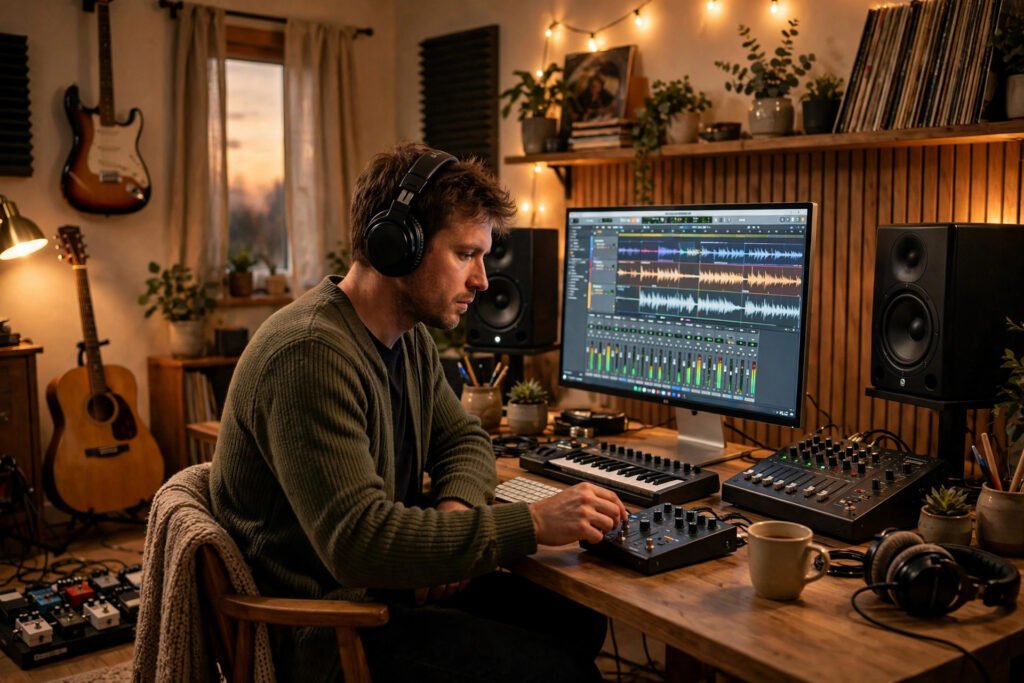
The home-studio revolution made session work location-independent. Remote session musicianship — recording guitar, vocal, horn, or string parts for clients worldwide via platforms like SoundBetter and AirGigs — pays $100–$500+ per track, and established players handle several weekly. Requirements: pro-quality home recordings (a $500–$1,000 treated setup suffices), fast turnaround, and the professionalism to nail parts from briefs without hand-holding.
Adjacent streams multiply this: mixing and mastering for indie artists ($100–$400/song), beat-making and production for rappers and singers (lease beats at $30–$300, exclusive rights far higher), podcast and video theme music (the creator economy’s endless appetite), and jingles/audio branding for local businesses. The common thread: your recording skills are the product, and the internet is the marketplace. Build a portfolio site with before/after samples; clients buy what they can hear.
Licensing, Royalties, and Passive Income
Sync licensing — placing your music in TV, film, ads, and games — is the non-touring musician’s lottery ticket with better odds than the actual lottery. Non-exclusive libraries (Pond5, AudioJungle) pay per placement; exclusive libraries and publishers pitch your catalog for bigger placements ($1,000–$50,000+ for major syncs). The strategy: write prolifically in licensable styles (emotional underscore, upbeat corporate, tension beds), produce broadcast-quality masters, and build a catalog of 100+ tracks — licensing is a numbers game where catalog size predicts income.
Streaming royalties alone rarely sustain anyone (Spotify pays roughly $0.003–$0.005 per stream — a million streams is $3,000–$5,000), but they’re passive income atop everything else, and playlist placement compounds. YouTube’s Content ID monetizes uses of your music you never knew existed. The realistic view: treat royalties as the long-tail bonus on a career built from active streams, not the foundation. Register everything with a PRO (ASCAP or BMI — free to join as a writer) from day one; unregistered music earns nothing.
Local Gigs That Aren’t Touring
“Without touring” doesn’t mean never performing. Local performance income without the road: wedding and corporate bands ($300–$1,000+ per musician per event — the best-paying regular gig in most markets), restaurant and brewery residencies (steady weekly income, low pressure), church music positions (many pay $200–$500 weekly for skilled players), private events and parties, and house concerts. These pay better per hour than most touring, let you sleep at home, and build the local reputation that feeds teaching and session referrals.
The wedding/corporate band path deserves emphasis: it’s unglamorous and lucrative, with professional musicians earning $30,000–$60,000+ yearly from weekends alone in strong markets. The skills are specific — vast repertoire, reliability, reading the room, professional presentation — but they’re learnable. And every local gig is marketing: local live music scenes run on relationships, and the musician everyone knows is the musician everyone hires.
Direct Fan Revenue: Patreon, Subscriptions, Merch
The internet lets 500 true fans sustain a musician. Patreon and similar platforms convert followers into monthly supporters ($3–$25/month tiers) for exclusive content: early releases, behind-the-scenes, livestream concerts, tutorials. A modest 200 patrons at $8 average is $1,600 monthly — life-changing for an independent musician, achievable with a few thousand engaged followers. The key: consistent exclusive value, not just a tip jar.
Digital products scale infinitely: sample packs and presets for producers ($20–$100, sold on Splice and your own site), sheet music and tabs, online courses. Physical merch at local shows (even small runs) carries high margins. And livestream concerts — ticketed online shows via platforms like StageIt or your own setup — monetize your playing for a global audience from your living room. None of this requires touring; all of it requires treating your music as a small business, which it is.
Conclusion
Making a living as a musician without touring means building a portfolio: teaching as the bedrock, session and production work for skill monetization, licensing for passive upside, local non-touring gigs for performance income, and direct fan revenue for independence. No single stream needs to be huge — five streams at $500–$1,500 monthly is a living. Start with the stream closest to your current skills (usually teaching or local gigs), add one per quarter, and treat it all as the small business it is: track income, reinvest in your setup, and market consistently. The road isn’t the only way; for many musicians in 2026, it’s not even the best way.
Frequently Asked Questions
Can you really make a living as a musician without touring?
Yes — through a portfolio of income streams: teaching, session work, licensing, local gigs, and direct fan revenue. Most non-touring musicians combine 4–7 streams totaling a full income. It requires business discipline, but the income is often more stable than touring’s feast-or-famine cycle.
How much do music teachers make?
Private teachers typically charge $40–$80/hour; 15 weekly students generate $2,400–$4,800 monthly. Rates are higher in major metros and for advanced specialties. Group classes and online courses increase hourly yield beyond one-on-one limits.
How do I start getting session work as a musician?
Build a pro-quality home recording setup ($500–$1,000), create a portfolio site with samples, join platforms like SoundBetter and AirGigs, and network in producer communities. Fast turnaround and professionalism matter as much as playing ability — clients rehire reliability.
Is sync licensing realistic for independent musicians?
Yes, with volume and quality: build a catalog of 100+ broadcast-quality tracks in licensable styles, submit to libraries (non-exclusive for volume, exclusive for bigger placements), and register with a PRO. Individual placements range from tens to tens of thousands of dollars; catalog size predicts income.