Is Online Learning as Effective as In-Person Classes?
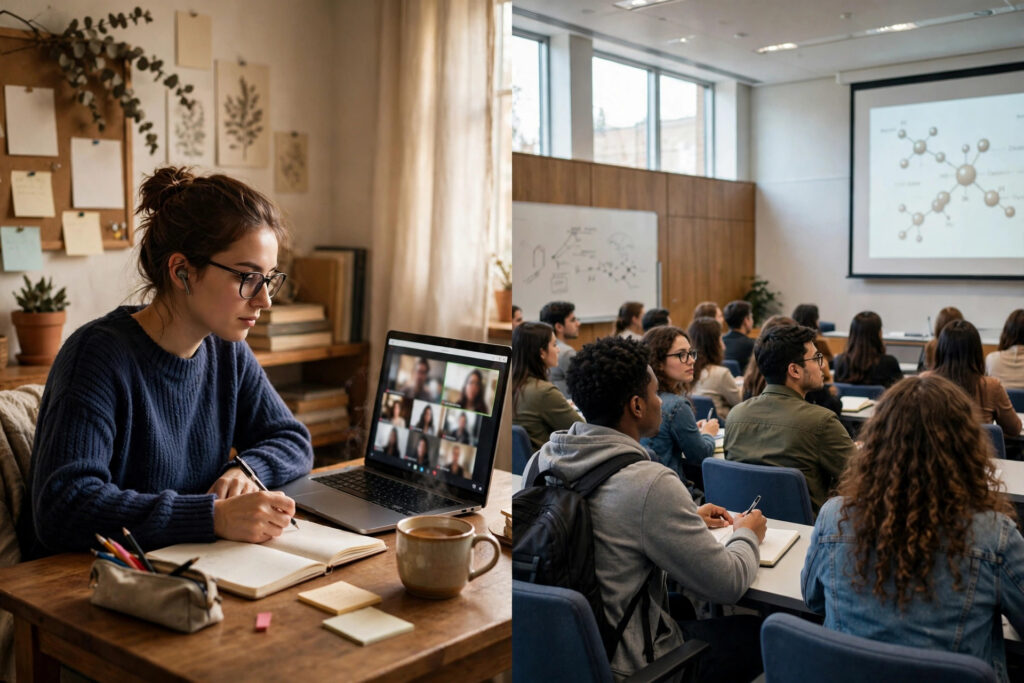
Your university just announced that half of next semester’s courses will be online. Or you’re choosing between an online program and commuting to campus. Either way, the question nags: am I getting a lesser education through a screen? It’s a fair question — and one that education researchers have studied extensively, especially after the pandemic forced a global experiment in remote learning. The answer is more encouraging (and more nuanced) than either the boosters or the skeptics claim.
This guide reviews what the research actually says about online versus in-person learning effectiveness, where each format wins, and how to make online learning work as well as it can.
What the research says: the headline finding
The most comprehensive answer comes from a landmark US Department of Education meta-analysis (and subsequent large reviews): students in online learning perform modestly better, on average, than those in purely face-to-face instruction — with the important caveat that the best results come from blended learning (online + in-person elements combined), which outperforms either alone.
But averages hide the real story. The research shows enormous variance: well-designed online courses with strong interaction can match or beat in-person; poorly designed ones — the infamous “watch recorded lectures and take quizzes” model — underperform significantly. The format matters less than the design. A great online course beats a mediocre lecture hall; a great seminar beats a mediocre online module. The question isn’t really “online or in-person” — it’s “well-designed or not.”
Where online learning wins
Flexibility and access: the decisive advantage — working adults, parents, rural students, and anyone far from campus get education that would otherwise be impossible. This isn’t marginal; it’s transformative for millions.
Self-pacing: strong students accelerate; struggling students rewind and rewatch. In a live lecture, the pace fits nobody perfectly; online, it fits everybody individually.
Deliberate practice: online platforms excel at quizzes, simulations, and interactive problems with instant feedback — the active-learning techniques research favors. Well-built online courses often include more active learning than passive lecture halls.
Written discussion: online forums give every student a voice — including the quiet ones who never raise hands in 300-person lectures. Instructors consistently report deeper, more thoughtful online discussions than live ones.
Data and personalization: learning analytics identify struggling students earlier; adaptive platforms adjust difficulty individually. The classroom teacher with 150 students can’t do this; software can.
Where in-person wins
Motivation and accountability: the biggest in-person advantage. Physical presence creates social pressure to attend, participate, and keep up — online courses have notoriously higher dropout rates, driven largely by procrastination, not comprehension difficulty.
Spontaneous interaction: the hallway conversation, the after-class question, the study group that forms organically — these serendipitous connections are hard to replicate online and matter enormously for learning and networking.
Hands-on and lab work: chemistry labs, clinical skills, studio art, performance — fields requiring physical practice, equipment, or embodied feedback remain stubbornly in-person. Simulations help but don’t fully substitute.
Social development: especially for traditional-age undergraduates, college is partly about learning to be an adult among adults — a dimension online formats thin out.
Structure for the unstructured: students who struggle with self-regulation — disproportionately younger and less-prepared students — do markedly worse online. The format’s freedom is a feature for the disciplined and a trap for everyone else. This is the most important caveat in the entire debate: online learning’s effectiveness is conditional on the learner’s executive function, which is why advisors steer first-year students toward in-person sections when possible.
The cheating question
Let’s address it directly: academic integrity is harder to police online, and everyone knows it. Unproctored online exams see higher cheating rates — which is why serious programs use proctoring software, project-based assessment, or in-person testing centers for high-stakes exams. But the deeper point: courses designed around learning (projects, papers, discussions) are both harder to cheat and better pedagogy than courses designed around testing — online or off. If you’re a student navigating these waters honestly, see is it cheating to use AI for school assignments for where the lines actually are. And the AI question cuts both ways — see how teachers use AI in the classroom for how instruction itself is evolving.
How to make online learning maximally effective
- Treat it like a job: fixed schedule, dedicated space, full attention. The students who fail online treat it as optional; the ones who succeed treat it as employment.
- Engage actively: post in discussions early and substantively, form virtual study groups, attend live sessions. Passive watching is the online equivalent of sleeping through lecture.
- Use the rewind strategically: rewatch confusing segments actively — pause, attempt the problem yourself, then watch the solution. Passive rewinding is just expensive TV.
- Seek help early: online instructors hold virtual office hours that students underuse dramatically. A 15-minute video call resolves what three days of confused forum lurking won’t.
- Choose blended when possible: the research is clear — some in-person component (labs, discussions, intensives) plus online flexibility is the effectiveness sweet spot.
Conclusion
Online learning is as effective as in-person classes in America when it’s well-designed — and blended learning beats both. Online wins on flexibility, self-pacing, and active-learning tools; in-person wins on motivation, spontaneous interaction, hands-on work, and structure for developing learners. The format is secondary to design quality and your own discipline. Choose based on your life circumstances and self-knowledge, then engage like it matters — because in either format, that’s what determines what you learn.
The pandemic’s lasting lesson
COVID-19 forced the largest educational experiment in history — and the results reshaped the debate permanently. Emergency remote teaching (hastily converted lectures, minimal interaction) performed poorly, which skeptics cited as proof online learning fails. But researchers distinguish sharply between emergency remote teaching and designed online learning: the former was crisis improvisation, the latter is a deliberate pedagogy with decades of refinement. Post-pandemic, the institutions that kept well-designed online and hybrid options report strong outcomes and student satisfaction, while those that reverted entirely did so more from cultural inertia than evidence. The lesson isn’t that screens beat classrooms or vice versa — it’s that intentional design beats accident, in every medium. For authoritative guidance, see the U.S. Department of Education and the National Center for Education Statistics.
Frequently Asked Questions
Is online learning as effective as in-person classes?
Yes, on average — a major US Department of Education meta-analysis found online learners perform modestly better than face-to-face-only students, with blended learning outperforming both. But design quality matters more than format; well-designed courses of either type beat poorly designed ones.
What are the disadvantages of online learning?
Higher dropout rates (driven by procrastination), weaker spontaneous social interaction, limited hands-on/lab experiences, and particular difficulty for students who struggle with self-regulation. Motivation and accountability are the main casualties.
Do employers respect online degrees?
Regionally accredited online degrees from known universities are widely accepted, especially when the diploma doesn’t distinguish delivery format. Employer skepticism targets unaccredited schools, not online learning itself.
Is blended learning better than fully online?
Research says yes — blended (online + in-person elements) consistently shows the strongest outcomes, combining online’s flexibility and active-learning tools with in-person’s accountability and interaction.
How can I succeed in online classes?
Fixed schedule, dedicated study space, active participation in discussions, strategic use of rewind (pause and attempt problems yourself), early help-seeking via virtual office hours, and treating the course with the seriousness of a job.