Estimating Fixer-Upper Renovation Costs Before You Buy
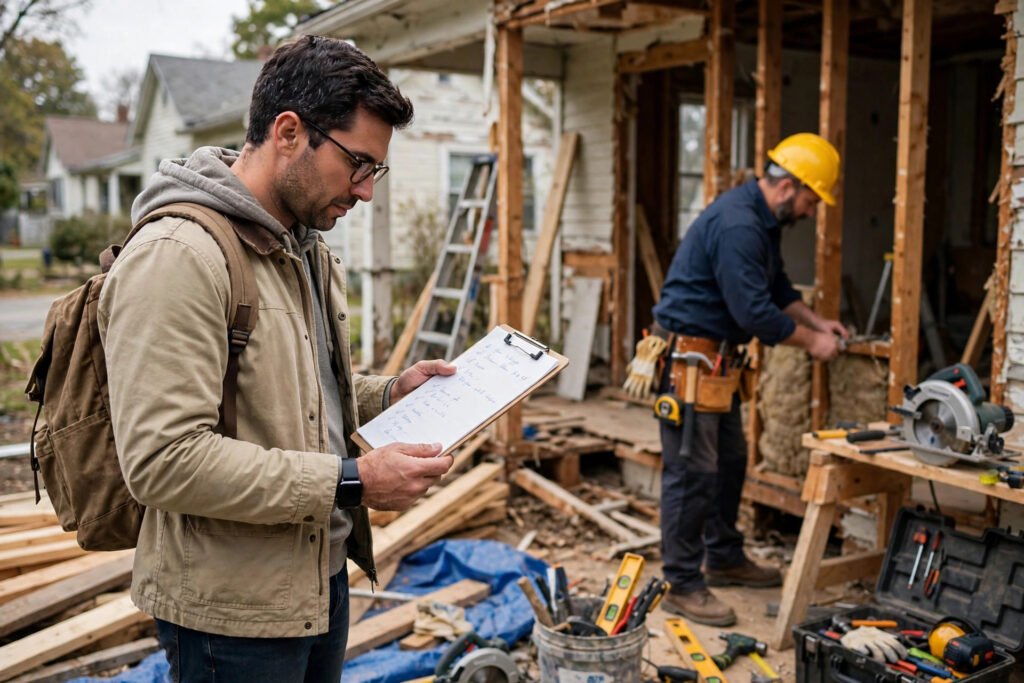
That charming 1960s ranch with the “good bones” and the price $80,000 below everything else on the street — is it a steal or a money pit wearing a costume? Every year, thousands of American buyers fall for fixer-uppers without ever doing the renovation math, and the surprise bills arrive right on schedule: the $25,000 roof, the $40,000 foundation, the electrical panel that three contractors refuse to touch. Estimating renovation costs before you buy isn’t about getting a perfect number. It’s about getting a number that’s close enough to keep you from making a six-figure mistake. Here’s how to build a realistic budget before you write the offer.
Start With the Walkthrough: What to Price Before Anything Else
Your first estimate happens during showings, and it starts with triage. Divide everything you see into three buckets: cosmetic (paint, flooring, fixtures, landscaping), mechanical (roof, HVAC, plumbing, electrical, water heater), and structural (foundation, framing, major water damage, additions). Cosmetic work is predictable and shoppable — you can price paint and LVP flooring from your phone standing in the living room. Mechanical and structural items are where budgets go to die, because they’re expensive, often hidden, and frequently worse than they look.
Learn the tell-tale signs. Stains on ceilings mean roof or plumbing leaks — budget for both the repair and the water damage you can’t see. A musty basement smell suggests moisture issues that range from a $1,500 grading fix to a $15,000 waterproofing system. Flickering lights or a fuse box instead of a breaker panel signals electrical work. Sloping floors or cracks wider than a quarter-inch in foundation walls warrant a structural engineer’s opinion ($300–$500) before you go further — that single inspection has saved countless buyers from catastrophic purchases. For a deeper dive on vetting the people who’ll do this work, read our guide to choosing the right contractor for a home renovation before you start collecting bids.
The Price Ranges You Need Memorized
You don’t need contractor-level precision; you need realistic ranges for the big-ticket items, because those drive the entire decision. Based on national averages that remodelers and real estate economists publish annually (notably the National Association of Realtors’ Remodeling Impact Report), here are ballparks for 2026: a roof replacement runs $8,000–$20,000+ depending on size and material; HVAC replacement $7,000–$15,000; a full electrical panel upgrade $2,500–$5,000, with whole-house rewiring reaching $15,000+; plumbing repipes $5,000–$15,000; foundation repairs $5,000–$30,000+ depending on severity. Kitchens run $25,000–$75,000 for a real renovation (not just new cabinet doors), and full bathroom remodels $10,000–$30,000 — our breakdown of what a small bathroom remodel costs shows how quickly even modest projects add up.
Now the critical step most buyers skip: add 20% contingency on top of your total, minimum. Not 10%. Twenty. Renovation projects uncover surprises as a matter of course — the rot behind the shower tile, the knob-and-tube wiring the inspector couldn’t see, the plumbing stack that’s disintegrating. Experienced flippers budget 20–25% contingency and still get surprised; first-timers budgeting 10% are planning to run out of money. If purchase price plus realistic renovation estimate plus 20% contingency doesn’t leave you at or below the home’s after-repair value, the “deal” isn’t a deal.
Get Real Numbers: The Pre-Offer Bid Strategy
Ranges get you oriented; bids get you truth. Before making an offer on a serious fixer-upper, get at least two contractors through the property for rough estimates. Yes, this takes effort. Yes, some contractors won’t bother for a house you don’t own. Offer to pay for their time ($100–$200 for a walkthrough estimate) — it’s the cheapest insurance in real estate. Give each contractor the same scope list so the bids are comparable, and ask them to separate labor from materials and to flag anything they couldn’t fully assess.
Treat the bids like data, not gospel. Throw out any bid dramatically lower than the others — it’s either missing scope or from someone who’ll discover “unforeseen issues” halfway through. Ask each contractor for a worst-case number alongside their base estimate; the spread between the two tells you how uncertain the project is. And verify licenses and insurance through your state’s contractor board before you let anyone’s numbers influence a six-figure decision. For renovation financing specifically, look into the FHA 203(k) program through HUD, which rolls purchase and renovation costs into a single mortgage — it’s paperwork-heavy but purpose-built for exactly this situation.
The Math That Decides: After-Repair Value
Here’s the formula investors use and owner-occupants should steal: After-Repair Value (ARV) minus purchase price minus renovation costs minus contingency minus carrying costs (mortgage payments, taxes, insurance during the renovation months) minus your time and stress equals your actual margin. If that number is thin or negative, walk away no matter how much you love the house. To estimate ARV, look at comparable renovated homes sold within the last six months within half a mile — not list prices, sold prices, and not the aspirational listing that’s been sitting for 200 days.
Be especially careful with two traps. First, over-improving for the neighborhood: a $100,000 kitchen in a $300,000 neighborhood doesn’t create a $400,000 house; appraisals anchor to comparable sales, and you can’t comp your way out of a modest zip code. Second, underestimating timeline: a “three-month renovation” that takes eight months costs you five extra months of mortgage payments, taxes, and insurance — plus five months of living in construction chaos or paying rent elsewhere. Price the timeline honestly, then add two months. Everyone’s project runs long; the prepared buyer just budgets for it.
Red Flags That Mean “Walk Away”
Some fixer-uppers are projects; others are warnings. Walk away from major structural movement that an engineer can’t confidently scope, extensive mold suggesting long-term water intrusion, aluminum wiring or other fire hazards requiring whole-house rewiring on top of everything else, and any property where the renovation cost exceeds 50% of the after-repair value — at that point you’re essentially building a new house inside a liability. Also walk away when the seller won’t allow contractor walkthroughs or an inspection contingency; there’s always a reason, and it’s never a good one.
And know yourself. A cosmetic fixer — paint, floors, kitchen refresh — is a reasonable first project for a handy buyer with cash reserves. A mechanical-and-structural fixer requiring six months of contractor management is a second or third project, or a job for someone hiring a general contractor full-time. There’s no shame in buying the boring move-in-ready house; there’s considerable shame-free wisdom in it, in fact. The goal was never to renovate. The goal was to own a home you love without financial ruin attached.
The Bottom Line
Estimating fixer-upper renovation costs before buying comes down to disciplined triage: price the mechanical and structural items first (they decide everything), memorize realistic ranges for big-ticket work, get paid pre-offer bids from licensed contractors, add a 20% contingency without flinching, and run the after-repair-value math coldly. If the numbers work with margin to spare, you’ve found a genuine opportunity. If they only work by assuming everything goes perfectly — it won’t, and you already know that. The best renovation budget is the one that lets you sleep at night before the demolition even starts.
Frequently Asked Questions
How much should I budget for renovations on a fixer-upper?
A common starting framework: cosmetic-only fixers run $20,000–$50,000; homes needing mechanical updates (roof, HVAC, electrical) run $50,000–$150,000+; structural projects can exceed $150,000. Always add 20% contingency on top of contractor estimates.
Can I get a mortgage that covers renovation costs?
Yes — the FHA 203(k) loan and Fannie Mae HomeStyle loan both roll purchase and renovation costs into one mortgage. They require more paperwork and lender oversight of the work, but they’re designed specifically for fixer-uppers.
Should I get a home inspection on a fixer-upper I already know needs work?
Absolutely — more so than on a move-in-ready home. The inspection’s job on a fixer isn’t to find cosmetic issues you can see; it’s to uncover the structural, electrical, and plumbing problems you can’t, which are exactly the items that destroy budgets.
What’s the biggest budget-killer in fixer-upper renovations?
Water damage and the structural issues hiding behind it. Leaks, rot, foundation problems, and mold routinely cost 2–3x initial estimates because the full extent isn’t visible until demolition begins. When in doubt, budget for the worst case on anything moisture-related.