Water on Mars: What We Know, How We Know, and Why It Matters
Every few months, headlines announce “water found on Mars!” with breathless excitement — and readers are entitled to ask: didn’t we already know that? The answer is yes, no, and it’s complicated. Scientists have known about Martian water for decades, but each new discovery reveals a different form of water in a different place, and each form answers different questions. The real story is not a single discovery but a decades-long detective case with enormous stakes: water is the key to past life, future human missions, and understanding planetary fate.
Here is what we actually know about water on Mars, how we know it, and why it matters so much.
What “Water on Mars” Actually Means: The Inventory
Mars has water in several distinct reservoirs, discovered by different missions:
Polar ice caps. Known since the earliest telescopes: Mars has white polar caps. We now know the south cap holds enough frozen water to cover the planet meters deep, with layered deposits recording millions of years of climate cycles — like tree rings for the whole planet. The north cap is mostly water ice; the south has a permanent carbon-dioxide ice layer atop the water ice.
Subsurface ice. Radar instruments (like MARSIS on Mars Express) have mapped vast buried ice deposits at mid-latitudes — in some places, nearly pure ice slabs just meters below the dust. NASA’s Phoenix lander literally scraped up water ice in 2008 and watched it sublimate. This is the most accessible water for future astronauts.
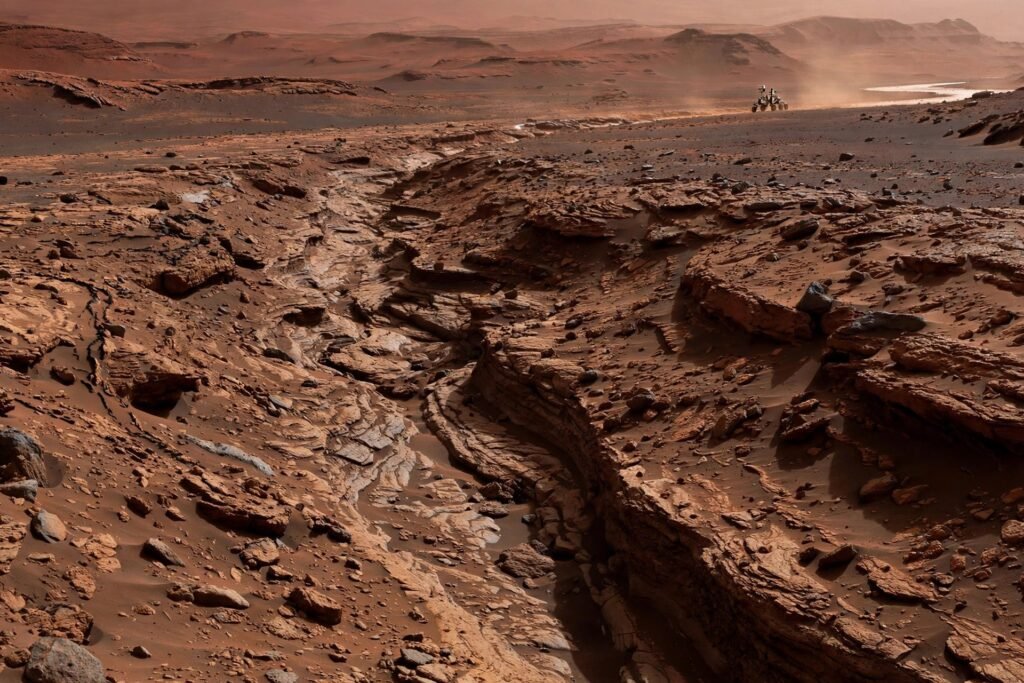
Ancient riverbeds and lakebeds. Orbiters have photographed unmistakable dried river valleys, deltas, and lake basins. The Curiosity rover has rolled across ancient streambeds with rounded pebbles — rounded only by flowing water — and Perseverance is exploring Jezero Crater, a former lake with a preserved river delta. Mars was once very wet.
Possible liquid water today. This is the controversial frontier. Recurring slope lineae (dark streaks that grow in warm seasons) were once attributed to briny liquid flows; later analysis suggested dry granular flows instead. More exciting: radar data hinting at subglacial liquid lakes beneath the south polar cap — briny, super-salty water kept liquid by pressure and salts despite freezing temperatures. The evidence is debated but tantalizing. NASA’s Mars program (nasa.gov/mars) and the European Space Agency (ESA) track each mission’s water findings as they develop.
How We Know: The Detective Toolkit
Nobody has dipped a cup into Martian water. The evidence is remote but converging: spectrometers detect water molecules’ chemical fingerprints in ice and minerals; ground-penetrating radar reveals buried ice layers and possible liquid reflections; rovers analyze water-formed minerals (hematite “blueberries,” clays, sulfates) and sedimentary structures that only water creates; neutron detectors map hydrogen (proxy for water) in the top meter of soil globally. Each instrument is indirect; together they are overwhelming. When orbiters, landers, and rovers all point to water through different physics, the conclusion is solid.
Why It Matters, Reason 1: The Search for Life
“Follow the water” has been NASA’s Mars strategy for decades because every known life-form needs liquid water. Mars’s wet past — rivers, lakes, possibly oceans, for hundreds of millions of years — means it had the habitability window life requires. Perseverance is currently caching samples from an ancient lakebed specifically to search for biosignatures — chemical or structural traces of past microbial life.
Present-day water matters even more: if briny liquid water exists underground today, it could theoretically harbor living microbes right now. Earth has microbes thriving in subglacial Antarctic lakes and deep salty aquifers — Martian equivalents are plausible habitats. The discovery of current liquid water would instantly make Mars the most promising place to find extant extraterrestrial life in our solar system. For context on how life persists in extreme environments, researchers study Earth’s own deep subsurface microbes — and just as staying hydrated daily is non-negotiable for health on Earth, accessible water will decide where humans can survive on Mars.
Why It Matters, Reason 2: Human Missions
Water is the single most important resource for human Mars exploration — and not just for drinking. Drinking and agriculture: crews need water to survive, obviously. Radiation shielding: water is excellent shielding; burying habitats under Martian ice protects against cosmic rays. Rocket fuel: this is the big one — water can be split into hydrogen and oxygen, i.e., rocket propellant. Making return fuel on Mars (in-situ resource utilization) is what makes human missions economically conceivable; hauling return fuel from Earth is prohibitively expensive.
The location of accessible ice directly determines where humans can land. Missions are now scouting mid-latitude ice deposits precisely because future crews will need to literally mine their water, air, and fuel from the ground. Water maps are landing-site maps.
Why It Matters, Reason 3: The Fate of Planets
Mars is Earth’s cautionary tale. It was once warm and wet — then lost its magnetic field, the solar wind stripped its atmosphere, and the water froze, sublimated away, or retreated underground. Understanding how a habitable planet became a frozen desert teaches us about planetary habitability generally — including the long-term stakes of atmospheric loss and climate change. Mars is the control experiment for what happens when a water-rich world loses its protection. The European Space Agency and NASA’s joint Mars science programs continue refining this history with each mission.
The Big Unanswered Questions
How much liquid water exists today, and where? Did Martian life ever arise in the ancient lakes — and could it persist underground now? How did Mars lose its water — to space, or locked into minerals? Each upcoming mission (sample return, future rovers, eventual human scouts) targets these questions. The same water-hunting techniques now target distant exoplanets — a story told brilliantly in modern space documentaries — and Mars is our local training ground for the cosmic search.
Conclusion
Yes, there is really water on Mars — in polar caps, buried ice sheets, ancient riverbeds, water-formed minerals, and possibly briny liquid reservoirs underground today. Each discovery has peeled back another layer of the planet’s wet history. And it matters for three profound reasons: it marks where life might have existed (or might exist still), it provides the resources that make human exploration possible, and it tells the story of how a habitable world can lose everything. Mars is not just a red dot in the sky — it is a mirror, a destination, and possibly a habitat. The water is why.
Frequently Asked Questions
Is there liquid water on Mars right now?
Possibly — radar data suggests briny liquid water beneath the south polar ice cap, and recurring slope streaks remain debated. No liquid water has been directly sampled. Ancient Mars definitely had abundant liquid water; current liquid water is likely but unconfirmed.
How much water is on Mars?
The south polar cap alone holds enough ice to cover Mars several meters deep if melted. Including subsurface ice, estimates suggest enough water to cover the planet tens of meters deep — a fraction of Earth’s oceans, but enormous.
Could humans drink Martian water?
Yes, with processing — melted ice would need filtration for perchlorates (toxic salts widespread in Martian soil) and mineral content. Future missions plan to purify subsurface ice for drinking, agriculture, and fuel production.
Did Mars once have oceans?
Evidence strongly suggests large ancient bodies of water — northern lowlands show features consistent with an ancient ocean, and orbiters have mapped shorelines. The extent and duration remain active research questions.
Why did Mars lose its water?
After losing its magnetic field ~4 billion years ago, the solar wind stripped away the atmosphere, dropping pressure and temperature until liquid water could not persist on the surface. Remaining water froze underground, sublimated to space, or became locked in minerals.