Why Do We Yawn and Is Yawning Actually Contagious
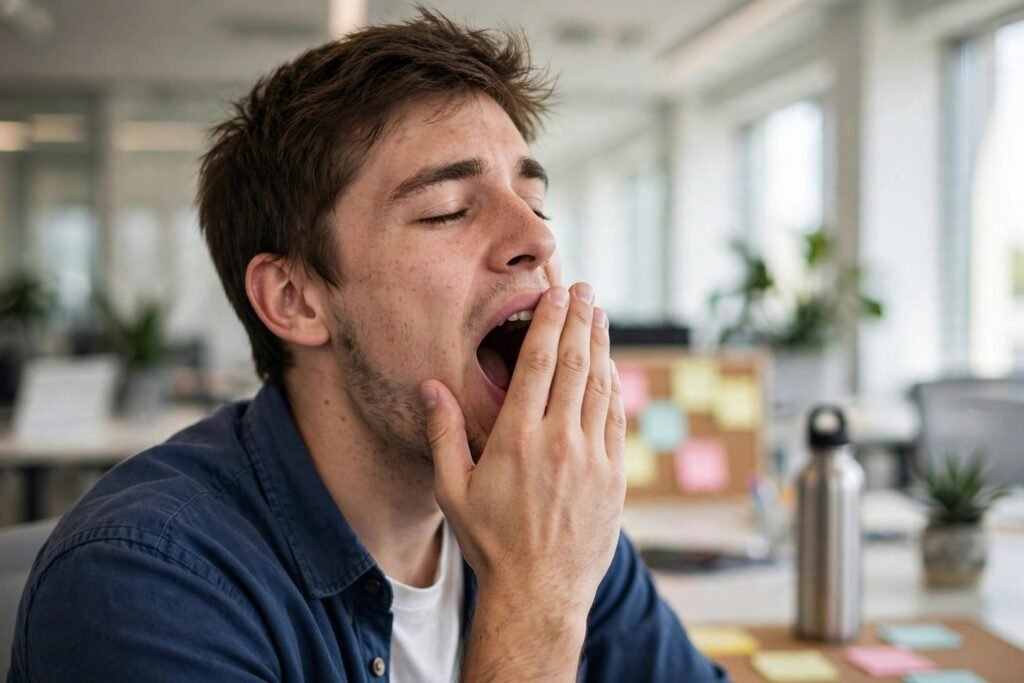
You see someone yawn, and seconds later your own jaw is stretching wide — against your will, in the middle of a meeting, broadcasting to the room exactly how engaged you are. Contagious yawning is one of the most universally experienced and least understood human behaviors. And the deeper question — why do we yawn at all? — has puzzled scientists for centuries, with the leading theories overturned surprisingly recently. The real answers involve brain thermoregulation, empathy circuitry, and one of the strangest social behaviors in nature.
Why Do We Yawn? The Theories, Ranked
The oxygen myth (debunked)
The old textbook explanation — yawning boosts oxygen intake when you’re drowsy — was tested directly and failed: breathing pure oxygen does not suppress yawning, and raising carbon dioxide does not trigger it. Generations learned this explanation; it was wrong. A useful reminder that plausible-sounding biology needs testing.
The brain-cooling hypothesis (current leader)
The best-supported theory today: yawning cools the brain. The deep inhalation draws cooler ambient air across the nasal and oral vasculature; the powerful jaw stretch increases blood flow to the skull; the tearing and facial muscle action promote heat exchange. Predictions confirmed: yawning increases when ambient temperature rises toward body temperature (but decreases in extreme heat, when inhaled air can’t cool); people yawn less when holding a cold pack to the forehead; and brain temperature measurements show the predicted dip following yawns. It’s an elegant thermoregulatory mechanism — your brain running its own cooling fan.
The arousal/attention hypothesis
Yawning spikes during transitions — waking up, preparing for action, shifting attention — suggesting it promotes alertness rather than signaling sleepiness per se. The physiological arousal (heart rate increase, eye muscle activation, cerebrospinal fluid circulation changes) fits a “reset and ready” function. This explains the paradox of yawning when bored and when about to compete: both are moments demanding a state change.
The honest scientific position: brain cooling has the strongest evidence, arousal modulation likely contributes, and the full picture may combine both — thermoregulation serving attention. What is certain is that yawning is far more sophisticated than “being tired.” The Sleep Foundation’s resources cover yawning’s relationship to sleep and alertness for readers wanting the clinical context.
Is Yawning Actually Contagious? Yes — and Strangely Selective
Contagious yawning is thoroughly documented: seeing, hearing, reading about, or even thinking about yawning triggers yawns in roughly 40–60 percent of adults. (If you have yawned while reading this article, you are demonstrating the phenomenon in real time.) But the contagion is selective in fascinating ways:
It’s social
You are more likely to “catch” a yawn from someone you know — and most likely from close family and friends — than from strangers. The contagion strength tracks social closeness, a pattern that immediately suggests the mechanism involves social cognition rather than simple mimicry.
It’s linked to empathy
Multiple studies find contagious yawning correlates with empathy measures: people scoring higher on empathy catch yawns more readily. Populations with reduced empathic processing — including some individuals on the autism spectrum and people with certain psychopathic traits — show reduced contagious yawning. This does not make yawning a diagnostic tool (the research is correlational and complex), but it strongly implicates the brain’s social-mirroring systems.
It involves the mirror neuron system
Brain imaging during contagious yawning shows activation in regions associated with empathy and self-processing — the superior temporal sulcus, precuneus, and areas overlapping the mirror neuron network. The leading model: perceiving a yawn automatically activates your own yawn motor program through empathic simulation, and inhibiting it requires active suppression (which is why stifling a yawn feels effortful).
It crosses species (sometimes)
Dogs catch human yawns — one of the most charming findings in animal cognition, suggesting deep interspecies social attunement from domestication. Chimpanzees catch each other’s yawns with the same social-closeness gradient as humans. Your dog yawning when you yawn is genuine social contagion, not coincidence.
When Yawning Signals Something Medical
Excessive yawning — far beyond normal frequency — occasionally signals medical issues worth knowing: it can accompany sleep disorders (the brain-cooling/arousal system working overtime against sleep deprivation — relevant if you feel tired all the time even after sleeping), certain neurological conditions, medication side effects (notably SSRIs), and in rare cases cardiovascular or thermoregulatory dysfunction. The threshold for concern is yawning that is dramatically excessive, new in onset, and accompanied by other symptoms — not the ordinary contagious yawns of daily life. When in doubt, mention it to your doctor; it is a legitimate clinical data point, not a trivial complaint.
The Evolutionary Perspective
Stepping back, yawning looks like ancient social technology. The leading evolutionary account: yawning evolved first as a physiological mechanism (brain cooling, arousal regulation) present across vertebrates — even fetuses yawn in the womb — and was later co-opted in social species as a synchronization signal. A group whose members’ alertness states synchronize (everyone’s brain cooling and arousing together before a collective action) coordinates better. Contagious yawning may be the visible trace of brains attuning to each other — a hypothesis that reframes the embarrassing meeting-yawn as a deep social instinct misfiring in a conference room.
This also explains why suppression feels so difficult: you are fighting circuitry that evolved to bind groups together, deployed here in service of nothing more than a dull presentation. The NIH funds ongoing research into the neuroscience of social contagion, of which yawning remains one of the cleanest natural experiments.
The Bottom Line
We yawn primarily to cool the brain and modulate arousal — not to grab oxygen, a myth now retired. Yawning is genuinely contagious, spreading through empathic mirror-neuron circuitry that tracks social closeness, crosses into dogs, and correlates with empathy measures. It is ancient physiology repurposed as social technology: your brain’s cooling fan, wired into the circuitry of human connection. So the next time a yawn escapes in a meeting, you can note — accurately — that it is your thermoregulation and your empathy acting up simultaneously.
Yawning, Sleep Pressure, and Your Brain
Whatever its original purpose, yawning tracks closely with sleep pressure — the buildup of adenosine that makes you drowsy. Yawns cluster during the pre-sleep wind-down, the post-wake grogginess window, and the mid-afternoon circadian dip, which is why a meeting at 3 PM feels like a yawn convention. Boredom amplifies it: understimulated brains yawn more, possibly as an arousal-seeking mechanism. If you find yourself yawning through the day despite adequate time in bed, the issue may be sleep quality rather than quantity — fragmented sleep from apnea, stress, or late screens leaves sleep pressure unresolved. Working on falling asleep faster without medication often reduces daytime yawning more effectively than another espresso. And if excessive daytime sleepiness persists for weeks, that is a conversation for a doctor, not a yawn-theory debate.
Frequently Asked Questions
Why is yawning contagious?
Perceiving a yawn activates your own yawn motor program through empathic mirror-neuron circuitry. Contagion strength tracks social closeness and correlates with empathy measures — it’s social cognition, not simple mimicry.
Does yawning mean you’re not getting enough oxygen?
No — this old explanation was experimentally debunked. Breathing pure oxygen doesn’t suppress yawning. The leading theory is brain thermoregulation: yawning cools the brain via deep inhalation and increased cranial blood flow.
Why do I yawn when I’m not tired?
Yawning tracks state transitions and brain temperature, not just sleepiness — it occurs when waking, when bored (attention flagging), before competition (arousal needed), and in warm environments. It’s an alertness and cooling mechanism.
Do dogs really catch human yawns?
Yes — dogs catch their owners’ yawns at significant rates, one of the most charming findings in animal cognition, likely reflecting the deep social attunement of domestication.
When should excessive yawning concern me?
If yawning is dramatically excessive, new in onset, and accompanied by other symptoms (fatigue, neurological changes), mention it to your doctor — it can occasionally signal sleep disorders, medication effects, or other conditions.