How Do I Build a Backlog of Games I’Ll Actually Finish
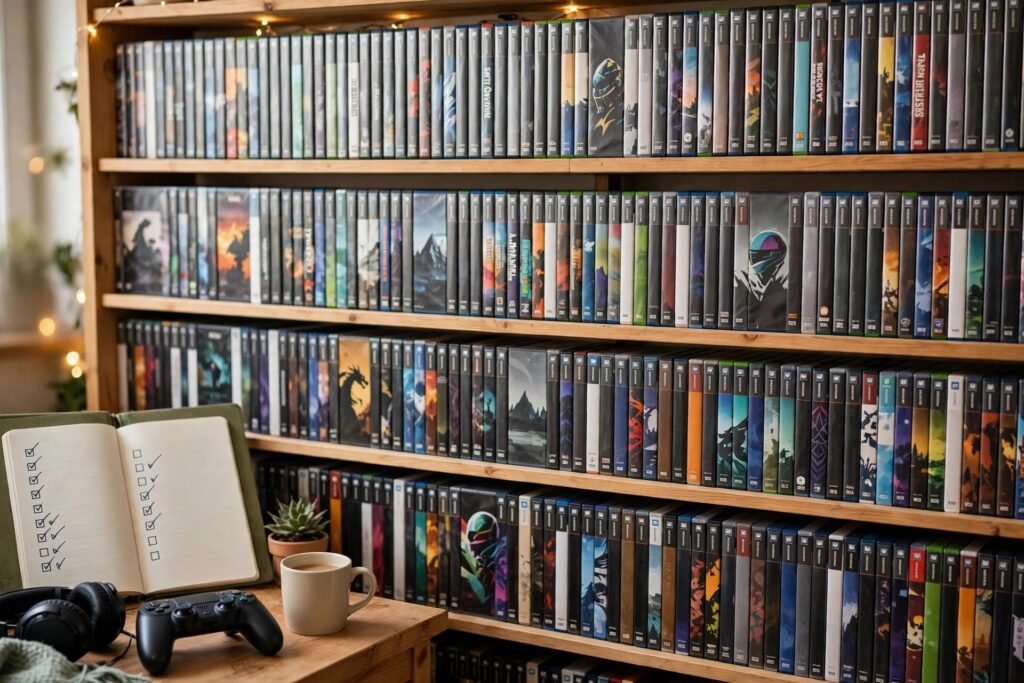
Your Steam library has 347 games. You’ve finished 12. Every sale adds five more. The backlog has become a source of guilt rather than joy — a monument to good intentions and Steam sale psychology. Meanwhile, you keep replaying the same comfort game because choosing from the wall of shame feels like work. Building a backlog you’ll actually finish isn’t about buying fewer games (though that helps) — it’s about redesigning your relationship with the pile. Here’s the system.
Step 1: Audit Honestly (The Uncomfortable Hour)
Before organizing, confront reality. Export your library list and categorize every unplayed game ruthlessly:
The four buckets
Excited to play: Games you genuinely want to experience — not “someday,” but with real anticipation. Be honest: anticipation you can feel. Obligation: Games you feel you should play (classics everyone references, gifts, bundle filler). Aspirational: Games for a fantasy version of you (the 200-hour CRPG for someone with 4 gaming hours a week). Dead: Games with no remaining pull — impulse sale buys, duplicates, things that looked interesting for 30 seconds in 2019.
Now the liberating move: hide or remove the Dead bucket entirely. Steam lets you hide games; other platforms have similar features. They’re not deleted — they’re just not staring at you. The psychological research is clear: visible unfinished tasks create cognitive load (the Zeigarnik effect). A 347-game visible backlog isn’t a library; it’s 347 open loops generating background guilt. Hiding the dead weight is the single highest-impact backlog intervention.
Next, interrogate the Obligation and Aspirational buckets. “Should play” is not a reason — if the thought of starting it feels like homework, it belongs in Dead. Aspirational games get one honest question: “Will my life circumstances change to accommodate a 150-hour game in the next two years?” If no, hide it. You’re not giving up; you’re curating. The goal is a backlog of games you’re excited to play, not a museum of intentions.
Step 2: Build the “Now Playing” System
The core system that actually finishes games:
One main, one side, one palate cleanser
Maintain exactly three active games: one main game (your primary experience — the big RPG, the story adventure, whatever deserves focus); one side game (shorter sessions — roguelikes, multiplayer with friends, puzzle games — for when the main game feels like too much); and one palate cleanser (something radically different in tone — a cozy game alongside a horror title, a strategy game beside an action game). Three is the magic number: enough variety to match any mood, few enough to make progress. More than three and attention fragments; progress stalls everywhere.
The finishing protocol
When you start a game, commit to one of three outcomes: finish it (credits roll — the goal), consciously abandon it (played enough to know it’s not for you — this is a decision, not failure; log it and move on guilt-free), or pause deliberately (life intervened — note where you stopped and why you’ll return). What you must never do: drift away ambiguously. Ambiguous abandonment is what built the backlog. Every game gets a verdict.
Track simply
A simple list — notes app, spreadsheet, or a backlog-tracking site — with three columns: Now Playing (max 3), Up Next (5–10, the curated excited list), and Finished/Abandoned (the record). The Finished column is motivational fuel: watching it grow rewires the backlog from guilt source to achievement log. Many players find that tracking transforms their habits more than any other change.
Step 3: Fix the Buying (Stem the Bleeding)
No system survives unchecked inflow. The buying rules that work:
The 24-hour rule for sales
See a deal? Wait 24 hours. If you’re still thinking about the specific game (not the discount), consider it. Most sale urgency is artificial — Steam sales recur; the game will be cheap again. The discount is not the reason to buy; the desire to play is.
The one-in, one-out (or one-in, one-finished) rule
Buy a new game only when you’ve finished (or consciously abandoned) one. This ties inflow to outflow and makes each purchase deliberate. Strict versions of this rule clear backlogs within a year.
Stop buying aspirational genres
Know your actual taste, not your aspirational taste. If you’ve abandoned three 100-hour open-world games, stop buying 100-hour open-world games — no matter the reviews. Your play history is data about what you enjoy; trust it over hype. This is self-knowledge as backlog management.
Unsubscribe from sale alerts
Sale emails and “deals” subreddits are engineered temptation. If backlog guilt bothers you, the deal-notification pipeline is working against you. Curate your information diet like you curate the backlog.
Step 4: Optimize for Finishing
Some games are structurally easier to finish — factor this into selection: length awareness (HowLongToBeat.com is essential — a 12-hour game you’re excited about beats a 60-hour game you feel obligated toward); natural stopping points (games with chapters or missions fit busy lives better than endless systems); difficulty honesty (no shame in story mode — the goal is experiencing the game, and difficulty-related abandonment is the most preventable kind); and mood matching (the three-game system exists so you always have something fitting your current energy — forcing a heavy RPG when you’re exhausted produces abandonment, not progress).
Also: embrace the abandonment verdict proudly. A game abandoned at hour 8 with a clear “not for me” is a success of the system, not a failure — it cost 8 hours, taught you something about your taste, and freed the slot. The backlog’s enemy isn’t abandonment; it’s ambiguity. And remember that gaming is one leisure among many — the same intentionality that makes indoor hobbies fulfilling applies here: choose actively, engage deeply, and let go cleanly.
The Bottom Line
Build a finishable backlog by: auditing honestly and hiding the dead weight (kill the 347 open loops), running a three-game system (one main, one side, one palate cleanser) with a verdict for every game (finish, abandon consciously, or pause deliberately), stemming inflow with buying rules (24-hour rule, one-in-one-finished, no aspirational genres), and optimizing for finishing (length awareness, difficulty honesty, mood matching). The backlog stops being a monument to guilt and becomes what it should be: a curated menu of adventures you’re genuinely excited to have.
Plan With Real Numbers
Stop estimating game length from vibes. HowLongToBeat aggregates thousands of player completion times into honest averages — main story, extras, and completionist runs — so you can see that a “short indie” is 6 hours and that RPG is actually 90. Use those numbers against your real weekly gaming hours to build a finishable queue: if you play five hours a week, a 90-hour epic is a four-month commitment, and you should know that going in. IGN’s reviews increasingly note completion times for this reason. And keep a couple of short games in the backlog for low-energy weeks or rainy days with the kids — finishing something small sustains momentum better than stalling on something huge. A backlog built on real numbers stops being a guilt pile and starts being a plan.
Frequently Asked Questions
How many games should I have in my backlog?
There’s no magic number, but the system matters more than the count: 3 active (one main, one side, one cleanser), 5-10 curated “up next,” and everything else hidden. A visible backlog of hundreds generates guilt, not excitement.
Should I feel guilty about unfinished games?
No — reframe it. Games are entertainment, not obligations. Give every game a conscious verdict (finished, deliberately abandoned, or paused) and the guilt evaporates because nothing is ambiguously unfinished.
How do I stop buying games on sale?
24-hour rule (wait a day; buy only if you still want the game, not the discount), one-in-one-finished rule, and unsubscribe from sale alerts. Remember: Steam sales recur — the deal will come back.
What’s a good game length for busy adults?
10-25 hours is the sweet spot for actually finishing — check HowLongToBeat.com before starting. Shorter games you finish beat longer games you abandon.
Is it OK to play on easy mode?
Absolutely — the goal is experiencing the game. Difficulty-related abandonment is the most preventable kind, and story mode exists precisely so more players can finish.