Electric vs Gas Cars: The Real Cost of Ownership
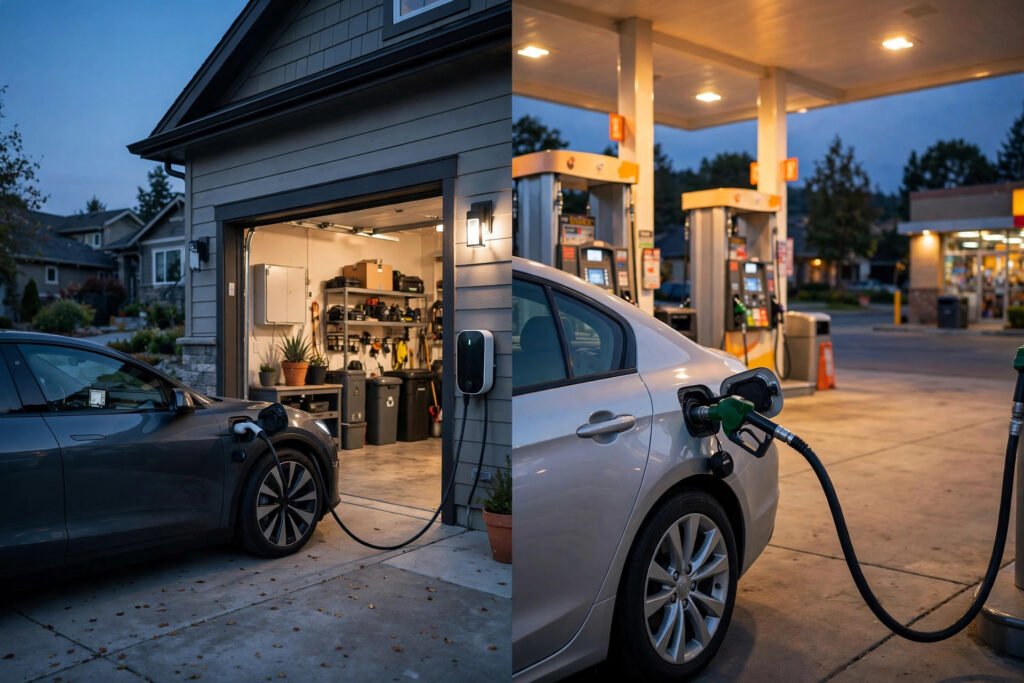
“Electric cars are cheaper to own” has become conventional wisdom — and like most conventional wisdom, it’s true on average and wrong for plenty of real people. The real cost of owning an electric car versus a gas car depends on your electricity rates, your driving patterns, how long you keep cars, and which models you’re comparing. Run the numbers honestly and EVs win big for some drivers and lose for others. Here’s the complete cost breakdown so you can do the math for your situation.
We’ll compare total cost of ownership over five years: purchase price, fuel/energy, maintenance, insurance, depreciation, and the hidden costs both sides like to omit. All figures reflect typical 2026 American conditions.
Purchase Price: The EV Premium Is Shrinking
New EVs still cost more upfront than equivalent gas cars — typically $5,000–$10,000 more before incentives, though the gap narrows yearly as battery prices fall. But the sticker price isn’t the purchase price: the federal EV tax credit (up to $7,500 for qualifying new EVs, $4,000 for used) plus state incentives can erase most of the premium. In 2026, several mass-market EVs (Chevrolet Equinox EV, Tesla Model 3, Hyundai Kona Electric) land near price parity with gas equivalents after credits.
The used market is where EVs get genuinely cheap: three-year-old EVs have depreciated steeply (more on why below), making used EVs some of the best values in car buying — a $18,000 used EV against a $18,000 used gas car is a very different comparison than new-vs-new. Just verify battery health before buying used; degradation of 5–10 percent over three years is normal, over 15 percent is a red flag. Check Edmunds’ true cost-to-own data for model-specific five-year figures before deciding.
Fuel vs. Electricity: Where EVs Usually Win Big
This is the EV’s strongest category. The average American drives about 14,000 miles yearly. A 30-MPG gas car at $3.40/gallon costs roughly $1,585/year in fuel. An EV averaging 3.5 miles/kWh at the national average $0.17/kWh costs about $680/year — a $900 annual saving. But your mileage may vary enormously: at California’s $0.30+/kWh peak rates with no time-of-use plan, the advantage shrinks; in Washington or Texas with $0.10/kWh overnight rates, it doubles.
The game-changer is home charging on a time-of-use rate — many utilities offer overnight EV rates under $0.10/kWh, cutting “fuel” costs to $400/year. Without home charging, the math deteriorates: public fast charging costs $0.35–$0.60/kWh, nearly erasing the fuel advantage, plus the time cost. Rule of thumb: if you can charge at home overnight, EVs win decisively on energy; if you depend on public charging, run your local numbers carefully. The EPA’s fueleconomy.gov calculator lets you input your exact rates and mileage for a personalized comparison.
Maintenance: Simpler Machine, Smaller Bills
EVs have roughly 20 moving parts in the drivetrain versus 2,000+ in a gas car — no oil changes, no transmission services, no spark plugs, no exhaust systems. Real-world data from fleet operators and consumer surveys puts EV maintenance at roughly half the cost of gas cars: about $400/year versus $800/year for typical drivers. Brake pads last dramatically longer thanks to regenerative braking — many EV owners go 100,000+ miles on original pads.
The counterpoint: when EVs do need repair, it’s expensive. Out-of-warranty battery replacement ($10,000–$20,000) is the nightmare scenario, though actual failure rates within 10 years are low (under 2 percent in most studies) and federal law mandates 8-year/100,000-mile battery warranties. Tires wear faster on EVs (instant torque + heavy batteries) — budget an extra $200–$300 per tire cycle. And body repairs cost more: aluminum bodies and sensor-laden bumpers make even minor collisions pricier. Net: EVs are cheaper to maintain until something big breaks, which is rare but costly.
Insurance, Depreciation, and Hidden Costs
Insurance runs 10–25 percent higher for EVs — pricier repairs, expensive battery packs insurers fear totaling, and higher MSRPs all push premiums up. Get quotes before buying; the difference can be $300–$600/year. Depreciation is the EV’s weak spot: rapid tech improvement and price cuts on new EVs crush used values — great for used buyers, painful for new buyers who sell within three years. Gas cars depreciate more predictably.
Hidden costs both sides omit: EVs may need a home charger installation ($500–$2,000 if your panel needs upgrading), and apartment dwellers without charging access face the public-charging penalty above. Gas cars face the volatility risk — $5/gallon spikes like 2022’s can add $1,000+/year overnight, a risk EVs largely dodge. Factor your situation: a homeowner with a garage and solar panels is the ideal EV economic case; a renter dependent on fast chargers is the worst. For drivers weighing long highway use, budgeting road trips looks quite different by powertrain — charging stops are cheaper but slower than gas fill-ups.
The Five-Year Verdict by Driver Type
Suburban homeowner, 15,000 miles/year, home charging: EV wins by $6,000–$10,000 over five years. This is the slam-dunk case — cheap overnight electricity, high mileage amplifying fuel savings, and maintenance savings compounding.
Apartment renter, 10,000 miles/year, public charging: Gas likely wins by $2,000–$4,000. Public charging erases fuel savings, insurance costs more, and you can’t capture the home-charging advantage. Revisit when your living situation changes.
Low-mileage driver (under 8,000 miles/year): Gas usually wins — you don’t drive enough for fuel savings to overcome the EV’s purchase premium and higher insurance. The cheapest car to own is the one you barely use, regardless of powertrain.
Long-term keeper (10+ years): EV advantage grows — years 6–10 are nearly maintenance-free for EVs while gas cars enter the expensive repair window (transmissions, timing belts, emissions systems). Battery degradation warranties cover the highest-risk period. Still undecided? Renting an EV for a week makes an excellent trial — check what to know before renting a car abroad for the general rental checklist first.
Conclusion
The real cost of owning an electric car versus gas comes down to three questions: Can you charge cheaply at home? Do you drive enough miles for fuel savings to matter? Will you keep the car long enough to amortize the premium? Yes to all three, and the EV saves you thousands. No to two or more, and gas remains the rational choice — for now, as the economics shift toward EVs every year. Ignore the slogans from both camps, plug your numbers into a total-cost calculator, and let your situation decide.
Frequently Asked Questions
Are electric cars really cheaper to maintain?
Yes — roughly half the maintenance cost of gas cars in real-world data, thanks to no oil changes, no transmission services, and regenerative braking extending pad life. The caveat is repair severity: rare out-of-warranty battery or electronics failures are very expensive, though failure rates are low.
How long do EV batteries actually last?
Modern EV batteries typically retain 85–90 percent capacity after 100,000 miles and are engineered for 15–20 years of service. Federal warranty mandates 8 years/100,000 miles minimum. Complete battery failure (not just degradation) affects under 2 percent of EVs within a decade.
Is it worth buying an EV without home charging?
Usually not on economics alone — public fast charging at $0.35–$0.60/kWh nearly erases the fuel-cost advantage, and the inconvenience is real. The case improves if you have free workplace charging or very cheap local public options. Otherwise, wait until your living situation allows home charging.
Do EVs hold their value as well as gas cars?
No — EVs currently depreciate faster, driven by falling new-EV prices and rapid technology improvements. This hurts new-EV sellers but creates excellent used-EV values. If you buy new and sell within three years, expect steeper depreciation than an equivalent gas car.