How to Park on a Hill Without Damaging Your Transmission
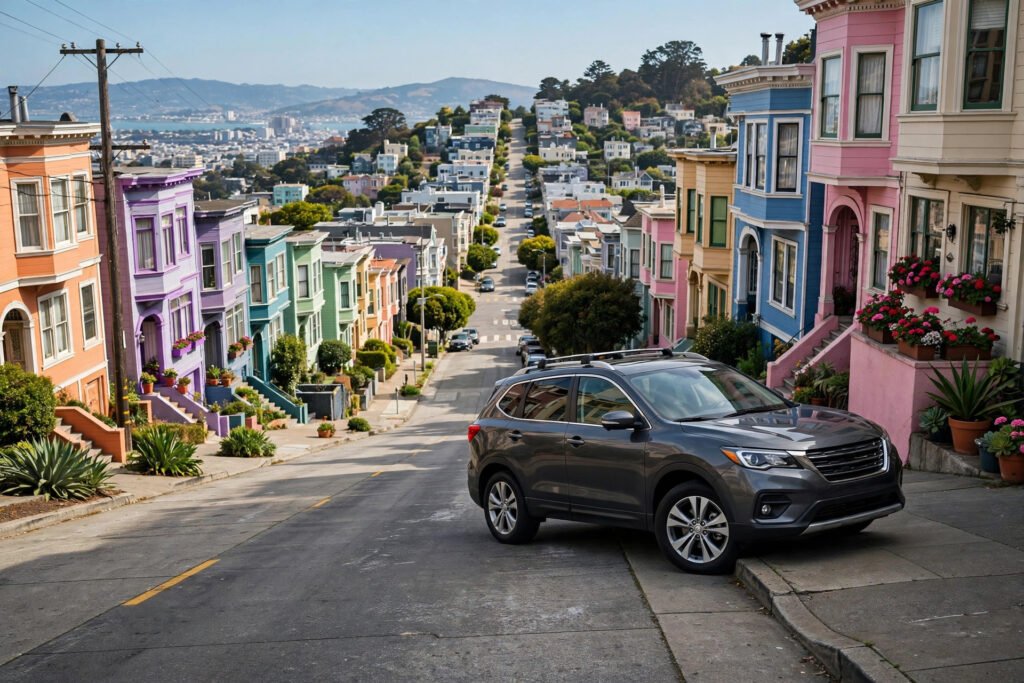
San Francisco, Pittsburgh, Seattle — America’s hilliest cities punish drivers who never learned proper hill parking. Get it wrong and your car’s entire weight hangs on a tiny metal pin inside the transmission called the parking pawl, a component designed as a backup, not a load-bearing anchor. Over time, that stress wears the pawl and can lead to a transmission that won’t hold park — a repair costing $300 to $600, or far worse if the car rolls. The good news: parking on a hill without damaging your transmission takes about ten seconds once you know the sequence. Here’s the exact method, plus the physics of why it matters.
Why Hills Hurt Transmissions
When you shift to Park on flat ground, the parking pawl — a small hardened-steel pin — engages a notched wheel on the transmission’s output shaft, locking it. On level pavement, the pawl holds almost no load; your brakes did the stopping, and nothing pulls the car. On a hill, gravity immediately tries to roll the car downhill, and the full weight of your 3,500-pound vehicle presses against that little pin.
Two problems follow. First, the pawl and its mating notches wear under sustained load — they’re engineered for occasional use as a failsafe, with the parking brake intended as the primary holder. Second, the loaded pawl can jam: ever tried to shift out of Park on a steep hill and felt the shifter clunk violently? That’s the pawl releasing under load, and each clunk is metal-on-metal stress. Do it daily for years and you’re buying a transmission repair that a ten-second habit would have prevented. This applies to automatics; manual-transmission drivers face a related issue with relying solely on gear engagement, covered below.
The Correct Sequence (Automatics)
Memorize this order — it matters more than any other detail:
1. Stop completely with your foot on the brake. Come to a full stop in your parking spot, wheels positioned correctly (more on that below).
2. Keep your foot on the brake and engage the parking brake. This is the critical step most drivers skip. The parking brake — whether a pedal, lever, or electronic button — locks the rear wheels mechanically, independent of the transmission.
3. Shift into Neutral, then release the foot brake briefly. Let the car settle — you’ll feel it roll an inch or two until the parking brake catches the full weight. This transfers the load from the transmission to the brakes, exactly where it belongs.
4. Press the brake again and shift into Park. Now the pawl engages with zero load on it — it’s a backup, as designed.
When leaving: foot on brake, shift to Drive (or Reverse), then release the parking brake, then go. Reversing the sequence keeps the pawl unloaded in both directions. Electronic parking brakes engage with a button and often auto-release when you drive off — the same load-transfer principle applies. Drivers who rent cars abroad encounter electronic brakes frequently in European models, so learning the sequence now pays off on every future trip.
Turn Your Wheels: The Curb Rule
Separate from the transmission, always curb your wheels — it’s the law in most hilly cities and your last line of defense if every brake fails. The National Highway Traffic Safety Administration includes proper hill parking in its driver-safety guidance. The rule: downhill (facing downhill), turn wheels toward the curb; uphill with a curb, turn wheels away from the curb; uphill without a curb, turn wheels toward the edge. The mnemonic: “down, down” (downhill → wheels down toward curb) and “up and away.”
Done right, a brake failure means the car rolls inches into the curb and stops, instead of rolling into traffic. San Francisco tickets uncurbed wheels aggressively — fines run $100+ — because runaway cars on 30-percent grades kill people. This takes three seconds and costs nothing.
Manual Transmissions and EVs
Manual drivers: leave the car in first gear (or reverse) plus the parking brake — never rely on gear alone, since engine compression can slowly bleed off and let the car creep. The gear-plus-brake combination is the manual equivalent of the automatic sequence above.
Electric vehicles simplify this: most EVs engage a parking pawl automatically and many apply the electronic parking brake when you power off. But the physics doesn’t change — on steep grades, manually engaging the parking brake before the pawl takes load still reduces wear. Check your owner’s manual; some EVs have a specific hill-park procedure. And for long-term hill dwellers, planning drives through hilly regions is worth doing with brake condition in mind — mountain descents punish brakes far more than ascents.
Signs Your Parking Pawl Is Already Worn
Catch damage early and it’s a minor repair; ignore it and the car can roll away. Warning signs: the shifter clunks or resists moving out of Park on hills, the car rolls more than an inch or two after you release the foot brake in Park, or you hear grinding when engaging Park. Any of these warrants a transmission shop visit — describe the hill-parking symptoms specifically, since pawl wear is a distinct diagnosis from general transmission failure. Until it’s fixed, park only on flat ground and always use the parking brake plus curbed wheels.
Teaching New Drivers the Habit
If you have a teen driver, teach the brake-then-Park sequence from their first week behind the wheel — before the lazy habit of slamming into Park forms. Have them practice the full sequence (brake, parking brake, neutral, settle, Park, curbed wheels) ten times in your driveway until it’s muscle memory. It’s also worth demonstrating what a loaded pawl feels like once, safely on a gentle slope: shift to Park without the parking brake, then try shifting out — that ugly clunk is a lesson no teenager forgets, and it motivates the habit for life.
Conclusion
Parking on a hill without damaging your transmission is a ten-second habit: brake, parking brake, neutral, let it settle, then Park — plus curbed wheels every time. The parking pawl is a backup device, not a load-bearing one, and treating it that way adds years to your transmission’s life. Teach the sequence to every driver in your household; it’s the cheapest transmission insurance ever invented, and it costs exactly nothing. AAA’s defensive-driving resources cover hill techniques as part of everyday safe-driving basics.
Frequently Asked Questions
Is it bad to park on a hill every day?
Not if you use the parking brake correctly every time. The damage comes from letting the transmission’s parking pawl bear the car’s weight daily. With the proper sequence — parking brake first, then Park — daily hill parking causes no abnormal transmission wear.
Should I use the parking brake in winter? Won’t it freeze?
On modern cars with well-maintained cables or electronic systems, freezing is rare and the benefits outweigh the risk. If you drive an older car with a sticky cable brake in subfreezing weather, have the cables serviced — a functioning parking brake matters more in winter, when icy hills multiply rollaway risk.
What does it cost to replace a parking pawl?
Typically $300 to $600, since the transmission pan must come off but the transmission usually doesn’t need full removal. However, a failed pawl that allowed a rollaway can cause far more expensive damage — or a total loss — which is why prevention is the real answer.
Do I need to curb my wheels on a slight incline?
It’s good practice on any grade, and legally required on posted hills in many cities. The habit costs three seconds; the one time your brakes fail on a “slight” incline, you’ll be glad the curb was there to catch the car.