How to Improve Your Car’s Fuel Efficiency for Free
Your car’s EPA fuel-economy rating was measured in a laboratory. Your actual mileage is determined by your right foot, your tires, and your habits — which means most drivers are leaving 10 to 25 percent of their fuel efficiency on the table without spending a dollar on upgrades. At $3.40 a gallon and 14,000 miles a year, a 20 percent improvement saves roughly $380 annually. These are the free techniques that actually move the needle, ranked by impact.
1. Fix Your Driving Style (Biggest Single Factor)
Aggressive driving — rapid acceleration, hard braking, speeding — can lower gas mileage by 15 to 30 percent on the highway and 10 to 40 percent in stop-and-go traffic, according to the Department of Energy. The fix is anticipatory driving: look far ahead, coast toward red lights instead of racing to them, accelerate moderately (imagine an egg under the gas pedal), and brake gently and early.
Speed itself is the silent killer: fuel economy typically peaks around 50 mph and drops rapidly after 60. Driving 75 instead of 65 mph can cost you 15 percent in efficiency — on a 400-mile trip, that’s real money for arriving 45 minutes earlier. Cruise control on flat highways maintains steadier throttle than your foot can, worth a few percent. And idling: modern engines need no warm-up — 30 seconds is plenty — and idling for more than a minute burns more fuel than restarting. Turn it off at long lights, drive-throughs, and school pickups.
2. Tires: The Free Efficiency You’re Probably Losing
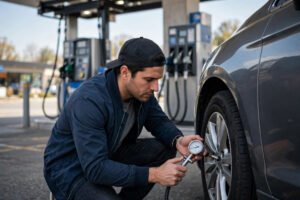
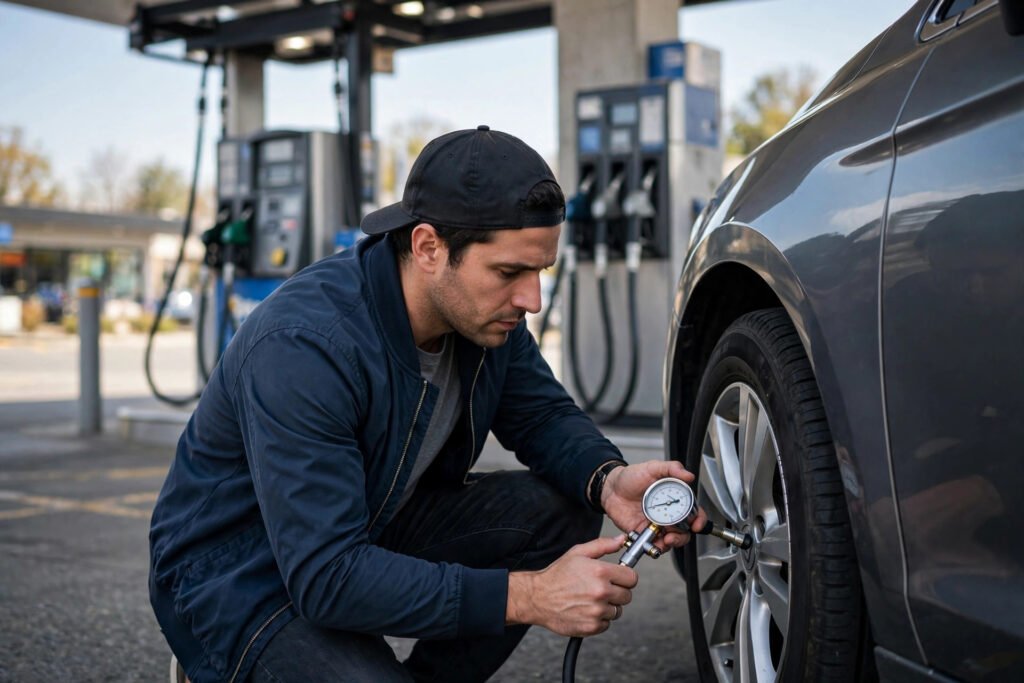
Underinflated tires are the most common free fix in America — the DOE estimates nearly a third of cars run on underinflated tires. Every 1 PSI below recommended pressure cuts efficiency by about 0.2 percent; the typical neglected car is 5–8 PSI low, costing 1–2 percent. More importantly, proper inflation is a safety issue: underinflation increases blowout risk and braking distances.
Check pressures monthly (tires lose 1–2 PSI monthly naturally) and always when cold — morning before driving. Use the pressure on the driver’s door jamb sticker, not the tire sidewall maximum. While you’re at it, get a wheel alignment if the car pulls or tires wear unevenly; misalignment drags efficiency by up to 10 percent in severe cases. These two checks cost nothing but ten minutes and are the highest-ROI maintenance in car ownership. Drivers who rent cars abroad should do the same walk-around check — unfamiliar cars with soft tires handle worse and drink more fuel.
3. Lighten the Load and Cut the Drag
Every 100 pounds of extra weight costs roughly 1 percent in fuel economy — clean out the trunk, the back seat, and the roof. Roof racks and cargo boxes are far worse: an empty roof rack can cut highway efficiency by 5 percent, and a loaded cargo box by 10–25 percent. Remove roof carriers the day the trip ends, not “eventually.”
Windows versus air conditioning is the classic debate, and the answer is speed-dependent: below 40 mph, open windows beat A/C; above 55 mph, aerodynamic drag from open windows costs more than the A/C compressor. Around town, windows down; on the highway, windows up and A/C on moderate. And in winter, skip the remote-start warm-up marathons — they achieve zero MPG by definition. For drivers mapping budget road trips, these load and drag habits compound over thousands of miles into serious savings.
4. Maintain What’s Already There
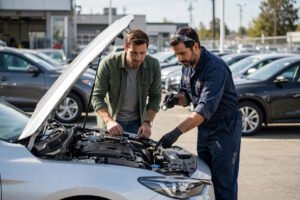
No upgrades needed — just don’t neglect the basics. A dirty engine air filter on a modern fuel-injected car barely affects mileage (the computer compensates), but it does hurt acceleration and can mask other issues — replace it on schedule anyway. What actually matters: old spark plugs (worn plugs cause misfires that tank efficiency), a stuck thermostat (engine never reaching temperature runs rich), and dragging brakes (a stuck caliper can cost 10+ percent — if one wheel is hot after driving, get it checked).
Use the manufacturer’s recommended motor oil grade — thicker “high mileage” oil in an engine designed for 0W-20 increases internal friction measurably. And fix the check-engine light promptly: the EPA notes that a faulty oxygen sensor alone can cut mileage by up to 40 percent. That glowing light isn’t a suggestion; it’s your fuel budget leaking onto the pavement.
5. Plan Smarter Trips
Cold engines are inefficient engines — a short trip from a cold start can use twice the fuel per mile as the same distance with a warm engine. Combine errands into one outing with the farthest stop first (letting the engine warm fully), and the per-mile cost drops dramatically. Avoid peak congestion when possible: stop-and-go traffic is the worst efficiency scenario, and a slightly longer free-flowing route often burns less fuel than the shorter jammed one.
Carpool the predictable trips — the school run, the commute — even one day a week cuts that trip’s fuel cost in half. And track your mileage for a month (most cars show trip MPG; reset it per tank): the feedback loop alone typically improves driving efficiency 5–10 percent, because what gets measured gets managed. The fueleconomy.gov site offers personalized tips based on your exact make and model.
What About “Fuel-Saving” Gadgets?
Save your money. The EPA has tested over a hundred aftermarket “fuel-saving” devices — magnets, vortex generators, intake turbulators, fuel-line ionizers — and found essentially none that work; several increased emissions. If a $30 gadget genuinely improved mileage 20 percent, automakers facing billion-dollar CAFE fines would install it at the factory. Premium gasoline in a car designed for regular is equally wasteful — higher octane isn’t “better” fuel, it’s just knock-resistant, and your engine can’t use what it wasn’t designed for. The free habits above outperform every gadget ever sold.
Conclusion
Improving fuel efficiency without upgrades comes down to five free habits: drive smoothly and slower, keep tires inflated and aligned, ditch the roof rack and excess weight, maintain the basics (plugs, sensors, oil grade), and combine trips while tracking your MPG. Together they’re worth 15–25 percent — hundreds of dollars a year — for zero dollars spent. Start with tire pressure and your right foot this weekend; they’re the two biggest levers and they take ten minutes.
Frequently Asked Questions
Does driving slower really save gas?
Yes, significantly. Fuel economy peaks around 50 mph and falls rapidly above 60 — driving 75 instead of 65 mph typically costs about 15 percent in efficiency. On long highway trips, moderating speed is the single easiest fuel saver.
Do fuel-saving gadgets actually work?
No. The EPA has tested 100+ aftermarket fuel-saving devices and found virtually none effective. Automakers spending billions to meet efficiency standards would use any technology that genuinely worked. Spend the money on proper tire inflation instead — it’s free and proven.
Is premium gas worth it for better mileage?
Only if your car requires it. Premium isn’t higher-quality fuel — it’s just more knock-resistant. In an engine designed for regular, premium provides zero benefit and wastes 20–30 cents per gallon. Check your owner’s manual: “required” means buy it; “recommended” usually means regular is fine.
How much does tire pressure affect gas mileage?
About 0.2 percent per PSI below recommended — and the average neglected car is 5–8 PSI low, costing 1–2 percent plus safety risks. Monthly checks are the highest-ROI ten minutes in car ownership.