Best Low-Impact Exercises for Bad Knees (US Guide)
Your knees ache going down stairs. Running is out. Squats feel like grinding glass. And every fitness article seems to assume you can do burpees and box jumps. If you have bad knees — arthritis, old injuries, chronic pain — the standard exercise advice feels written for someone else’s body. But here’s what orthopedic specialists want you to know: the worst thing for bad knees is usually doing nothing. Inactivity weakens the muscles that protect the joint, stiffens the joint itself, and accelerates the exact decline you’re afraid of.
The key is choosing the right exercises — movements that strengthen the knee’s support system without punishing the joint. This guide covers the low-impact exercises with the best evidence for bad knees, how to do them safely, and the warning signs that mean “see a professional.”
Why exercise helps bad knees (the counterintuitive truth)
Knee osteoarthritis — the most common cause of chronic knee pain in Americans over 50 — is routinely treated with exercise as first-line therapy. The American College of Rheumatology’s guidelines put exercise on par with medication for knee OA pain. Strong quadriceps act as shock absorbers, reducing load on the joint surfaces; strong glutes and hips control knee tracking; and movement itself nourishes cartilage, which has no blood supply and depends on joint motion for nutrition.
The research is striking: structured exercise programs reduce knee OA pain by 25–40 percent on average — comparable to anti-inflammatory drugs, without the side effects. The catch is doing the right exercises with the right dosing. More isn’t better; appropriate is better.
The best low-impact exercises for bad knees
1. Walking (yes, really)
Walking is the most underrated knee therapy in existence. It’s low-impact, weight-bearing (which maintains bone density), and endlessly scalable. Start with 10–15 minutes on flat, forgiving surfaces; build toward 30 minutes. Avoid steep downhills initially — downhill walking multiplies knee forces. If walking itself is painful, start with the pool or bike and graduate to walking as strength improves. The general case for daily walking is strong — see the benefits of walking 30 minutes a day.
2. Stationary cycling
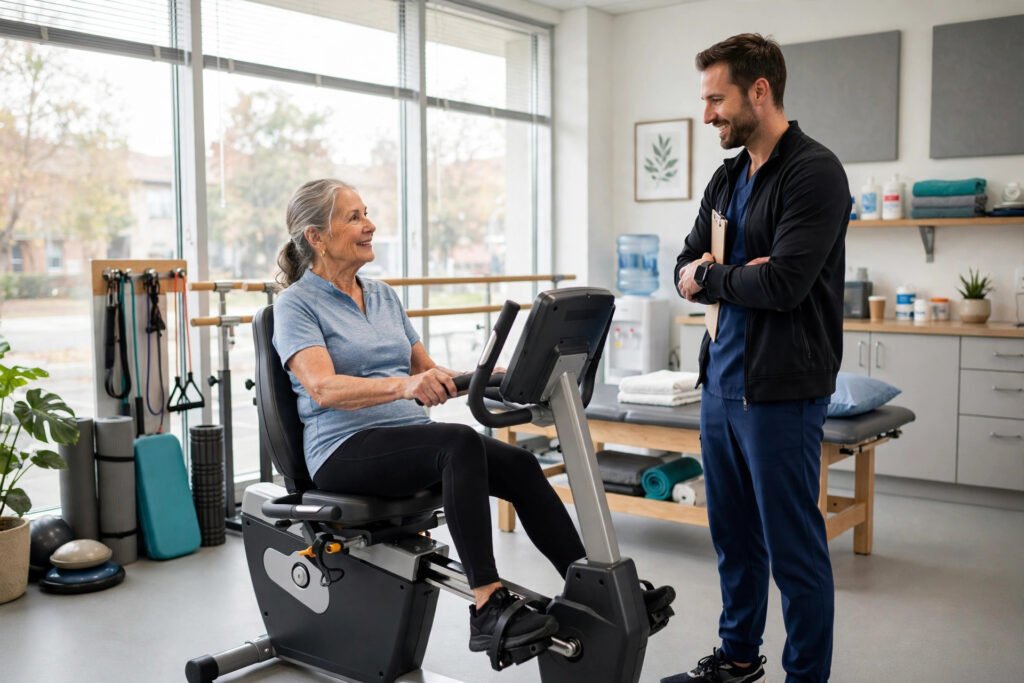
The gold standard for knee-friendly cardio. Cycling loads the knee through a controlled range with minimal impact, strengthens the quadriceps through exactly the motion knees need, and allows precise intensity control. Set the seat high enough that your knee has a slight bend (25–30 degrees) at the bottom of the pedal stroke — too-low seats are the number one cause of cycling knee pain. Start with 15–20 minutes at easy resistance; the goal is smooth revolutions, not heroics.
3. Swimming and water aerobics
Water unloads 70–90 percent of body weight while providing resistance in every direction — the ideal combination for painful knees. Lap swimming, water walking, and water aerobics classes (a staple of American YMCAs and community pools) all qualify. The warmth of heated therapy pools additionally relaxes stiff joints.
4. Straight-leg raises and quad sets
The foundation exercises physical therapists prescribe first: lying quad sets (tighten the thigh muscle, hold 5 seconds) and straight-leg raises build the quadriceps without bending the knee under load — safe even during painful flare-ups. Do them daily; they’re boring and they work.
5. Glute bridges and clamshells
Weak glutes let the knee collapse inward during movement — a primary pain mechanism. Bridges and clamshells strengthen the hip stabilizers that keep knees tracking correctly. These two exercises resolve a remarkable share of “mysterious” knee pain.
6. Partial wall sits and mini-squats
Once baseline strength exists, shallow squats (0–45 degrees of knee bend) and wall sits build functional quad strength. The rule: pain during the exercise should stay at 3/10 or below, and should not be worse the next morning. Discomfort that fades is adaptation; pain that lingers is overload.
Exercises to avoid (or modify) with bad knees
Deep squats and lunges past 90 degrees load the kneecap heavily — keep ranges shallow. High-impact activities (running, jumping, basketball) are usually out during painful phases, though some people return to them after strengthening. Kneeling directly on hard surfaces aggravates many knee conditions — use padding or avoid. Leg extension machines with heavy weight create high patellofemoral forces; light weights with higher reps are safer. None of these are lifetime bans — they’re “not yet” or “not like that” categories.
The pain-monitoring rules
Exercise with bad knees requires a traffic-light system: Green — mild discomfort (0–3/10) during exercise that resolves within an hour and isn’t worse the next day. Keep going. Yellow — moderate pain (4–5/10) or next-day soreness that fades within 24 hours. Reduce volume or intensity one notch. Red — sharp pain, swelling, locking, giving way, or pain above 5/10. Stop and get assessed. Understanding your specific pain pattern helps — our guide to why knees hurt going up stairs decodes common knee pain presentations.
When to see a professional
See an orthopedist or physical therapist if: pain persists beyond 2–3 weeks of sensible exercise, the knee locks/catches/gives way, there’s significant swelling, you can’t bear weight, or pain severely limits daily life. Physical therapy for knee OA has excellent evidence — a few sessions to learn proper form and get a personalized program is money well spent. And know that “bone on bone” on an X-ray doesn’t automatically mean surgery; many people with severe imaging findings do well with conservative care.
Building your weekly knee-friendly routine
Here’s how it fits together for a typical week. Monday, Wednesday, Friday: 20–30 minutes of cycling or brisk walking, followed by 10 minutes of strengthening (quad sets, straight-leg raises, glute bridges, clamshells — two sets of 12–15 each). Tuesday, Thursday: gentle mobility and a walk, or a water aerobics class. Weekend: one longer low-impact session — a 45-minute swim or a scenic flat walk. Start at half this volume if you’re currently inactive and build over a month. The pattern matters more than any single session: regular, moderate, joint-friendly movement beats occasional heroic efforts every time, and it’s the pattern that the arthritis guidelines are built around.
Conclusion
Bad knees need movement, not rest: walking, cycling, swimming, and targeted strengthening of the quads, glutes, and hips reduce pain 25–40 percent on average and protect the joint long-term. Start easy, use the traffic-light pain rules, avoid deep loaded knee flexion initially, and see a professional for red-flag symptoms. Your knees aren’t fragile — they’re undertrained. Train them wisely. For authoritative guidance, see the Arthritis Foundation exercise guidance and the Mayo Clinic on knee pain.
Frequently Asked Questions
What is the best exercise for bad knees?
Stationary cycling and walking top the evidence list — low-impact, scalable, and excellent quad builders. Swimming/water aerobics are ideal during painful flare-ups. Pair cardio with quad sets, straight-leg raises, glute bridges, and clamshells for the complete program.
Should I avoid squats with bad knees?
Avoid deep squats past 90 degrees initially, but shallow mini-squats (0–45 degrees) with pain at 3/10 or below are therapeutic and build the quad strength knees need. Depth and load progress as symptoms allow.
Is walking good for knee arthritis?
Yes — walking is first-line therapy for knee osteoarthritis in major guidelines. Start with 10–15 minutes on flat surfaces, avoid steep downhills initially, and build gradually. It reduces pain, maintains function, and supports healthy weight.
When should I see a doctor for knee pain?
See a professional for locking/catching/giving way, significant swelling, inability to bear weight, pain persisting beyond 2–3 weeks of sensible exercise, or pain that severely limits daily activities.
Can exercise reverse knee arthritis?
Exercise can’t reverse cartilage loss, but it dramatically improves pain, function, and quality of life — often matching medication effectiveness. Strong muscles offload the joint and slow functional decline, which is what actually matters day to day.