How to Choose the Right Foundation Shade: Matching Method
We’ve all seen it — the jawline demarcation line, the face that’s three shades lighter than the neck, the “right” shade that looks perfect in the store and orange at home. Choosing foundation shade is the highest-stakes decision in makeup, and the beauty industry makes it absurdly hard: inconsistent shade naming across brands, yellow store lighting, and shade ranges that still underserve deep skin tones. But there’s a method — part color science, part practical testing — that gets it right reliably. Here’s how to find your true match.
Step 1: Know Your Undertone (The Part Everyone Skips)
Shade matching fails most often not on depth (light/medium/deep) but on undertone — the subtle hue beneath the surface. The AAD’s guidance on makeup and skin health reminds us that even cosmetic choices should respect the skin barrier underneath. The three undertone categories:
Warm: golden, peachy, yellow hues. Veins look greenish; gold jewelry flatters; you tan relatively easily.
Cool: pink, red, bluish hues. Veins look blue/purple; silver jewelry flatters; you burn more than tan.
Neutral: a mix — hard to tell with the vein test; both gold and silver work.
The vein test (check inner wrist in natural light) is a decent starting heuristic, not gospel — many people are neutral or olive (greenish-yellow, common in Mediterranean, Latin American, and South Asian skin, and chronically underserved by shade ranges). A better test: hold white paper to your face in daylight — the contrast reveals whether your skin leans yellow, pink, or neutral. Getting undertone right matters beyond foundation — it’s the same color logic behind finding colors that flatter warm skin tones in clothing, and the principles transfer directly.
Step 2: Test in the Right Place, in the Right Light
The rules professionals use:
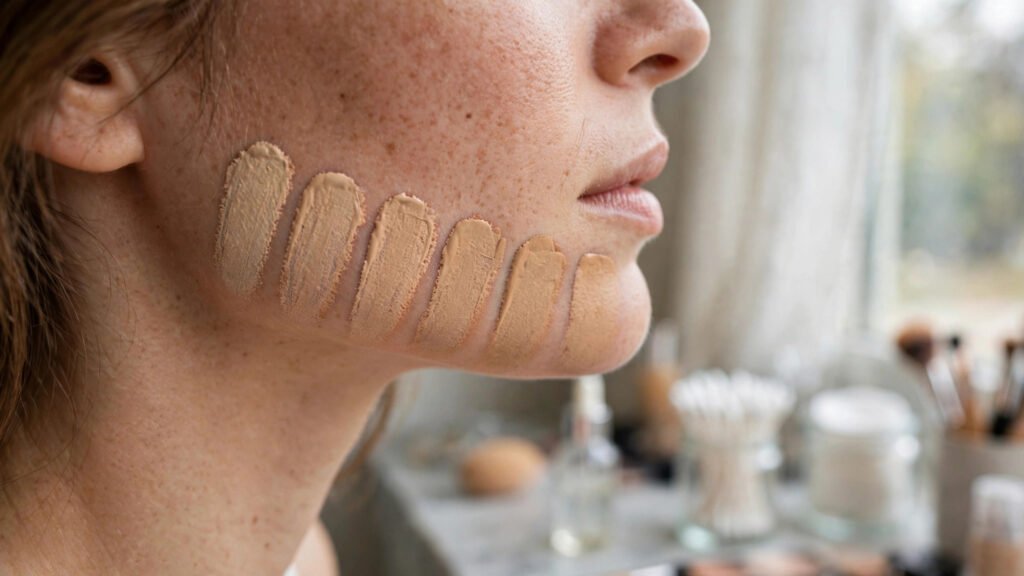
Test on the jawline, not the hand. Your hand is almost never your face’s shade. Swipe three candidate shades in vertical stripes along the jaw, extending slightly onto the neck.
Natural daylight is the only truth. Store lighting — especially the warm yellow spots in American department stores — lies systematically. Apply the stripes, then walk outside or to a window. The shade that disappears into both face and neck is the match.
Wait 10 minutes. Foundations oxidize — they darken and shift warmer as they react with skin oils and air. The shade that matches at minute one may be orange by minute ten. Test, wait, then judge.
Match the neck and chest, not just the face. Most faces are slightly darker or redder than the neck; matching only the face creates the floating-head effect. When in doubt, match the neck — it’s the larger visible area.
Step 3: Decode the Shade System
American brands use maddeningly inconsistent naming, but patterns exist. MAC’s famous NC/NW system is backwards from intuition (NC = “neutralizes cool,” i.e., for warm/yellow skin; NW = “neutralizes warm,” for pink/cool skin). Most brands now use number + letter systems (e.g., 3W = depth 3, warm undertone). When switching brands, use comparison tools (shade-finder databases online map equivalents across brands) rather than guessing — “medium beige” means wildly different things at different price points.
For deep skin tones: the range has improved enormously, but undertone variety at the deep end still lags — look for brands with 40+ shades and explicit undertone labeling, and be wary of ranges where all deep shades skew red or all skew ashy. Your undertone exists at every depth.
Formula and Finish Affect the Match
The same shade number looks different across formulas: matte foundations read darker and flatter; dewy/luminous finishes reflect light and read lighter; full-coverage formulas show undertone more strongly; sheers are more forgiving of near-misses. Seasonal shifts matter too — most Americans need a shade deeper in late summer and lighter in winter; the practical solution is two shades (or one shade plus a mixer) rather than a year of mismatch. And skin changes over time — reassess every year or two, not once per decade.
Common Matching Mistakes
Going too light (the ashy, ghostly look) — usually from testing on the hand or in bad light. Going too warm — the orange jawline, from ignoring undertone. Testing on made-up skin — test on a bare, moisturized face. Buying online without research — if you must, order from retailers with free returns and order two adjacent shades. Ignoring the neck — the number one visible error. And sticking with a wrong shade from loyalty — your perfect match from 2019 may not be your match now.
Budget doesn’t determine match quality — an $12 drugstore foundation in the right shade beats a $50 luxury one in the wrong shade every time. The FDA’s cosmetic safety information is a useful reality check on marketing claims while you shop. The skill is in the testing method, not the price tag, which is the same logic as dressing stylishly on a budget: technique outperforms spending.
When Your Match Changes (And It Will)
Foundation matching isn’t a one-time event — your skin changes, and the match must follow. Seasonal shifts: most Americans are a half-shade to full shade deeper in late summer than midwinter. The practical fix: own your winter shade and a summer shade (or your shade plus a darker mixer), rather than wearing a mismatch for months. Self-tanner: if you self-tan, match to the tanned skin, not the natural — or skip full-face foundation on tanned days in favor of spot concealing. Hormonal and age changes: skin undertones can shift subtly with hormonal changes and aging; the warm foundation that matched at 25 may read orange at 45. Reassess every year or two with fresh daylight testing.
Weight changes alter how foundation sits (fuller faces reflect light differently), and skincare changes affect the finish — a new glowy skincare routine under the same matte foundation changes the final look. The habit to build: a 60-second jawline check in natural light whenever something changes — new season, new skincare, noticeable tan. Catching a mismatch early beats discovering it in photos later. Your perfect match is a moving target; the skill isn’t finding it once, it’s re-finding it whenever the target moves.
Conclusion
Find your undertone (veins, white-paper test, jewelry), test three jawline stripes in natural daylight, wait ten minutes for oxidation, and match the neck — that’s the whole method. Learn to decode your brands’ shade systems, reassess seasonally, and never trust store lighting. Foundation matching is a skill, not a talent, and once you learn it, the jawline line becomes something you only see on other people.
Frequently Asked Questions
How do I know my skin undertone?
Check wrist veins in daylight (greenish = warm, blue/purple = cool), hold white paper to your face, and note whether gold or silver jewelry flatters you. Many people are neutral or olive — a mix.
Should foundation match my face or neck?
Your neck (and chest). Matching only the face creates a visible line at the jaw. The shade that disappears into both face and neck is correct.
Why does my foundation look orange after an hour?
Oxidation — the formula darkens and warms as it reacts with your skin’s oils and air. Always wait 10 minutes after testing before judging a shade, and consider going half a shade lighter if oxidation is strong.
Where should I test foundation shades?
On the jawline in natural daylight — never on your hand, and never trust store lighting alone. Swipe 2-3 candidates, walk outside, and pick the one that vanishes.
Do I need a different shade in summer and winter?
Most people do — skin darkens with sun exposure. Keep a summer and winter shade (or one shade plus light/dark mixers) rather than wearing a mismatch half the year.