Golden Retriever Exercise: How Much Do They Really Need?
America’s sweetheart dog — the Golden Retriever — has a reputation as the perfect family companion: gentle, eager, endlessly friendly. What’s less advertised is the engine under the hood. Goldens were bred as all-day working gun dogs, retrieving waterfowl across Scottish marshes for hours. That heritage didn’t vanish because the dog now lives in a suburb. An under-exercised Golden isn’t a calm Golden; she’s a destructive, anxious, overweight Golden. So how much exercise does a Golden Retriever actually need daily? More than most owners expect — and the type matters as much as the amount.
The Baseline: 1–2 Hours Daily for a Healthy Adult
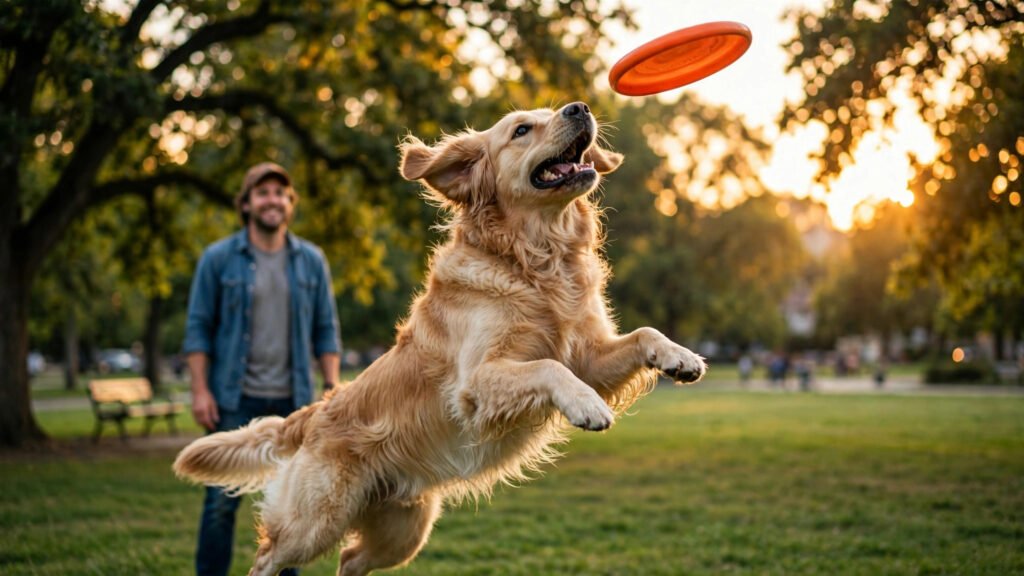
For a healthy adult Golden Retriever (roughly 1–8 years old), plan on 60 to 120 minutes of purposeful exercise per day, with most thriving around the 90-minute mark. “Purposeful” is the key word — a slow amble around the block where the dog sniffs every mailbox is lovely enrichment, but it doesn’t touch a Golden’s athletic needs. The daily mix should include at least 30–45 minutes of genuinely vigorous activity: brisk walking or jogging, fetch, swimming, or active play that gets the dog panting happily.
This isn’t arbitrary. Retrievers as a breed group consistently rank among the highest-energy companion dogs, and the American Kennel Club breed standard describes Goldens as active, athletic dogs requiring regular vigorous exercise. PetMD’s Golden Retriever breed guide breaks down the exercise needs by age with the same 60-plus-minute baseline. Owners who hit the 90-minute mark report dramatically fewer behavior problems — the data on exercise and canine behavior is unambiguous.
Adjusting for Life Stage
Puppies: the 5-minute rule
Golden puppies are deceptively energetic and dangerously fragile. Growing joints — especially in a breed prone to hip and elbow dysplasia — can’t handle forced repetitive exercise. The widely used guideline: 5 minutes of structured exercise per month of age, twice daily (a 4-month-old gets ~20 minutes, twice a day). Free play on soft surfaces is fine; leashed jogging, long hikes, and repetitive fetch on hard ground are not. Over-exercising a Golden puppy risks orthopedic damage that lasts a lifetime.
Adults (1–8 years): the full program
This is the 60–120 minute window. Prime-age Goldens can hike for hours, swim endlessly, and run happily — build up gradually if your dog has been sedentary, just like a human athlete returning to training.
Seniors (8+): quality over quantity
Older Goldens still need daily movement — it’s critical for managing arthritis and weight — but shift to lower-impact: swimming (the perfect senior exercise), gentle walks, and sniff-based enrichment. Watch for lagging, stiffness after rest, or reluctance on stairs, and adjust. Two shorter outings often beat one long one for creaky joints.
The Right Mix: Physical, Mental, and Breed-Specific
Physical exhaustion alone doesn’t satisfy a Golden — they’re thinkers bred to work with humans. The ideal weekly rotation:
Aerobic work (daily): fetch, swimming, jogging, flirt pole. Swimming deserves special mention — Goldens are water dogs to their core, and it’s the lowest-impact full-body workout available. A 20-minute swim tires most Goldens more than an hour-long walk.
Mental work (daily): training sessions, puzzle feeders, scent games, “find it” exercises. Fifteen minutes of nose work or training tires a dog as effectively as much longer physical exercise — the brain burns energy too. A mentally under-stimulated Golden invents her own entertainment, usually involving your drywall.
Retrieving (the breed’s joy): structured fetch and retrieving games satisfy deep breed instincts. But vary it — straight-line repetitive fetch on hard surfaces stresses joints; mix in swimming retrieves, uphill retrieves, and search games.
Social exercise: well-managed play with compatible dogs provides physical and social enrichment simultaneously. Not all Goldens love dog parks (and that’s fine), but most thrive with a few good dog friends.
Building the habit is a lifestyle project — staying motivated to exercise regularly yourself gets dramatically easier when a joyful Golden is your training partner, and a daily 30-minute walk covers the baseline for both species at once.
Bad Weather and Indoor Alternatives
American weather doesn’t always cooperate — summer heat waves, winter deep freezes, and storm seasons can sideline outdoor exercise for days. An under-exercised Golden stuck inside for a week becomes a special kind of destructive, so indoor alternatives aren’t optional extras; they’re part of the plan. Stair-free hallway fetch (throwing up stairs stresses joints — keep it flat), hide-and-seek with treats or family members (powerful nose work), puzzle feeders and frozen Kongs for meals, trick training sessions (15 minutes of learning new behaviors tires the brain enormously), and treadmill training for the truly committed (introduced gradually with positive association, never forced).
Heat deserves special caution: Goldens overheat easily with their dense coats. Above 85°F, shift exercise to early morning or late evening, carry water, watch for excessive panting or lagging, and know that asphalt burns paws — if it’s too hot for your bare hand, it’s too hot for the walk. Swimming is the perfect hot-weather exercise: full-body workout, zero heat stress, and the breed’s favorite activity. In winter, the dense double coat handles cold well, but ice-melting salt demands paw care (rinse after walks, consider boots or paw wax). The goal is consistency across seasons — a Golden exercised year-round is a Golden whose behavior stays stable year-round.
Signs Your Golden Needs More (or Less) Exercise
Needs more: destructive chewing, excessive barking, hyperactivity indoors (the “zoomies” at 10 p.m.), weight gain, attention-seeking pestering, digging. These are the classic under-exercised Golden behaviors, and owners frequently mistake them for training problems when they’re really exercise deficits.
Needs less or different: lagging on walks she used to enjoy, stiffness after rest, heavy panting disproportionate to the effort, limping, or reluctance to start. These signal overexertion, age-related change, or a medical issue — particularly in a breed prone to orthopedic problems. When in doubt, vet check first, then adjust.
The Weight Connection
This matters enormously for Goldens: the breed is notoriously prone to obesity, and studies show overweight Goldens live nearly two years less than lean ones. Exercise and portion control are inseparable — you can’t out-walk a overfilled food bowl, but you also can’t keep a Golden lean on diet alone without the activity her body expects. Ribs should be easily felt (not seen) under a light fat covering.
Conclusion
A healthy adult Golden Retriever needs 60–120 minutes of daily exercise — a genuine mix of vigorous physical activity, mental work, and breed-satisfying retrieving or swimming — adjusted down for puppies’ growing joints and seniors’ aging ones. Hit that target and you get the Golden of the movies: calm indoors, joyful outdoors, and healthy for years longer. Miss it consistently and you get the other Golden: the counter-surfer, the shoe-destroyer, the 95-pound lap dog with behavior “problems” that are really just an athlete with no sport.
Frequently Asked Questions
Is 30 minutes of exercise enough for a Golden Retriever?
No — 30 minutes is a bare minimum for a young senior, not an adult. Healthy adult Goldens need 60-120 minutes daily, including 30-45 minutes of vigorous activity.
Can you over-exercise a Golden Retriever puppy?
Yes, and it’s a real orthopedic risk. Follow the 5-minutes-per-month-of-age guideline twice daily, avoid forced running on hard surfaces, and let the puppy set the pace.
What’s the best exercise for Golden Retrievers?
Swimming — it’s the breed’s natural sport, full-body, and low-impact. Combined with fetch, training games, and daily walks, it covers all their needs.
How do I exercise my Golden in bad weather?
Indoor options: stair-free fetch down hallways, puzzle feeders, scent games (“find the treat”), training sessions, and treadmill training (introduced properly). Mental exercise substitutes well short-term.
My Golden is destructive — is it lack of exercise?
Very often yes. Destructive chewing, hyperactivity, and attention-seeking in Goldens are textbook under-exercise symptoms. Increase both physical and mental exercise before assuming a training problem.