Improve Public Speaking Skills Before Graduation
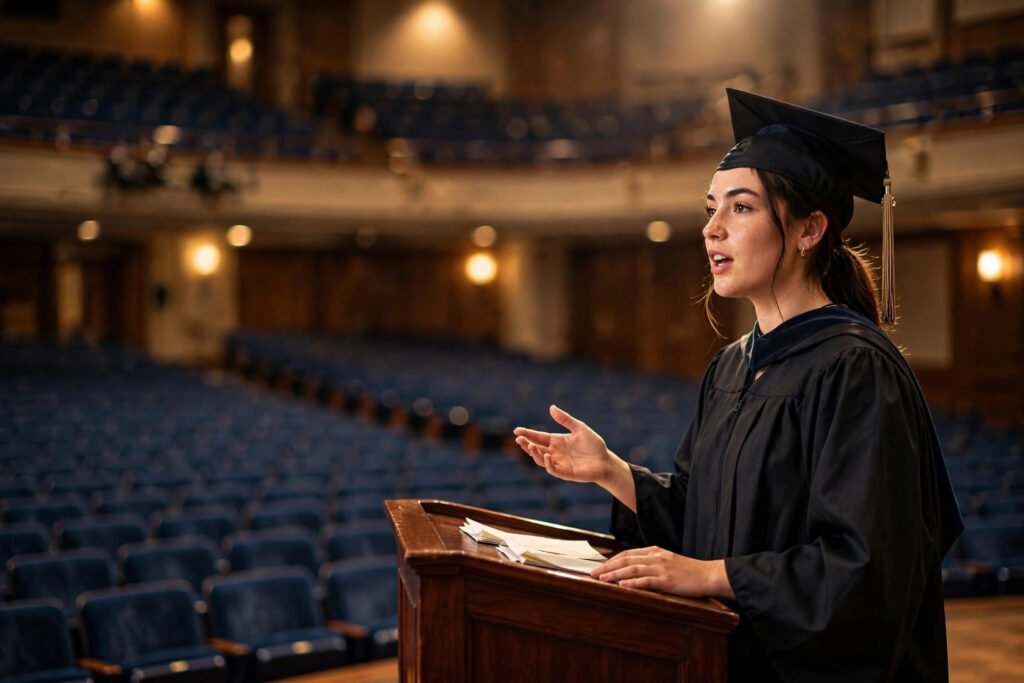
Graduation is coming — and with it, the job interviews, the presentations, the networking events, and the terrifying realization that your degree didn’t teach you to talk to humans. Public speaking consistently ranks among Americans’ top fears, above spiders, heights, and (in some surveys) death. But here’s the good news for soon-to-be graduates: public speaking is a trainable skill, not a personality trait. The confident speakers you admire aren’t fearless — they’re practiced.
With months (or weeks) before graduation, you can build genuine speaking competence. This guide gives you the complete system: managing the fear, structuring what you say, delivering it well, and practicing efficiently on a student schedule.
First: understand the fear (so you can dismantle it)
Stage fright is physiology, not character flaw. Your brain’s threat-detection system treats social evaluation like physical danger — hence the racing heart, shaking hands, and blank mind. This response evolved to keep you alive; it’s just miscalibrated for conference rooms. Two facts defuse it: the audience can’t see most of your anxiety (studies show speakers vastly overestimate how nervous they appear), and the fear peaks before you start — within 30–60 seconds of speaking, adrenaline metabolizes and most speakers settle.
The reframe that works: nervousness is energy. Olympic athletes, trial lawyers, and keynote speakers all feel it — they’ve just learned to interpret the arousal as readiness rather than danger. You don’t need to eliminate the butterflies; you need to get them flying in formation.
Structure: the skeleton of every good talk
Most bad speaking isn’t a delivery problem — it’s a structure problem. Rambling, unclear talks terrify their speakers because deep down, they know there’s no plan. Use this skeleton for any graduation-season talk (interviews, presentations, toasts):
- Hook (10%): a surprising fact, a brief story, a provocative question — something that earns attention in the first 30 seconds.
- Thesis (5%): one clear sentence stating your point. If you can’t say it in one sentence, you’re not ready.
- Three points (75%): three supporting ideas, each with one concrete example or story. Three is the magic number — audiences remember three things.
- Close (10%): restate the thesis, end with a forward-looking statement or call to action. Never trail off with “so… yeah.”
Write bullet points, not scripts. Memorized scripts sound robotic and collapse if you lose your place; bullet points keep you structured while sounding human. For interview-specific preparation, the same structuring skill applies — see how to improve your public speaking skills for the broader communication toolkit.
Delivery: the mechanics of looking confident
Voice: slow down (nervous speakers rush — deliberately pace at 70% of your instinct), pause between points (silence feels eternal to you and thoughtful to the audience), and vary your tone (monotone is the delivery killer; emphasize key words).
Body: plant your feet (no swaying or pacing), gesture naturally from the heart outward (gestures above the waist read as confident; hands in pockets read as hiding), and make eye contact with individuals for 3–5 seconds each (not scanning the room like a lighthouse).
The opening 60 seconds: memorize your first minute verbatim. Starting strong on autopilot carries you through the peak-anxiety window; by minute two, you’re settled and can speak from bullets. This single trick does more for nervous speakers than any other.
The practice system: how to get good fast
Speaking improves with deliberate practice, not just repetition. The system:
- Record yourself. Phone video, 5-minute talk, watch it back. Painful? Yes. The fastest feedback loop in existence? Also yes. You’ll spot filler words (“um,” “like,” “you know”), pacing issues, and distracting mannerisms in one viewing.
- Practice out loud, standing up. Rehearsing in your head doesn’t count — your mouth needs the reps. Practice in the actual physical configuration: standing, gesturing, projecting.
- Get a live audience. Roommates, family, a campus Toastmasters club (many colleges have chapters — free and specifically designed for this), or your university’s speaking center. Live eyes create the pressure that rehearsal alone can’t.
- Do the reps. Volunteer for class presentations, club announcements, anything with a microphone. Confidence is a function of stage hours — there’s no shortcut, but campus life offers abundant free reps.
Targeted practice beats generic advice: one recorded rehearsal teaches more than ten articles. And the career payoff extends well beyond graduation — strong communicators get promoted faster in nearly every field, which is part of why negotiating a higher salary starts with the confidence to articulate your value.
Graduation-season specific scenarios
Job interviews: structure answers with STAR (Situation, Task, Action, Result) — it’s the hook-thesis-points-close skeleton in interview form. Prepare 5–6 stories covering common prompts; practiced stories beat improvised brilliance.
Networking events: prepare a 30-second introduction (who you are, what you’re looking for, one interesting detail) and three good questions to ask others. Having questions ready eliminates the awkward silence panic.
Presentations and defenses: know your first and last minute cold, prepare for the three hardest questions (ask a friend to play hostile questioner), and bring water — dry mouth is universal and sipping looks natural.
Conclusion
Improving public speaking before graduation is a weeks-long project with a clear method: understand that anxiety is normal physiology, structure every talk (hook, thesis, three points, close), deliver with deliberate pacing and body language, memorize your opening minute, and practice out loud on video and in front of live audiences. The confident graduates you see on stage aren’t a different species — they’re just further along the same practice curve you’re starting now.
Your 4-week pre-graduation speaking plan
If graduation is a month away, here’s the sprint version. Week 1: record a 5-minute talk on your phone, identify your top three weaknesses (fillers, pace, eye contact), and join campus Toastmasters or book the speaking center. Week 2: practice the hook-thesis-three-points-close structure on three different topics, out loud and standing. Week 3: deliver in front of live humans at least twice — friends, family, a club meeting — and record one session for review. Week 4: polish your interview stories (five STAR-format answers), rehearse your networking introduction, and do one final recorded run-through. Four weeks of deliberate practice won’t make you a keynote speaker — but it will make you noticeably, hireably better than the graduates who never practiced at all. For authoritative guidance, see the Toastmasters International and the American Psychological Association.
Frequently Asked Questions
How can I get over my fear of public speaking?
Reframe anxiety as energy, memorize your opening 60 seconds (the fear peaks before you start), and accumulate stage hours through low-stakes reps — class presentations, Toastmasters, club announcements. The fear diminishes with exposure, not with waiting.
What is the best structure for a short presentation?
Hook (attention-grabbing opening), one-sentence thesis, three supporting points with examples, and a strong close. Use bullet points rather than memorized scripts — they sound more natural and survive lost places.
How do I stop saying “um” when presenting?
Record yourself to hear the pattern, then replace fillers with deliberate pauses — silence feels awkward to you but thoughtful to audiences. Slowing your overall pace by about 30% eliminates most filler words automatically.
Should I memorize my speech word for word?
No — memorize only your opening minute (to survive peak anxiety) and your closing line. Deliver the middle from bullet points. Full memorization sounds robotic and collapses if you lose your place.
Where can college students practice public speaking?
Campus Toastmasters chapters, university speaking/writing centers, class presentations, student club leadership roles, and even recording yourself. Most campuses offer free, purpose-built practice venues students never use.