The Montessori Method: Does It Really Work?
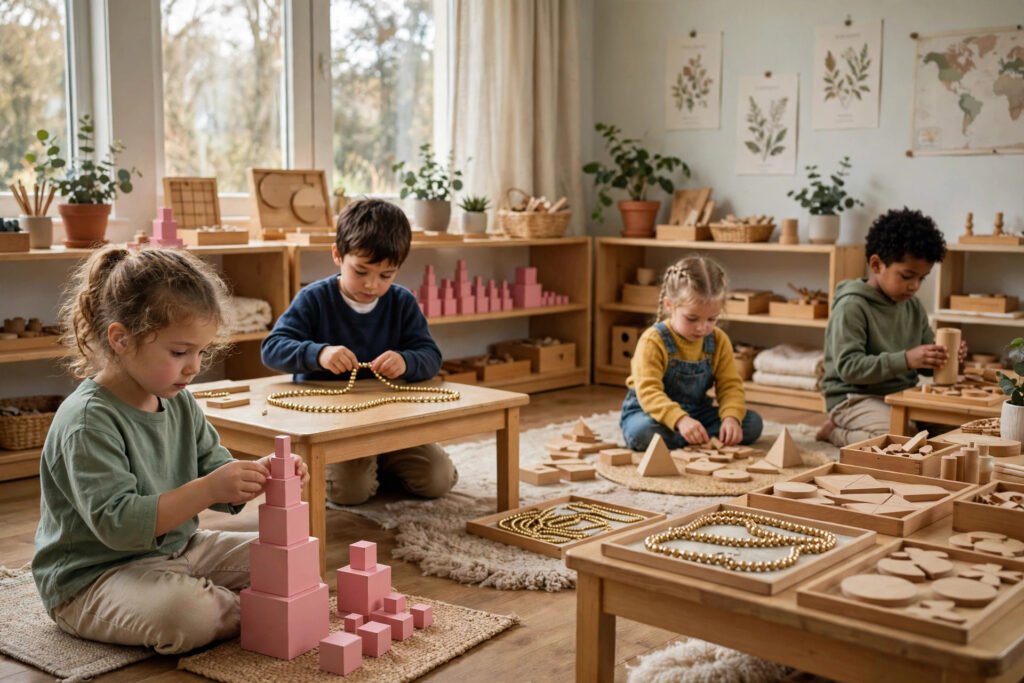
Walk into a Montessori classroom and it looks nothing like school as most Americans remember it: no rows of desks, no teacher lecturing at a whiteboard. Instead, children aged 3 to 6 (or 6 to 12, in elementary programs) move freely between hands-on materials — pouring water between pitchers, tracing sandpaper letters, building decimal systems with golden beads. It’s calm, purposeful, and a little mysterious. And American parents keep asking the same question: does it actually work, or is it expensive progressive theater?
Maria Montessori’s method is over a century old, educates hundreds of thousands of American children, and has accumulated a genuine research base — with genuinely mixed results. This guide explains what the method actually is, what the science says, what it costs, and how to decide if it fits your child.
What the Montessori method actually is
Developed by Italian physician Maria Montessori in the early 1900s, the method rests on specific principles, not vibes:
- Mixed-age classrooms (typically 3-year spans: 3–6, 6–9, 9–12): younger children learn from older ones; older children consolidate learning by teaching.
- Self-directed activity: children choose their “work” from available materials and pursue it for uninterrupted blocks (often 2–3 hours), rather than following a teacher’s schedule.
- Hands-on materials: scientifically designed manipulatives that isolate single concepts — the pink tower (size gradation), sandpaper letters (phonetic awareness), golden beads (decimal system). Children learn through touch and movement before abstraction.
- The teacher as guide: Montessori teachers (“guides”) observe and introduce materials individually rather than lecturing groups. Intervention is minimal by design.
- No grades, tests, or rewards: intrinsic motivation is the engine — no gold stars, no honor roll, no punishments. The work is supposed to be its own reward.
This is a coherent educational philosophy, not a branding aesthetic — which matters because many American programs use the word “Montessori” loosely. Authentic programs pursue AMI (Association Montessori Internationale) or AMS (American Montessori Society) accreditation and employ trained Montessori teachers. Unaccredited “Montessori-inspired” programs may share only the wooden toys.
What the research says: the honest summary
The most-cited study — a 2006 randomized lottery study by Angeline Lillard published in Science — found Montessori preschoolers outperformed conventionally schooled peers on academic and social measures by kindergarten’s end. A 2017 follow-up found advantages persisting into elementary years, particularly for lower-income children. These are genuinely rigorous studies, not marketing.
But the full picture is more complicated. A 2023 large-scale review found that Montessori outcomes vary enormously with implementation fidelity — high-fidelity programs (trained teachers, full materials, proper mixed-age groupings) show meaningful benefits; low-fidelity programs show little or none. And some researchers note selection effects: Montessori families tend to be highly engaged, educated parents, which confounds comparisons. The fair summary: well-implemented Montessori works well, especially for preschool and early elementary — but the “Montessori” label alone guarantees nothing.
Where Montessori shines (and where it struggles)
Strengths: independence and executive function (children manage their own time and choices from age 3); intrinsic motivation (no reward dependency); social development (mixed-age mentoring builds empathy and leadership); hands-on learners (children who struggle sitting still often thrive with movement-based materials); and early academics — Montessori’s phonetic reading and concrete-to-abstract math sequences are genuinely excellent.
Potential weaknesses: highly structured children who crave clear direction can flounder with open choice; the no-grades approach means less external accountability (some kids coast); social dynamics in mixed-age rooms need skilled management; and transitions to conventional schools can jar children unaccustomed to tests, grades, and teacher-directed schedules. Children also need rich language and social experiences beyond the classroom — building a daily reading habit at home complements any school philosophy.
What it costs in America
Authentic private Montessori in the US typically runs $8,000–$20,000+ per year depending on metro area — comparable to other private preschools. Public Montessori programs exist in many districts (often via lottery admission) and are free, though spots are competitive. When evaluating cost, compare against your local alternatives honestly: an excellent conventional preschool at $6,000 may beat a mediocre “Montessori-inspired” program at $14,000. Fidelity matters more than philosophy.
How to evaluate a specific program
Tour with these questions: Are teachers AMI/AMS trained (not just “Montessori-experienced”)? Is the classroom genuinely mixed-age with full 3-year spans? Are the materials complete and in good condition (a sparse shelf is a red flag)? How long are uninterrupted work periods? How does the school handle children who struggle with self-direction? What do graduates’ transitions to elementary school look like — ask for specifics, not assurances. Observe a classroom: it should hum with purposeful activity, not chaos and not silence. Trust the observation over the brochure.
Also consider your child’s temperament honestly: self-directed, curious, persistent children tend to flourish; children who need significant external structure or have certain special needs may do better with more directed approaches — discuss specific needs with the school frankly. Social foundations matter regardless of method; see teaching kids good manners for the social skills that help in any classroom.
Conclusion
The Montessori method, well-implemented, is one of the better-validated alternative pedagogies in American education — strong on independence, intrinsic motivation, and early academics, with real (if fidelity-dependent) research support. But the label isn’t the method: accreditation, trained teachers, complete materials, and genuine mixed-age classrooms are what you’re paying for. Tour skeptically, match the philosophy to your child’s temperament, and remember that an engaged parent matters more than any pedagogy.
Montessori at home: what parents can borrow
You don’t need to enroll to use Montessori principles. The most transferable ideas: create a prepared environment (child-sized tools, everything accessible, order and beauty — children absorb the calm), follow the child (observe what captivates them and provide more of it, rather than imposing a curriculum), favor hands-on over worksheets (pouring, sorting, building, and real tasks like cooking teach concentration and sequencing), and resist interrupting deep focus (when your child is absorbed in an activity, protect that concentration like the developmental gold it is). These home practices benefit children in any school setting — and they cost nothing. For authoritative guidance, see the American Montessori Society and the U.S. Department of Education.
Frequently Asked Questions
Does the Montessori method really work?
Well-implemented Montessori shows meaningful benefits in rigorous studies, especially for preschool and early elementary — independence, social skills, and early academics. But outcomes depend heavily on implementation fidelity; the label alone guarantees nothing.
What is the difference between Montessori and traditional preschool?
Montessori uses mixed-age classrooms, self-directed work with hands-on materials, teachers as guides rather than lecturers, and no grades or rewards. Traditional preschools typically use same-age classes, teacher-directed activities, and more structured schedules.
How much does Montessori school cost in the US?
Private Montessori typically costs $8,000–$20,000+ per year depending on location. Public Montessori programs (often lottery admission) are free where available. Compare against local alternatives on quality, not just philosophy.
Is Montessori good for children with ADHD?
It depends on the child. The movement-based, hands-on materials suit many ADHD learners, but the self-directed structure can challenge children who need significant external scaffolding. Discuss your child’s specific needs frankly with the school.
Do Montessori kids struggle transitioning to regular school?
Some do — tests, grades, and teacher-directed schedules can jar children used to self-direction. Well-run programs prepare students for transitions explicitly; ask prospective schools how they handle it and what graduate outcomes look like.