How to Cover Dark Spots With Makeup Naturally: Pro Method
That cluster of sun spots on your cheek. The post-acne marks along your jawline. The melasma patches that appeared during pregnancy and never quite left. Dark spots are among the most common skin concerns in America — and covering them with makeup is a skill, not a product. Most people get it wrong in the same way: they pile on full-coverage foundation everywhere, ending up with a mask-like face where the spots still peek through. The professional approach is the opposite — targeted, minimal, and strategic. Here’s how to cover dark spots naturally, so your skin looks like skin, just more even.
The Philosophy: Spot-Correct, Don’t Mask
The fundamental error is treating dark spots as a full-face problem. They’re not — they’re isolated areas of excess pigment on otherwise fine skin. Covering your entire face in heavy foundation to hide three spots gives you the worst of both worlds: unnatural-looking skin overall, plus spots that still show through because foundation alone was never designed for concentrated pigment.
The pro method inverts this: sheer-to-medium base everywhere (letting your natural skin show), with concentrated coverage only on the spots themselves. The result reads as “great skin” rather than “makeup covering something.” Less product in the right places beats more product everywhere — every time.
Step 1: Prep for Smooth Application
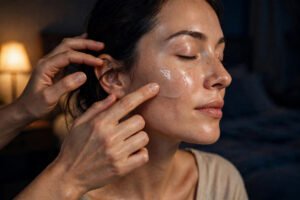
Makeup grabs unevenly on dry, textured skin — and dark spots often sit on skin that’s slightly rougher. Gentle exfoliation 2–3 times weekly keeps the surface smooth; daily moisturizer (applied a few minutes before makeup) creates an even canvas. This matters more than any coverage product: smooth, hydrated skin needs less makeup to look even.
Sun protection is the non-negotiable partner step — UV exposure darkens every type of hyperpigmentation, undoing both your makeup work and any brightening treatments. SPF 30+ daily, applied as the last skincare step. Covering spots while letting the sun create new ones is bailing water with a hole in the bucket. The AAD’s hyperpigmentation treatment guidance ranks daily sun protection as the single most important step.
Step 2: Color-Correct Before You Conceal
This is the step that changes everything, and the one most people skip. Color theory: opposite colors neutralize each other.
Peach/salmon corrector — for blue/purple-toned darkness and most brown spots on light-to-medium skin. The single most useful corrector shade; it neutralizes without the ashy cast that plain concealer leaves on pigmented spots.
Orange/deep peach corrector — for dark spots on medium-deep to deep skin tones, where lighter correctors turn ashy. Match the corrector depth to your skin: deeper skin needs deeper corrector.
Yellow corrector — for mild redness-tinged marks and brightening dull areas.
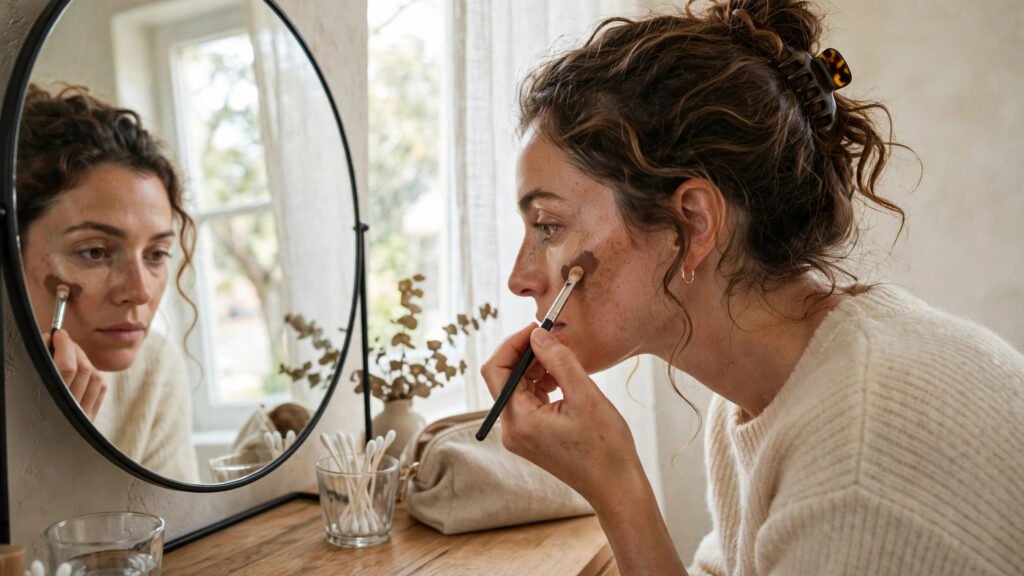
Apply the corrector only on the spot itself — a tiny amount, patted with a fingertip or small brush, feathered at the edges. The corrector neutralizes the discoloration so the concealer on top doesn’t have to work as hard — which means less concealer, which means a more natural finish. Understanding your skin’s color behavior pays dividends elsewhere too — knowing your most flattering colors helps you choose corrector and foundation shades that harmonize rather than fight your undertones.
Step 3: Conceal With Precision
Over the corrector, apply a full-coverage concealer — but only on the spot. Technique: dot the concealer directly on the discoloration, then pat (never drag) the edges to blend into surrounding skin, using a small brush, damp sponge tip, or fingertip. The center of the spot keeps full coverage; the edges melt away invisibly.
Formula choice matters: creamy, high-pigment concealers designed for spot coverage (not the runny under-eye brightening type) — they need to be opaque in a thin layer. Set each concealed spot with the tiniest press of translucent powder — un-set concealer migrates and fades by afternoon, re-exposing the spot. This targeted setting (just the spots, not the whole face) keeps the rest of your skin looking natural.
Step 4: The Sheer Base Over Everything
Now — and only now — apply your base: a sheer-to-medium foundation or tinted moisturizer over the entire face, applied lightly over the concealed spots without disturbing them (stipple or press, don’t drag). The base unifies skin tone; the spot work underneath does the heavy lifting. Because the spots are already neutralized, the base can stay sheer — and sheer base is what reads as “natural.”
Finish thoughtfully: a light dusting of powder only in the T-zone (not over the concealed spots — powder over heavy concealer cakes), and consider a subtle luminizer on the high points of the face. Strategic glow draws the eye to your features, not to the areas you corrected. The supporting details complete the natural effect — healthy skin from within means less to cover in the first place, and that’s the long game worth playing alongside the makeup technique.
Melasma: The Special Case
Melasma — the symmetrical brown patches on cheeks, forehead, and upper lip, often triggered by pregnancy or hormonal contraception — deserves separate discussion because it behaves differently from sun spots or post-acne marks. It’s hormonally driven, which means it’s stubborn: it fades slowly, recurs easily, and worsens with heat and sun exposure (even without burning). Makeup covers it with the same spot-correcting technique, but the corrector choice matters more — melasma’s diffuse edges need feathered, sheer correction rather than opaque spot concealing, or the coverage itself looks patchy.
Treatment requires patience and professional guidance: strict sun protection (including iron-oxide tinted sunscreens, which block the visible light that worsens melasma — regular sunscreen alone is insufficient), and dermatologist-supervised options (azelaic acid, tranexamic acid, cautious hydroquinone cycles, gentle peels). What to avoid: aggressive laser treatments from inexperienced providers (they can worsen melasma dramatically) and picking at the skin. Melasma is a marathon condition — the makeup technique gives you confidence while the slow treatment work happens underneath, and the combination of camouflage plus proper treatment is how most people successfully manage it for years.
The Long Game: Fading Spots While Covering Them
Makeup is camouflage; treatment is the cure. Mayo Clinic’s overview of age spots covers when discoloration warrants a dermatologist’s look rather than drugstore treatment. While covering, treat: daily sunscreen (prevents darkening), vitamin C serum (inhibits melanin production, 8–12 weeks for visible fading), niacinamide (interferes with pigment transfer), and for stubborn spots, dermatologist options (prescription retinoids, hydroquinone under supervision, chemical peels, laser for appropriate candidates). The makeup routine buys you confidence today; the treatment routine reduces what needs covering tomorrow. They work best together — and the better your skin gets, the less of this technique you need.
Conclusion
Natural-looking dark spot coverage is a four-step method: prep smooth and protected, color-correct the spots precisely (peach/orange for brown spots, matched to your depth), conceal only the spots with patted, set coverage, then unify with a sheer base everywhere. Targeted correction plus sheer foundation beats full-coverage masking in every way — less product, more natural, better wear. And while the makeup handles today, sunscreen plus brightening treatments handle tomorrow, until there’s less to cover at all.
Frequently Asked Questions
How do I cover dark spots without looking cakey?
Spot-correct instead of masking: color corrector + concealer only on the spots, then a sheer foundation everywhere. Targeted coverage with a light base looks natural; full-coverage foundation everywhere looks cakey.
What color corrector covers dark spots?
Peach/salmon for light-to-medium skin, deeper orange for medium-deep to deep skin tones. The corrector neutralizes brown/purple pigment so you need less concealer on top.
Should I apply concealer before or after foundation for dark spots?
For dark spots: corrector, then concealer on the spots, then a sheer foundation over everything. (This differs from under-eye concealer, which usually goes after foundation.)
Can makeup make dark spots worse?
Makeup itself doesn’t worsen pigmentation, but skipping sunscreen under makeup does — UV darkens spots daily. Always wear SPF 30+ as your last skincare step before makeup.
How do I make spot concealing last all day?
Set each concealed spot with a tiny press of translucent powder immediately after application, avoid touching your face, and use a setting spray. Un-set concealer migrates within hours.