Earthquakes Explained: How They Happen and Can We Predict Them
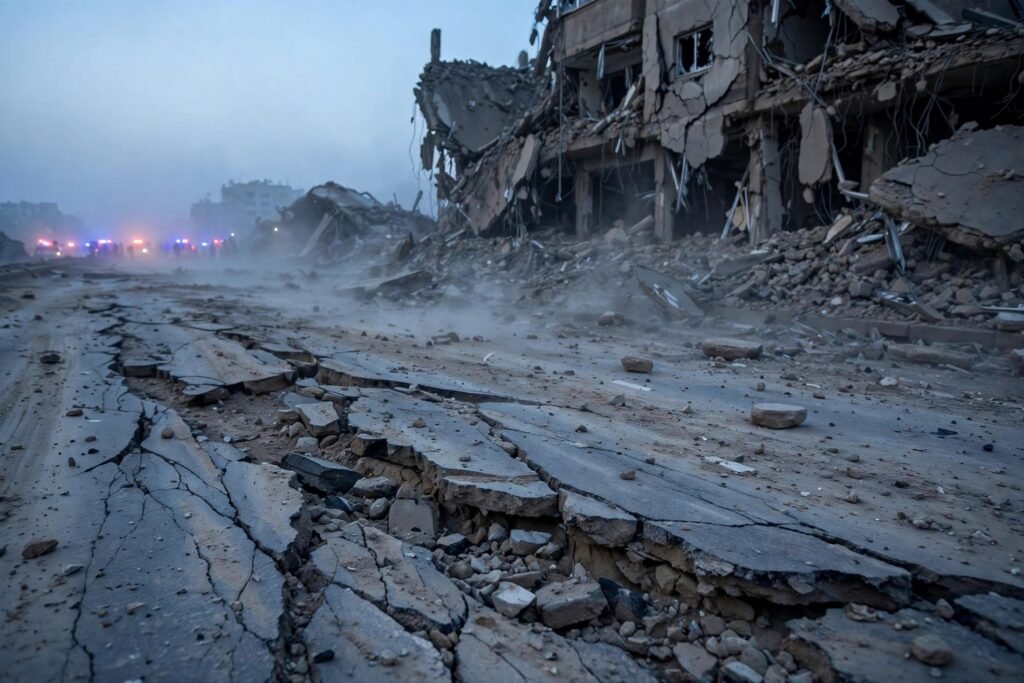
The ground lurches sideways. Bookshelves topple, windows shatter, and in under a minute, a city is transformed. Earthquakes are among the most terrifying natural phenomena precisely because they strike without the visible buildup of a hurricane or the warning sirens of a tornado. But “without warning” is not the same as “without cause” — seismologists understand exactly why earthquakes happen. The harder question, the one that could save thousands of lives, is whether we can predict them.
This guide explains the geology behind earthquakes, what prediction science can and cannot do today, and how to actually stay safe in earthquake country.
Why Earthquakes Happen: Plate Tectonics in Action
Earth’s outer shell is broken into massive tectonic plates that drift atop the semi-fluid mantle — a few centimeters per year, about as fast as your fingernails grow. Where plates meet (faults), their rough edges lock together while the plates keep moving. Stress accumulates for years, decades, or centuries — until it exceeds the friction holding the fault, and the rocks rupture suddenly, releasing centuries of stored energy in seconds. That rupture is the earthquake; the seismic waves radiating outward are what you feel.
Three fault types produce three quake styles: strike-slip (plates sliding past each other horizontally — California’s San Andreas), normal (plates pulling apart), and reverse/thrust (one plate shoved over another — the type behind the largest megathrust quakes like Japan 2011). The USGS Earthquake Hazards Program (usgs.gov) maps every significant quake worldwide in near-real time and is the authoritative source for what just happened and why.
The Ring of Fire and America’s Seismic Zones
Most earthquakes cluster in narrow belts — overwhelmingly the Pacific Ring of Fire, where oceanic plates dive beneath continental ones. In the US, the highest risk concentrates in California (San Andreas and dozens of other faults), the Pacific Northwest (the Cascadia subduction zone, capable of magnitude 9+ — the region’s “big one” is a matter of when, not if), Alaska (America’s most seismically active state, home to the 1964 magnitude 9.2 quake, the largest in US history), Hawaii (volcanic quakes), and the Intermountain West (Utah’s Wasatch fault, Yellowstone’s volcanic seismicity).
The surprise for many: the central US has real risk too. The New Madrid Seismic Zone (Missouri/Arkansas/Tennessee) produced three magnitude 7+ quakes in 1811–12 that rang church bells in Boston — and the region’s buildings, unlike California’s, are largely not built for shaking. Intraplate quakes like these are less frequent but potentially more destructive because nothing is prepared.
Can We Predict Earthquakes? The Honest Answer
Here is the crucial distinction seismologists insist on: forecasting (probabilities over years and regions) works; prediction (exact time, place, and magnitude) does not — and may never.
What we can do — forecasting: the USGS produces seismic hazard maps giving the probability of damaging shaking over 30–50 years for every US location. California has a ~99% chance of a magnitude 6.7+ quake within 30 years; the Bay Area’s Hayward fault is considered “overdue.” These forecasts drive building codes that save thousands of lives — arguably prediction’s more useful cousin.
What we cannot do — prediction: no method reliably predicts a specific quake’s time, location, and magnitude. Foreshocks sometimes precede big quakes — but are only identifiable as foreshocks after the mainshock; most small quakes are not foreshocks of anything. Animal behavior, radon gas, electromagnetic signals — all have been claimed, none has survived rigorous testing; retrospective “predictions” invariably collapse under statistical scrutiny. Earthquake “predictors” who announce dates publicly have a perfect record of failure, and the USGS maintains that no scientific method for short-term prediction currently exists.
The fundamental problem: fault rupture is a chaotic, nonlinear process — like predicting exactly when a stretched rubber band snaps. We understand the loading perfectly; the triggering instant depends on microscopic details we cannot observe kilometers underground. Some seismologists believe prediction may be theoretically impossible, not just technically hard.
Early Warning: Seconds That Save Lives
While prediction remains elusive, early warning is real and deployed. Systems like ShakeAlert (US West Coast) detect the fast, weak P-waves of a quake and broadcast alerts before the destructive S-waves arrive — giving seconds to tens of seconds of warning. Seconds sound trivial; they are enough to stop surgeries, halt trains, open fire-station doors, and get under desks. Japan’s system famously gave millions up to a minute’s warning before the 2011 Tohoku quake. Download your region’s alert app if you live in seismic territory — it is the closest thing to prediction that physics currently allows.
What Actually Saves Lives: Preparedness
Since quakes cannot be predicted, survival depends on preparation — and the measures are well-established:
During: Drop, Cover, and Hold On — get under sturdy furniture, protect your head and neck, hold on until shaking stops. Do not run outside (falling debris kills); do not stand in doorways (modern myth — doorways are no stronger than elsewhere). If driving, pull over clear of structures.
Before: secure heavy furniture and water heaters to walls, know how to shut off gas, keep an emergency kit (water, food, medications, flashlight, radio, cash), and establish a family communication plan. The Federal Emergency Management Agency’s (Ready.gov) earthquake pages offer room-by-room checklists. Building codes are the great unsung hero — California’s strict codes are why its frequent quakes kill far fewer than comparable quakes elsewhere. If you live in seismic zones, securing and weatherproofing your home is part of the same resilience mindset.
After: expect aftershocks (sometimes nearly as strong), check for gas leaks and structural damage, and avoid damaged buildings. Tsunami risk follows coastal quakes — if shaking is strong and long near the coast, move to high ground immediately; do not wait for official warnings. Rounding out preparedness, essential tools every homeowner needs belong in every emergency kit — post-quake repairs start with what you have on hand.
Conclusion
Earthquakes happen because tectonic plates lock, load with stress, and rupture — a process we understand deeply. We can forecast where and how likely with genuine skill, and early-warning systems buy precious seconds. But predicting the exact time, place, and magnitude of the next quake remains beyond science — possibly beyond science in principle. The rational response is not anxiety but preparation: know your zone, secure your space, download the alerts, and practice the drill. We cannot know when the ground will move. We can absolutely be ready when it does.
Frequently Asked Questions
Can scientists predict earthquakes?
No — not the specific time, location, and magnitude. Scientists can forecast probabilities over years and regions (seismic hazard maps), and early-warning systems detect quakes seconds after they start, but reliable short-term prediction does not exist.
What causes most earthquakes?
Tectonic plate movement: plates lock at faults, stress accumulates over decades or centuries, and sudden rupture releases the energy as seismic waves. The Pacific Ring of Fire hosts the vast majority of the world’s earthquakes.
What is the safest thing to do during an earthquake?
Drop, Cover, and Hold On: get under sturdy furniture, protect your head and neck, and hold on until shaking stops. Do not run outside or stand in doorways — both are dangerous myths.
Can small earthquakes prevent big ones?
No — this is a persistent myth. Small quakes release negligible energy compared to large ones; it would take thousands of magnitude 4 quakes to equal one magnitude 7. Small quakes do not “let off pressure” meaningfully.
What was the largest earthquake in US history?
The 1964 Alaska earthquake, magnitude 9.2 — the second-largest ever recorded worldwide. It lasted over four minutes, generated a devastating tsunami, and reshaped the coastline.