How Your Brain Stores Long-Term Memories: The Neuroscience
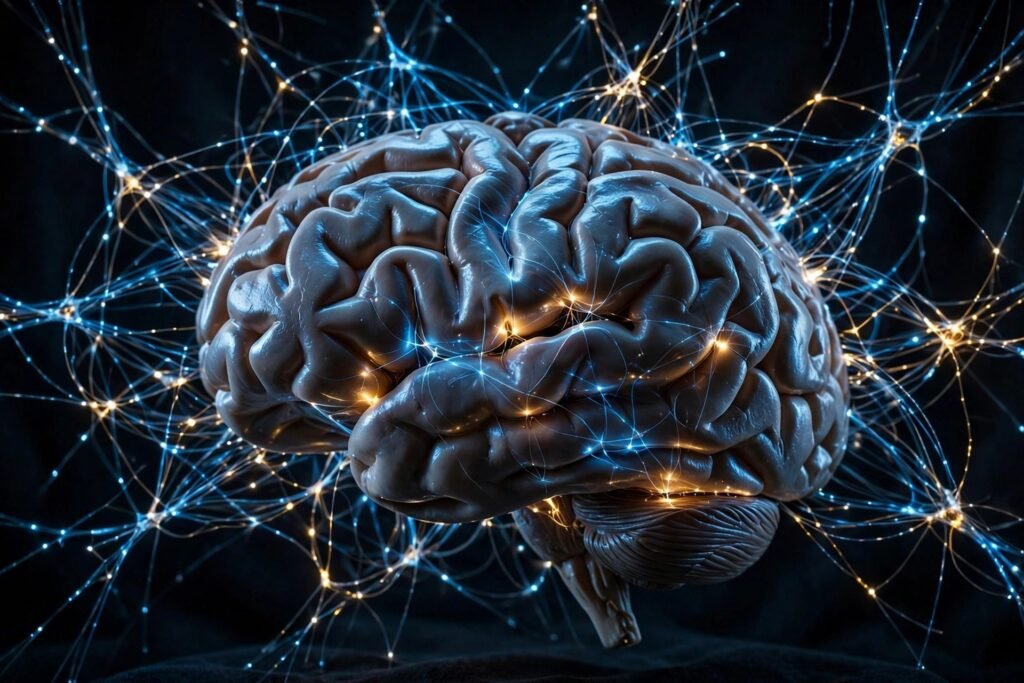
You can still picture your childhood home’s kitchen — the chipped yellow mug, the sunlight through the blinds — decades after you last stood in it. Yet you cannot remember what you had for lunch last Tuesday. The human brain stores a lifetime of experiences in about three pounds of tissue, with no hard drive, no backup, and no filing clerk. How does it do it? The neuroscience of long-term memory is one of the most elegant stories in biology — a tale of strengthening synapses, sleeping brains, and memories that are rewritten every time you recall them.
This guide explains how memories are formed, where they live, how they stabilize for the long term, and why they are far less reliable than they feel.
The Three Stages: Encoding, Storage, Retrieval
Every long-term memory passes through three stages. Encoding is the initial capture — your brain converting experience into neural patterns. Encoding is selective and lossy: attention is the gatekeeper, which is why you remember the conversation you focused on but not the background music. Emotional arousal supercharges encoding (the amygdala flags important experiences for priority storage), which is why you remember where you were on shocking news days but not ordinary ones.
Storage is maintenance over time — keeping the pattern intact for years. Retrieval is reactivation — reconstructing the pattern when needed. The critical insight of modern neuroscience: retrieval is reconstruction, not playback. Every recall rebuilds the memory from stored fragments, which is why memories change subtly with each remembering — and why eyewitness testimony is notoriously unreliable despite feeling certain.
Where Memories Live: It’s Not One Place
Forget the idea of a memory “filing cabinet.” Long-term memories are distributed across the brain regions that originally processed the experience: visual memories live partly in visual cortex, motor memories in motor areas, emotional coloring in the amygdala. Remembering is the coordinated reactivation of this scattered network.
Two structures orchestrate the system. The hippocampus — a seahorse-shaped structure deep in the temporal lobe — is the memory indexer: it binds the distributed fragments into a coherent episode and gradually trains the cortex to store it independently. Patient H.M., whose hippocampi were removed in 1953, could not form new long-term memories — proving the hippocampus is essential for creating memories while old ones survive without it. The prefrontal cortex manages retrieval strategy and working memory — the mental scratchpad where memories are assembled for use.
How Memories Stabilize: Consolidation and LTP
A new memory is fragile — easily disrupted for hours after formation. Consolidation is the stabilization process, and it has two phases. Synaptic consolidation (minutes to hours): at the cellular level, repeated neural firing triggers long-term potentiation (LTP) — the synapse physically strengthens, growing more receptors and eventually new connections. “Neurons that fire together, wire together” is the slogan; LTP is the mechanism. This is the molecular basis of learning, and the National Institutes of Health (NIH) funds extensive research into its chemistry.
Systems consolidation (weeks to years): the hippocampus repeatedly replays the memory to the cortex — largely during sleep — gradually transferring the storage burden. Over time, the memory becomes hippocampus-independent, woven into cortical networks. This is why old memories survive hippocampal damage while recent ones do not, and why healthy sleep habits are so intertwined with memory — the sleeping brain is doing the filing.
Why We Forget: The Features, Not Bugs
Forgetting is not system failure — it is design. The brain faces an impossible storage problem and solves it through strategic loss:
Decay and interference: unused synaptic connections weaken; similar memories compete and overwrite each other (which is why the name you learned yesterday blocks the one from today). Motivated forgetting: the brain actively suppresses painful memories — a protective mechanism. Retrieval failure: the memory exists but the access path is lost — the tip-of-the-tongue phenomenon, where the harder you grasp, the deeper it sinks (and it pops up hours later when you stop trying). Infantile amnesia: almost nobody remembers anything before age 3–4, because the hippocampus is still developing and early memories were never properly consolidated.
Understanding forgetting reframes “bad memory” — it is usually bad encoding (divided attention) or bad retrieval (no cues), not a broken storage system. Brain fog and its fixes often trace to these same attentional and consolidation mechanisms.
Strengthening Memory: What Actually Works
The research on memory improvement is refreshingly practical — no magic, just mechanisms:
Spaced repetition: reviewing material at expanding intervals exploits the consolidation curve — dramatically more effective than cramming. Retrieval practice: testing yourself beats re-reading, because the act of retrieval strengthens the memory trace itself. Elaborative encoding: connecting new information to what you know, visualizing it, making it meaningful — the brain stores meaning, not raw data. Sleep: non-negotiable for consolidation; all-nighters trade short-term cramming for long-term forgetting. Exercise: aerobic exercise promotes neurogenesis in the hippocampus — literally growing new memory cells. Manage stress: chronic cortisol damages the hippocampus; acute stress can enhance encoding but impairs retrieval.
What does not work: “brain training” games (they improve game performance, not general memory), most supplements marketed for memory (evidence is thin), and multitasking while learning (divided attention cripples encoding). The fundamentals — attention, sleep, exercise, spaced practice — outperform every shortcut.
The Unsettling Truth: Memory Is Reconstructed
Perhaps the most important finding: every time you recall a memory, it becomes temporarily malleable (reconsolidation) and is re-stored — slightly altered by your current mood, beliefs, and the act of recalling itself. Memories are not recordings; they are stories the brain retells, editing a little each time. This explains false memories (entirely fabricated events recalled with confidence), the misinformation effect (post-event information corrupting the original), and why two people remember the same event differently — both sincerely.
This is humbling but also hopeful: because memories reconsolidate, therapies can deliberately update traumatic memories’ emotional charge — the basis of effective PTSD treatments. The malleability is a feature that healing exploits. The American Psychological Association (APA) documents how memory science has transformed both courtroom practice and trauma therapy.
Conclusion
The human brain stores long-term memories through an elegant distributed system: experiences encoded via attention and emotion, bound by the hippocampus, stabilized through synaptic strengthening (LTP) and sleep-driven systems consolidation, and maintained in cortical networks for decades. Forgetting is strategic triage, not failure. And every recall is a reconstruction — which makes memory less like a video archive and more like a living document, edited each time it is read. Understanding this does not just satisfy curiosity; it tells you exactly how to learn better (space it, test yourself, sleep on it) and why to hold even your most certain memories with a grain of humility.
Frequently Asked Questions
Where are long-term memories stored in the brain?
They are distributed across the cortical regions that processed the original experience, coordinated by the hippocampus (which binds and consolidates them) and retrieved with prefrontal cortex involvement. There is no single “memory center.”
Why do we remember emotional events better?
The amygdala flags emotionally arousing experiences for priority encoding and consolidation — an evolutionary mechanism ensuring important (dangerous or rewarding) events are remembered. Stress hormones released during emotion directly strengthen memory formation.
Can you improve your long-term memory?
Yes — through mechanisms, not magic: spaced repetition, retrieval practice (self-testing), elaborative encoding (making meaningful connections), adequate sleep, aerobic exercise, and stress management. These are well-validated; brain games and most supplements are not.
Why can’t I remember my early childhood?
Infantile amnesia: the hippocampus and prefrontal cortex are still developing before age 3–4, so early experiences are not properly encoded or consolidated into lasting autobiographical memories.
Are recovered memories reliable?
Often not. Because recall reconstructs and reconsolidates memories, suggestion and leading questions can create vivid false memories. Courts and therapists now treat “recovered” memories with appropriate caution.