Why Do Onions Make Us Cry When We Cut Them
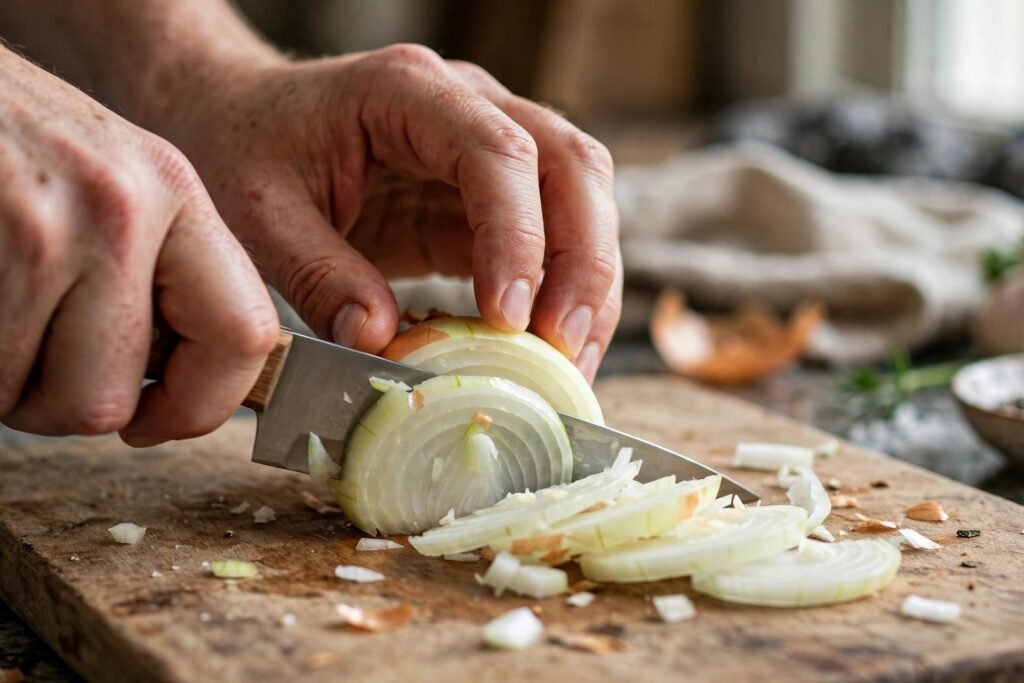
It is one of cooking’s great indignities: thirty seconds into dicing an onion, your eyes are streaming, your vision blurs, and you are chopping blind through the most basic task in the kitchen. Everyone knows it happens. Almost no one knows why — and the real answer is a miniature chemical warfare system that the onion evolved over millions of years, hijacked by your kitchen knife. The chemistry is genuinely fascinating, the evolutionary logic is elegant, and the prevention methods that actually work follow directly from understanding both.
The Chemical Weapon: Syn-Propanethial-S-Oxide
An intact onion is harmless. The tear gas factory only starts when you cut it, because the onion keeps its chemical precursors in separate cellular compartments — a defense strategy called compartmentalization. Onion cells store sulfur-rich compounds called 1-propenyl cysteine sulfoxides in one compartment and enzymes called alliinases in another. Your knife breaks the walls between them, the enzymes meet their substrates, and a cascade begins.
The enzymes convert the sulfoxides into sulfenic acids, and then a second enzyme — lachrymatory factor synthase, which exists in onions but not in garlic — converts those into syn-propanethial-S-oxide, the actual lachrymatory factor. This volatile gas rises from the cut surface, dissolves in the tear film covering your eyes, and forms a mild sulfuric acid solution on contact. Your corneal nerves detect the acid as a chemical attack (which, technically, it is) and trigger the lacrimal glands to flood the eye — tears are your body’s attempt to dilute and wash away the irritant. The American Chemical Society has published detailed breakdowns of this pathway, which was only fully mapped in the early 2000s — remarkably recent for something humans have experienced for millennia.
Why Onions Evolved Tear Gas
Onions did not evolve this system to annoy cooks. Wild alliums developed the sulfur chemistry as a defense against the organisms that actually threatened them: soil microbes, fungi, and grazing animals. The same sulfur compounds that make you cry are antimicrobial and anti-herbivore — they deter feeding and suppress pathogens. When an animal bites into the bulb, the enzymatic reaction produces the irritants in real time, right in the attacker’s mouth and eyes.
This is why the defense is damage-activated rather than always-on: maintaining the separate compartments costs the plant energy, but it means the weapon only deploys when needed. Garlic uses a related but distinct system (producing allicin instead of the lachrymatory factor — which is why garlic stinks powerfully but does not make you cry the same way). The evolutionary arms race also explains variation: sweet onions (Vidalias, Walla Wallas) grown in low-sulfur soils produce less of the precursors and make you cry less, while pungent yellow storage onions are chemical warfare heavyweights. Your dinner ingredients carry the legacy of ancient plant defense — a useful perspective when you are choosing foods that are good for gut health, since many of these same sulfur compounds have documented health effects.
Why Some People Cry More Than Others
Individual variation in onion tears is real and has multiple sources. Contact lens wearers famously cry less — the lens acts as a partial barrier reducing gas contact with the cornea. People with dry-eye conditions may paradoxically tear less effectively at washing away the irritant. Age matters: tear production declines with age, altering the response. And then there is simple exposure geometry — how close your face is to the cutting board, the room’s ventilation, and whether you are cutting with the root end (where sulfur compounds concentrate) facing you or away.
The onion’s side of the equation varies too: as noted, sulfur content differs by variety and growing conditions, and a freshly harvested onion differs from one stored for months (enzymatic activity changes during storage). So the difference between a tear-free dice and a weeping session is a genuine interaction of plant chemistry, human physiology, and technique — not just toughness.
What Actually Works (Ranked by Evidence)
The internet offers dozens of remedies — bread in the mouth, spoons on the tongue, whistling while you chop. Most are folklore. Here is what the chemistry says actually helps:
Chill the onion first
Refrigerating the onion for 30 minutes before cutting slows the enzymatic reaction significantly — colder enzymes work slower, producing less lachrymatory factor. This is the single most effective easy intervention, and it does not affect flavor.
Use a sharp knife
A sharp knife slices cleanly through fewer cells; a dull knife crushes a wide swath, rupturing far more compartments and releasing far more gas. Knife sharpness is the most underrated variable — and a sharp knife is safer generally, since it does not slip.
Cut under ventilation or near moving air
A fan blowing across the cutting board, or cutting near the range hood with the fan on, disperses the gas before it reaches your eyes. Simple fluid dynamics beats folk remedies.
Leave the root intact until last
The root end concentrates the sulfur precursors. Cutting it last (or cutting around it) minimizes exposure during most of the work.
Cut under running water (with caveats)
Water dissolves the gas before it becomes airborne — effective but awkward, slippery, and wasteful. Better: a damp cutting board area. The principle is sound; the execution is annoying.
What does not work: holding bread in your mouth (no mechanism), metal spoons (no mechanism), or “just getting used to it” (you do not develop meaningful tolerance). Trust chemistry over tradition. And for the broader kitchen, the same evidence-first approach that guides the healthiest cooking oil to use daily applies to every cooking claim — mechanism first, anecdote last.
The Frontier: Tearless Onions
Researchers have developed genuinely tearless onions by silencing the lachrymatory factor synthase gene — the enzyme unique to the tear-gas pathway. These onions retain their flavor compounds (which come from the earlier steps in the cascade) while producing no syn-propanethial-S-oxide. They exist, they work, and they illustrate something beautiful: once you understand a biochemical pathway completely, you can edit precisely the step you want to change. The National Institutes of Health funds plant biochemistry research that continues to unravel these pathways — the onion’s tear gas was mapped by science within living memory, a reminder of how much everyday chemistry remains to be fully understood.
The Bottom Line
Onions make you cry because cutting ruptures cellular compartments, mixing enzymes with sulfur precursors to produce syn-propanethial-S-oxide — a volatile gas that becomes mild sulfuric acid on your eyes, triggering defensive tears. It is evolved chemical warfare, modulated by onion variety, your physiology, and your technique. Chill the onion, sharpen the knife, ventilate the area, and save the root for last — and you will chop in relative comfort, armed with the actual chemistry instead of kitchen folklore.
Frequently Asked Questions
Why do onions make you cry but garlic doesn’t (as much)?
Onions uniquely possess lachrymatory factor synthase, the enzyme producing the tear-inducing gas syn-propanethial-S-oxide. Garlic uses a related pathway producing allicin instead — powerfully pungent but not a lachrymator.
Does chilling an onion really reduce tears?
Yes — refrigeration slows the enzymatic reaction that produces the lachrymatory factor. Thirty minutes in the fridge is the most effective easy intervention and doesn’t affect flavor.
Why do sweet onions make you cry less?
Sweet onions grown in low-sulfur soils contain fewer sulfur precursors, so the enzymatic cascade produces less tear gas. Pungent storage onions are the worst offenders.
Can you become immune to onion tears?
Not meaningfully — there’s no significant tolerance effect. Contact lens wearers cry less due to the physical barrier, but that’s mechanics, not immunity.
Are tearless onions real?
Yes — researchers have created onions with the lachrymatory factor synthase gene silenced. They produce no tear gas while retaining flavor compounds, demonstrating precise biochemical editing.