
What Is the Placebo Effect and Why Does It Work
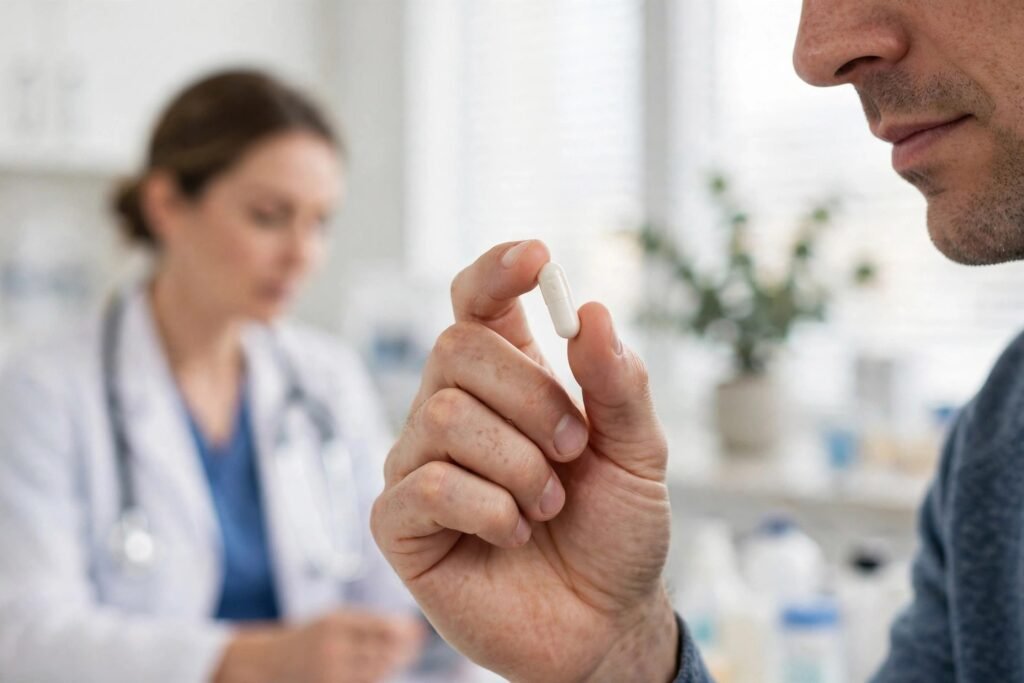
A patient with chronic pain takes a sugar pill, believing it is a powerful new drug — and the pain genuinely diminishes. Brain scans show real changes: altered activity in pain-processing regions, measurable dopamine release, reduced inflammation markers. This is not imagination or gullibility. The placebo effect is one of the most well-documented and least understood phenomena in medicine — real physiological change triggered by belief, expectation, and the ritual of treatment. Understanding why it works reshapes how you think about healing itself.
What the Placebo Effect Actually Is
The placebo effect is the measurable improvement in a patient’s condition attributable to the context of treatment rather than its specific pharmacological action. The “placebo” — typically an inert pill, saline injection, or sham procedure — does nothing chemically. But the patient’s brain, responding to expectation, conditioning, and the therapeutic encounter, does a great deal.
The critical distinction researchers make: the placebo effect (the genuine psychobiological phenomenon) versus the placebo response (everything that improves in a placebo group, including natural healing, regression to the mean, and reporting biases). The effect itself — the part caused by expectation and conditioning — is real, measurable, and biologically mediated. It is strongest for symptoms processed heavily by the brain: pain, nausea, fatigue, depression, anxiety, Parkinson’s motor symptoms, and irritable bowel symptoms. It does not shrink tumors or heal fractures — its domain is the brain-mediated experience of illness, which turns out to be a vast domain. The NIH’s National Center for Complementary and Integrative Health maintains an excellent research overview of what placebo science has established.
The Mechanisms: How Belief Becomes Biology
Placebo researchers have identified several converging mechanisms, each with solid evidence:
Expectation and predictive processing
Your brain is fundamentally a prediction machine — it constructs your experience of symptoms partly from what it expects to feel. When you expect relief, top-down neural pathways modulate pain signaling before it reaches conscious awareness. Brain imaging shows placebo analgesia activating the prefrontal cortex, anterior cingulate, and periaqueductal gray — the brain’s own pain-modulation circuitry — and triggering endogenous opioid release. Naloxone (which blocks opioid receptors) can abolish placebo pain relief, proving the effect runs on the brain’s own pharmacy. Your expectation literally manufactures neurochemistry.
Classical conditioning
Pavlovian learning applies to drug effects: after repeated pairings of a treatment ritual with real pharmacological relief, the ritual alone can trigger a conditioned physiological response. This is why placebo effects strengthen with treatment history — your body has learned the association. Remarkably, conditioning can produce drug-specific placebo effects: patients conditioned with immunosuppressive drugs show immunosuppression to placebo, because the body learned that particular response.
The therapeutic encounter
The doctor’s warmth, the thoroughness of the examination, the confidence of the explanation — these are not bedside-manner niceties but active ingredients. Studies varying only the clinician’s behavior (warm and attentive versus neutral and rushed) while giving identical placebos find significantly different outcomes. The ritual of medicine — the white coat, the prescription pad, the procedure — carries meaning that the brain translates into physiology. This is also why placebo effects vary across cultures: the meaning of treatment differs, so the brain’s response differs.
Why It Works Better for Some Conditions (and People)
Placebo responsiveness is not a personality trait — there is no “placebo personality.” But several factors modulate the effect’s strength: the invasiveness of the ritual (sham surgeries produce larger placebo effects than pills — the brain scales its response to the treatment’s apparent seriousness); the price and branding (expensive placebos outperform cheap ones; branded outperform generic — expectation tracks perceived value); the number of pills (two placebos beat one); and the condition’s brain-mediation (pain, mood, and motor symptoms respond strongly; infections and cancers minimally).
Genetics plays a role too — variants in dopamine and opioid pathway genes predict placebo responsiveness, suggesting the effect’s magnitude is partly hardwired. And perhaps most intriguingly, open-label placebos (where patients know they are taking a placebo) still produce significant effects for conditions like IBS, chronic back pain, and migraines. Belief in the pill is not even strictly required — belief in the possibility, plus the ritual, suffices. This finding, replicated in multiple trials, is reshaping clinical practice: some physicians now discuss placebo mechanisms openly with patients as a legitimate therapeutic tool.
The Nocebo Effect: The Dark Mirror
Expectation cuts both ways. The nocebo effect — harm from negative expectation — is the placebo’s evil twin: patients warned extensively about side effects experience them at higher rates; the mere suggestion of pain amplifies pain through the same pathways placebo dampens it (involving cholecystokinin rather than opioids). This creates genuine clinical dilemmas around informed consent — how to disclose risks without manufacturing them.
The nocebo effect also illuminates everyday health experiences: the headache that arrives after reading about a supplement’s side effects, the fatigue attributed to a new medication that is pharmacologically inert at that dose. Understanding nocebo is arguably more practically useful than understanding placebo, because negative expectations are easier to accidentally create than positive ones. Managing your information diet around health — being informed without catastrophizing — is a real skill, related to the broader challenge of understanding what causes brain fog and other symptom experiences where perception and physiology intertwine.
What Placebo Science Means for Medicine
The research frontier is translating placebo mechanisms into practice without deception. Ethical approaches being studied: maximizing the therapeutic encounter (training clinicians in expectation-optimizing communication); open-label placebo prescriptions for suitable conditions; conditioning-based dose reduction (pairing real drugs with placebos to maintain effects at lower doses — showing promise in ADHD, psoriasis, and immune conditions); and designing clinical environments that amplify positive expectation.
The deeper implication is philosophical: the placebo effect proves that healing is not purely a chemical transaction between drug and body. Meaning, expectation, ritual, and relationship are physiological forces. This does not validate every alternative therapy (many fail to outperform placebo, which is precisely the point of the comparison) — but it demands that medicine take the context of healing as seriously as its chemistry. The Harvard Health Publishing placebo resources offer an accessible entry point into this research for non-specialists.
The Bottom Line
The placebo effect works through expectation-driven neurochemistry (your brain manufacturing its own opioids and dopamine), Pavlovian conditioning of physiological responses, and the meaning-laden ritual of treatment — producing real, measurable biological change, strongest for brain-mediated symptoms. It is not imaginary, not gullibility, and not fully understood — but it is undeniably real, and medicine is finally learning to harness it honestly. The most powerful pharmacy may be the one between your ears, and learning to work with it — including recognizing whether what you feel is anxiety or something else — is becoming part of good healthcare.
Frequently Asked Questions
Is the placebo effect just the power of positive thinking?
No — it’s a measurable neurobiological phenomenon involving endogenous opioids, dopamine, and conditioned physiological responses. Brain imaging shows real changes in pain and motor circuits, and opioid blockers can abolish placebo pain relief.
Can placebos work if you know it’s a placebo?
Surprisingly, yes — open-label placebos (where patients know they’re taking an inert pill) show significant effects for IBS, chronic pain, and migraines in clinical trials. The ritual and the possibility of benefit seem sufficient.
What is the nocebo effect?
The placebo’s dark mirror: negative expectations causing real adverse effects. Patients warned about side effects experience them more often, through the same expectation pathways running in reverse.
Why don’t placebos cure everything?
Placebo effects are strongest for brain-mediated symptoms (pain, nausea, fatigue, mood, motor symptoms). They don’t shrink tumors, heal fractures, or fight infections — the effect operates through neural modulation, not magic.
Is it ethical for doctors to use placebos?
Deceptive placebo use is ethically fraught, but the field is moving toward honest approaches: open-label placebos, expectation-optimizing communication, and conditioning-based protocols that don’t require deception.