Learn to Swim as an Adult Beginner: Full Guide
You’re 35, or 45, or 60. You never learned to swim — maybe there was no pool nearby growing up, maybe lessons weren’t in the family budget, maybe water just scared you. Now you want to learn, and you feel ridiculous about it: adult swim classes sound like something for other people. Here’s the liberating truth: roughly a third of American adults can’t swim well enough to save themselves, and swim schools across the country run thriving adult beginner programs full of people exactly like you. You’re not behind. You’re the target demographic.
Learning to swim as an adult is genuinely different from learning as a child — you have more fear, more body awareness, and much better ability to follow technical instruction. This guide covers the real adult learning path: overcoming water anxiety, the skill progression that works, where to take lessons in America, and how long it actually takes.
Step 1: make peace with the water (weeks 1–2)
Most adult non-swimmers aren’t missing technique — they’re fighting the mammalian dive reflex and a lifetime of water anxiety. The first job is comfort, not strokes. In your first sessions, practice: standing in chest-deep water and controlling your breathing; putting your face in and exhaling underwater (the single most important beginner skill — panic comes from holding breath, not from water); floating on your back with support, then without; and the “dead man’s float” progression of tucking and letting the water hold you.
The key insight: human bodies float. Not effortlessly for everyone — muscle is denser than fat, so leaner adults float lower — but everyone can learn relaxed floating with proper breathing. A full exhale before floating, lungs as ballast: breathing out sinks you slightly, breathing in lifts you. Understanding this physics removes the mystery and much of the fear.
Step 2: the skill progression that works for adults
Forget the childhood “doggy paddle then freestyle” chaos. The adult-optimized progression:
- Breath control and rhythmic breathing (weeks 1–2): face in, exhale, turn to breathe — first standing, then with kickboard support. Everything else depends on this.
- Front float and glide (weeks 2–3): push off the wall, streamline, glide. Teaches body position — the foundation of all swimming.
- Flutter kick (weeks 3–4): small, fast kicks from the hip (not the knee) with a kickboard, then without. Most adults kick from the knees like pedaling a bike — the fix is thinking “long legs, tiny kicks.”
- Freestyle arms with breathing (weeks 4–8): add arm strokes one at a time, then bilateral breathing every three strokes. This is the long phase — coordination takes repetition.
- Backstroke (weeks 6–10): easier breathing (face stays up), excellent for building water confidence and balanced fitness.
- Breaststroke and treading water (weeks 8–12): the survival strokes — the ones that actually save lives in open water.
Expect the whole progression to take 3–6 months of weekly lessons plus practice. That’s normal and fine — you’re building a lifetime skill, not cramming for a test. Staying consistent with any new physical skill follows the same principles as staying motivated to exercise regularly: scheduled sessions, visible progress tracking, and self-compassion on bad weeks.
Where to learn: adult lessons in America
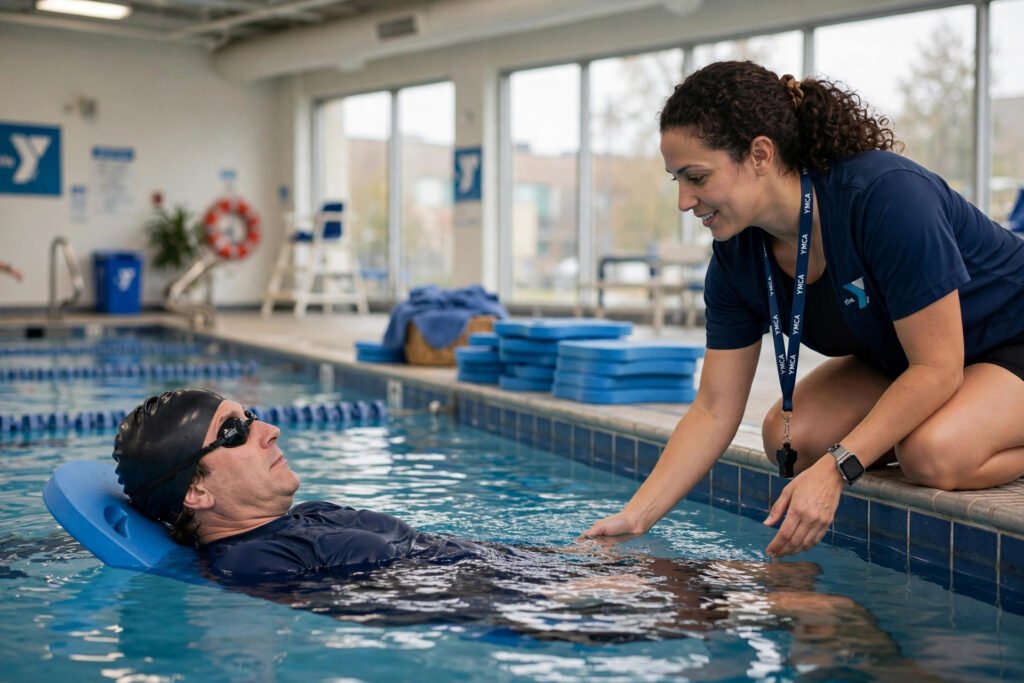
YMCA: the backbone of American adult swim instruction — affordable ($80–$150 for multi-week sessions), widespread, and genuinely good at adult beginners. Most Ys run dedicated adult beginner classes separate from kids’ lessons.
City/community pools: municipal recreation departments in most US cities offer adult lessons at the lowest prices ($40–$100 per session block). Quality varies — ask whether the instructor has adult-beginner experience specifically.
Private swim schools: franchises like British Swim School, Aqua-Tots (adult programs), and local independents offer semi-private or private lessons ($40–$80 per private session). Faster progress, higher cost — worth it if group settings spike your anxiety.
Masters swimming (later): once you can swim 100 yards continuously, US Masters Swimming clubs welcome adult improvers with coached workouts. It’s the graduate school of adult swimming — and wonderfully social.
What to look for in an instructor: experience with adult beginners specifically (teaching scared 40-year-olds is a different skill from teaching fearless 6-year-olds), patience with slow progress, and a comfort-first philosophy. Red flags: instructors who push you into deep water before you’re ready, or who skip breath-control fundamentals.
Gear and logistics
You need: well-fitting goggles (try them on — press to your face without the strap; suction should hold briefly), a comfortable swimsuit (athletic styles, not fashion swimwear), and a swim cap if you have long hair. That’s it. Kickboards, pull buoys, and fins are provided by every lesson program. Practical notes: shower before entering (pool chemistry), arrive 10 minutes early to acclimate, and eat lightly 60–90 minutes before — swimming on a very full stomach is miserable. Walking to the pool counts as a warm-up too — the benefits of walking 30 minutes a day apply nicely to the stroll to the Y.
Safety: the non-negotiable part
Learn the survival skills early, not last: treading water for 60 seconds, floating on your back to rest, and the “swim-float-swim” sequence (swim a bit, roll to back-float and breathe, swim again) that the American Red Cross teaches as the core drowning-prevention skill. Never practice alone as a beginner — always swim where lifeguards are present. And respect open water: pools are controlled; lakes and oceans add currents, cold, and poor visibility. Pool competence first, open water later with experienced companions.
Conclusion
Learning to swim as an adult beginner in America is a 3–6 month project with a clear path: water comfort and breath control first, then glides, kick, freestyle, backstroke, and survival strokes — best learned through YMCA or community-pool adult classes with an instructor experienced in adult beginners. A third of American adults are in your position; the ones who learn are simply the ones who sign up. Your first lesson is the hardest part, and it’s just showing up. For authoritative guidance, see the YMCA swim lessons and the American Red Cross water safety.
Frequently Asked Questions
How long does it take an adult to learn to swim?
Most adults reach basic freestyle competence (swimming 25–50 yards continuously) in 3–6 months of weekly lessons plus practice. Comfortable, confident swimming — multiple strokes, treading water, open-water readiness — typically takes 6–12 months.
Is it embarrassing to take swimming lessons as an adult?
Adult beginner classes are full of adults — roughly a third of American adults can’t swim proficiently, and swim schools run dedicated adult programs precisely because demand is high. Instructors who specialize in adult beginners see your situation daily.
What should I wear to adult swim lessons?
A comfortable athletic swimsuit, well-fitting goggles (test the suction in the store), and a swim cap for long hair. Lesson programs provide kickboards, buoys, and other training aids.
Can adults learn to swim if they’re afraid of water?
Yes — and most do. Good adult programs start with comfort and breath control, not strokes, specifically to address water anxiety. Progress is gradual and always at your pace; a patient instructor experienced with fearful adults makes all the difference.
Where can adults take swimming lessons in the US?
YMCAs (affordable, widespread, good adult programs), municipal community pools (cheapest), and private swim schools (fastest progress, highest cost). Look for dedicated adult beginner classes rather than mixed-age groups.