How to Socialize a Shy Rescue Dog: The Patient Protocol
You adopted her to give her a better life, and now she cowers behind the couch when anyone visits, flinches at sudden movements, and won’t take treats from strangers. Shy rescue dogs are among the most rewarding companions you’ll ever have — but the first months test every owner’s patience. Here’s the critical truth most adopters miss: socialization for a shy adult rescue is fundamentally different from puppy socialization. You can’t “catch up” a fearful adult by flooding her with experiences. The protocol is slower, quieter, and built on a single principle: the dog sets the pace, always.
First, Understand What You’re Working With
Shyness in rescue dogs usually traces to under-socialization (puppies that missed the critical 3–14 week exposure window), traumatic experiences, or genetics — fearfulness has a heritable component, and some dogs are simply wired more cautiously. None of these are the dog’s fault, and none are fixed quickly. What you’re building isn’t boldness — it’s confidence through predictability. A shy dog that learns the world is safe and predictable becomes a functional, happy dog; she may never become the life of the dog park, and that’s fine.
Set your timeline in months, not weeks. The commonly cited “3-3-3 rule” for rescues — 3 days to decompress, 3 weeks to learn routines, 3 months to feel at home — is optimistic for truly shy dogs. Six months to a year of steady progress is normal. Anyone promising faster results is selling something.
Phase 1: Decompression (Weeks 1–3)
The biggest mistake adopters make: doing too much, too soon. The well-meaning “welcome party” — visitors, dog park trips, pet store outings — overwhelms a shy dog and teaches her that her new home is as unpredictable as wherever she came from.
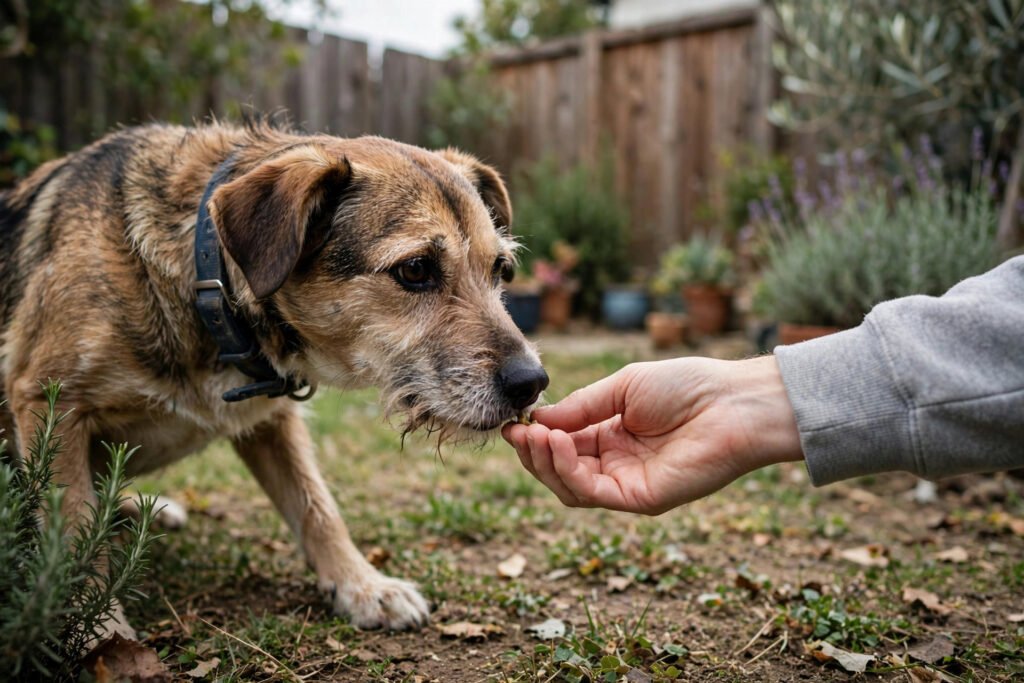
Instead: establish a small, predictable world. A quiet room or corner as her safe base with bed, water, and chews. A strict routine — same feeding times, same walk route, same calm rituals. Minimal visitors. No forced interaction: let her approach you, not the reverse. Sit on the floor reading, toss treats near (not at) her, and let curiosity do the work. Many shy dogs make their first approach within days when given space — and that first voluntary approach is worth more than a week of coaxing.
Exercise is decompression fuel: long, sniffy walks in quiet areas (sniffing is calming — let her sniff everything) do more for a shy dog’s mental state than any training exercise. A tired, sniff-satisfied dog is a braver dog.
Phase 2: Building Confidence Through Agency
Confidence comes from successful choices, not from being pushed. Structure the dog’s world so she succeeds constantly:
Choice-based interaction. Every interaction should be escapable. Pet her only when she solicits it; stop when she moves away. Let her choose walking routes. A dog that controls her own exposure learns the world is safe far faster than one that’s managed through it.
Training as confidence building. Teach simple, highly rewarded behaviors — touch (nose to hand), find it (treat scatters), basic cues. Training gives the dog a way to earn good things predictably, which is profoundly empowering for an animal whose life has been unpredictable. Keep sessions to 3–5 minutes, always ending in success.
Graduated exposure. Introduce new experiences one variable at a time: new person (calm, seated, ignoring the dog, treats tossed nearby — never reaching for her), then new person standing, then new environment at quiet times. Distance is your friend — every scary thing is less scary from 50 feet. Retreat is always allowed; a dog that learns she can leave learns she doesn’t need to panic.
Reading her signals accurately is essential — the same observational skill as recognizing anxiety versus ordinary stress helps you distinguish a dog that’s coping from one that’s shutting down. Lip licking, yawning, shake-offs, and displacement sniffing are stress signals, not disobedience.
Phase 3: Expanding the World (Months 2–6+)
As confidence builds, gradually widen her world: busier walking routes, calm visitors (briefed in advance: ignore the dog completely — no eye contact, no reaching, treats tossed on the floor), then structured social settings like a well-run training class designed for shy dogs (not a chaotic group class). Dog friendships come last and only with carefully chosen, calm, well-socialized dogs — one good dog friend teaches more than a hundred dog park encounters, and dog parks themselves are often the worst place for a shy dog.
What NOT to Do
Don’t flood. Forcing a shy dog into overwhelming situations “to get her used to it” creates sensitization — the fear gets worse, not better. The dog park on day three is how you get a dog that’s afraid of everything.
Don’t punish fear. Scolding a dog for cowering, barking fearfully, or hiding punishes the emotion and destroys trust. Fear isn’t misbehavior.
Don’t comfort frantically. Calm presence helps; panicked soothing (“oh no, it’s okay baby!”) signals danger. Be the calmest thing in the room.
Don’t compare. Your friend’s rescue was cuddling strangers in a week. Yours isn’t. Different histories, different temperaments, different timelines — comparison is the thief of patience.
When to Get Professional Help
Consult a certified professional (CPDT-KA trainer or veterinary behaviorist — the AVMA directory lists qualified behaviorists) if: the dog shows aggression rooted in fear (snapping, biting when cornered), panic is severe and not improving after a month of proper decompression, or the dog shuts down completely (won’t eat, won’t move). The ASPCA’s rescue-dog adjustment guide is a good companion resource while you wait for the appointment. These aren’t training failures — they’re cases where expert protocol design and sometimes anti-anxiety medication make the difference. Medication for fear isn’t sedation or giving up; it lowers the panic enough for learning to occur. And remember to care for yourself in the process — winding down after stressful days keeps you the patient, consistent presence a shy dog needs.
Conclusion
Socializing a shy rescue dog isn’t about manufacturing boldness — it’s about building trust through predictability, choice, and patience measured in months. Decompress first, then build confidence through small daily wins, expanding the world at the dog’s pace. The dog hiding behind your couch today can become the dog leaning against your leg while guests visit — not because you forced it, but because you proved, day after day, that her world is finally safe. There’s no more rewarding transformation in dog ownership.
Frequently Asked Questions
How long does it take a shy rescue dog to adjust?
The 3-3-3 guideline (3 days, 3 weeks, 3 months) is a minimum; truly shy dogs often need 6-12 months to fully settle. Progress is gradual but steady with the right approach.
Should I take my shy rescue to the dog park?
No — dog parks are overwhelming for shy dogs and frequently set progress back. Build confidence through quiet walks, training, and carefully chosen individual dog friendships instead.
How do I get my shy dog to trust me?
Predictable routines, letting her approach you, hand-feeding meals, calm coexistence without demands, and never forcing interaction. Trust builds through hundreds of small safe experiences.
Will my shy rescue dog ever be normal?
Most become happy, functional companions — though “normal” may mean calm and bonded rather than social-butterfly. Severe cases improve greatly with professional behavioral help and sometimes medication.
Should visitors ignore my shy dog?
Yes — brief visitors in advance: no eye contact, no reaching, no looming. Let the dog investigate on her terms, with treats tossed nearby (not handed) to build positive associations.