
How Is AI Used in Everyday Life for Regular People
AI is no longer some futuristic concept from science fiction movies. It is the reason your phone recognizes your face, why Netflix somehow knows you will love that obscure documentary, and how your email filters out 99 percent of spam before you ever see it. If you have been wondering how is AI used in everyday life for regular people, the answer might surprise you: you probably interact with AI dozens of times a day without noticing.
Let us pull back the curtain on the AI that is already woven into your daily routine — and what is coming next.
How Is AI Used in Everyday Life for Regular People? Your Morning Routine
Your day starts with AI before you are even fully awake:
- Your alarm and sleep tracking — smart alarms analyze your sleep cycles to wake you during light sleep; apps like Sleep Cycle use machine learning on movement and sound data
- Face recognition — your phone’s facial recognition is a neural network trained to recognize you in different lighting, with glasses, half-asleep
- Weather and traffic — your phone’s morning briefing uses AI models to predict your commute time based on real-time traffic patterns
- News feeds — the articles surfaced in Google News or Apple News are ranked by AI based on your reading history
AI at Work and in Your Pocket
- Email: spam filters, smart replies, and priority inboxes all run on machine learning; Gmail’s Smart Compose has saved users billions of keystrokes
- Voice assistants: Siri, Alexa, and Google Assistant use natural language processing to understand your requests — and they are getting noticeably better every year
- Maps and navigation: Google Maps predicts arrival times and reroutes around traffic using AI trained on billions of trips
- Photo organization: your phone automatically groups photos by person, place, and even pet — that is computer vision at work
- Banking: fraud detection algorithms scan every transaction in real time; your bank’s app probably flagged a suspicious charge before you noticed it
AI in Shopping and Entertainment
Every major retailer and streaming service runs on recommendation AI. Amazon’s “customers also bought,” Spotify’s Discover Weekly, TikTok’s For You page — these are some of the most sophisticated AI systems in the world, and their entire job is predicting what you will like next. If you are curious about the mechanics, my article on how AI powers online shopping recommendations goes deeper.
Even customer service is increasingly AI-driven — chatbots handle the routine questions while humans take the complex ones. Whether that is good or bad depends on the implementation, which is why the question of whether AI will replace customer service jobs is so hotly debated.
AI in Health and Home
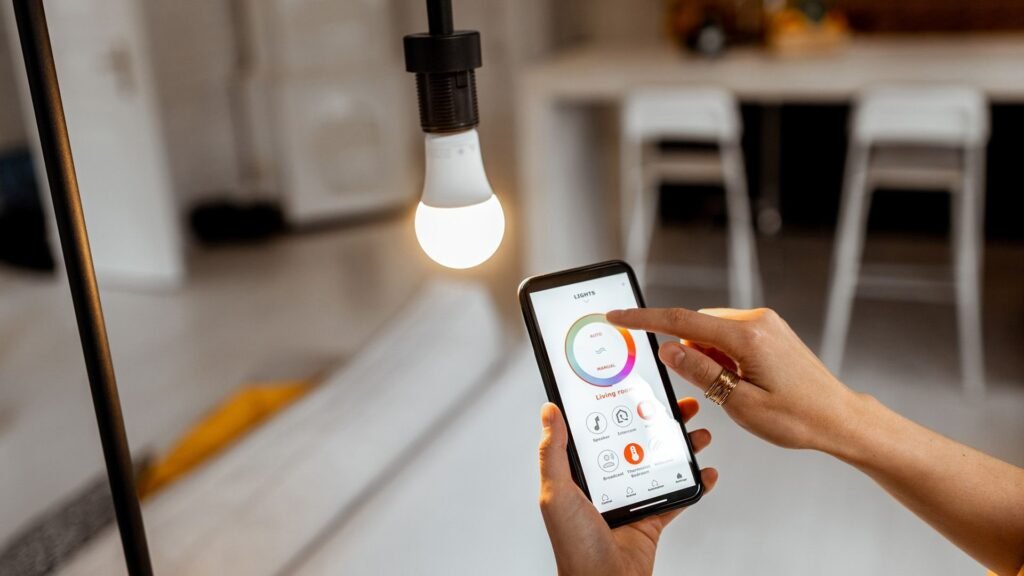
- Smart thermostats like Nest learn your schedule and preferences, cutting energy bills by 10 to 15 percent
- Health apps use AI to detect irregular heart rhythms from smartwatch data — Apple Watch’s AFib detection has literally saved lives
- Robot vacuums map your home and learn the most efficient cleaning paths
- Medical imaging: AI now assists radiologists in detecting cancers and fractures, often catching things human eyes miss — read more about how AI is being used in healthcare for patients
What Is Coming Next
The AI in your daily life is about to get more capable and more invisible. Real-time translation earbuds are already decent and improving fast. AI writing assistants are moving from novelty to standard productivity tools — if you have not tried one, my guide to the best free AI writing assistants for beginners is a good starting point. And AI features built into phones — photo editing, call screening, live transcription — keep expanding with every OS update.
The Pew Research Center regularly surveys Americans on AI awareness and attitudes — fascinating reading if you want to see how the public conversation is evolving.
AI You Will Meet in the Next Two Years
The AI in your daily life is about to get more capable and more invisible. Here is what is arriving:
- AI agents that do tasks, not just answer questions: instead of telling you how to book a flight, near-future AI will book it — comparing options, handling the checkout, managing changes. The shift from advisor to actor is the biggest change coming to consumer AI.
- Ambient computing: AI woven into environments rather than apps — your home anticipating needs, your car handling routine driving tasks, your workplace tools coordinating silently. Less tapping, more happening.
- Real-time translation everywhere: earbuds and phones approaching seamless cross-language conversation. The language barrier — one of humanity’s oldest frictions — is quietly dissolving.
- Personal AI memory: assistants that remember your preferences, history, and context across conversations and devices — genuinely useful and genuinely privacy-sensitive in equal measure.
- AI-generated media as default: personalized content — bedtime stories starring your kids, workout music matched to your pace, news briefings in your preferred style. The line between “content” and “content made for you” blurs.
- Health monitoring that predicts: wearables moving from tracking to forecasting — warning of illness before symptoms, detecting patterns your doctor would miss between annual visits.
The through-line: AI disappears into the background while becoming more powerful. The most transformative technologies are the ones you stop noticing — electricity, the internet, and soon, AI. The people who benefit most will be those who understand what is operating behind the curtain, which is exactly why learning this landscape now pays dividends later.
Key Takeaways
AI is already woven into daily life — usually invisibly. The people who benefit most are those who understand what is operating behind the curtain, use it deliberately, and stay alert to its limits.
- Your phone, inbox, maps, bank, thermostat, and streaming feeds all run on AI you rarely notice — dozens of interactions daily.
- The biggest near-term shifts: AI agents that complete tasks (not just answer), ambient computing, and real-time translation.
- Recommendation systems optimize for the platform’s goals as much as yours — enjoy the convenience, keep your judgment.
- The essential habit: use AI for drafting, exploring, and organizing — and verify anything important independently.
The Bottom Line
AI is not coming to everyday life — it is already here, quietly handling the spam, the traffic, the recommendations, and the fraud detection. Understanding where it operates helps you use it better and stay alert to its limits. The future is not robots taking over; it is AI fading into the background of everything you already do.







1 thought on “How Is AI Used in Everyday Life for Regular People”