Quantum Computing in Simple Terms for Beginners
Quantum computing gets described in two ways, both unhelpful: either as incomprehensible physics requiring a PhD, or as magic that will “solve everything.” The reality is more interesting than either. Quantum computers are real machines, built by real companies, doing real (if limited) computations today — and understanding the basic idea doesn’t require math beyond curiosity. Here’s the beginner’s guide that skips both the hype and the equations.
You’ll learn what makes quantum computers different from regular ones, what “qubits” and “superposition” actually mean in plain language, what quantum computers can and can’t do, where the technology stands in 2026, and why it matters to non-physicists.
Regular Computers vs. Quantum Computers: The Core Idea
Your laptop, phone, and every computer ever sold to consumers works with bits — tiny switches that are either 0 or 1, off or on. Everything digital, from photos to AI models, is ultimately long strings of these binary choices processed blindingly fast.
Quantum computers use qubits instead. Thanks to quantum mechanics — the physics of the very small — a qubit can exist in a blend of 0 and 1 simultaneously, a property called superposition. And qubits can be linked together through entanglement, so that the state of one instantly relates to the state of another, no matter the conceptual distance.
The practical consequence: while a regular computer with N bits can represent one of 2^N possible states at a time, N qubits can represent all 2^N states simultaneously. Add one qubit and you double the computational space — exponential scaling that regular computers can’t match. That’s the entire magic trick, and everything else follows from it.
An Analogy That Actually Works
Imagine you’re trying to find the lowest valley in a vast mountain range. A regular computer is a tireless hiker: it checks valleys one by one, very fast, but still sequentially. A quantum computer is more like flooding the entire range with water — the water explores all valleys simultaneously, and the lowest point reveals itself through the physics of the system.
Like all analogies, this one leaks if you push it. Quantum computers don’t literally try everything at once for every problem — the art of quantum algorithms is choreographing qubits so that wrong answers cancel out and right answers amplify. But the maze-exploring intuition captures why certain problems that are hopeless for regular computers become tractable: when the problem has a structure quantum mechanics can exploit, the speedup is dramatic.
What Quantum Computers Can Actually Do
Quantum computers aren’t faster at everything — they’re differently fast at specific things. The proven advantages cluster in a few domains:
Breaking (and making) encryption
The famous one: a sufficiently powerful quantum computer could break RSA and similar encryption that protects banking, messaging, and government secrets. This is why intelligence agencies and banks take quantum seriously — it’s a future threat to current security, on top of the present-day signs your phone may already be compromised. The flip side: quantum mechanics also enables theoretically unbreakable encryption (quantum key distribution). The U.S. National Institute of Standards and Technology has been standardizing “post-quantum” encryption algorithms, and the Department of Energy’s national labs are central to this transition.
Simulating molecules and materials
The most promising near-term application: simulating quantum systems themselves — molecules, chemical reactions, material properties. Designing better batteries, more efficient fertilizers, or new drugs by simulating molecules directly rather than through expensive physical trial and error. This is Feynman’s original 1980s vision for quantum computers, and it’s where the first practical advantages are emerging.
Optimization problems
Logistics, scheduling, financial modeling — problems with vast solution spaces where finding the best answer is computationally brutal. Quantum approaches show promise, though classical algorithms keep improving too, making this a race rather than a coronation.
What They Can’t Do (the Hype Correction)
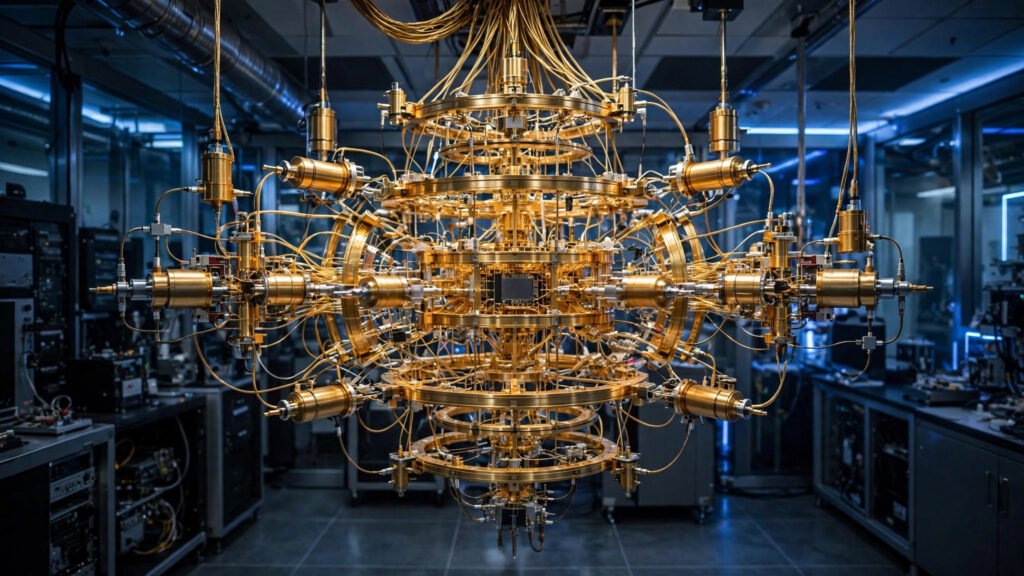
Quantum computers won’t replace your laptop — they’re worse at everyday computing and always will be. They won’t “solve AI” or magically accelerate all software. They won’t break Bitcoin tomorrow (or likely for many years — and the crypto world is preparing). Most importantly, building them is brutally hard: qubits are exquisitely fragile, disturbed by heat, vibration, and electromagnetic noise, requiring refrigeration near absolute zero and error-correction schemes that consume many physical qubits per reliable logical qubit.
In 2026, we’re in the NISQ era — Noisy Intermediate-Scale Quantum: machines with hundreds of qubits but significant error rates, useful for research and specific demonstrations but not yet for transformative commercial applications. Progress is real and accelerating, but the gap between “quantum computer exists” and “quantum computer changes your life” remains wide. Healthy skepticism toward tech hype serves you well here — the field rewards patient understanding over breathless headlines.
Why Non-Physicists Should Care
Three reasons. First, the encryption transition will touch everyone: your bank, your messages, and government systems are all migrating to quantum-resistant cryptography over the coming decade — the largest security upgrade in internet history, happening quietly — and a reminder of why sharing personal information carefully matters even before quantum threats arrive. Second, quantum-driven discoveries in materials and medicine could reshape industries from energy to pharmaceuticals within your working lifetime. Third, and most practically: understanding the basics now means you can evaluate claims later — distinguishing real breakthroughs from startup fundraising theater is a genuinely valuable skill as quantum goes mainstream.
NASA, the Department of Energy, and American universities operate some of the world’s leading quantum research programs — NASA’s quantum research pages offer accessible overviews of where the science stands, free of commercial spin.
Conclusion
Quantum computing in simple terms: computers that use quantum physics to explore many possibilities simultaneously, making them extraordinarily powerful for specific problems (encryption, molecular simulation, optimization) and irrelevant for everything else. The technology is real, progressing, and still years from transforming daily life — which makes now the perfect time to understand it, before the hype cycle’s next peak. You don’t need the math to grasp the idea; you just needed someone to explain it without the magic words.
Frequently Asked Questions
Will quantum computers break all encryption?
Eventually they could threaten current public-key encryption (RSA, elliptic curve), but not imminently — it requires millions of stable qubits, far beyond today’s machines. Governments and industry are already migrating to quantum-resistant algorithms well ahead of the threat.
Can I buy a quantum computer?
No — and you wouldn’t want to. They require extreme cooling, specialized facilities, and solve only specific problem types. Access happens through cloud services offered by IBM, Google, Amazon, and others, aimed at researchers and enterprises.
How is quantum computing different from AI?
They’re unrelated technologies solving different problems. AI finds patterns in data using classical computers; quantum computing uses quantum physics to solve specific computational problems faster. They may eventually combine (quantum machine learning is a research field), but neither requires the other.
When will quantum computers be practically useful?
Estimates vary widely: narrow advantages in simulation and optimization are emerging now; broad transformative impact is likely a decade or more away. The honest answer is that timelines in this field have consistently been optimistic — expect progress, not miracles, on any specific date.
Do I need to learn quantum computing for my career?
Unless you’re in physics, cryptography, or advanced computing, no — but basic literacy helps you evaluate claims and opportunities. The encryption transition alone will create demand for professionals who understand what’s happening, even if they never touch a qubit.