Proper Squat Form to Avoid Knee Injury (Guide)
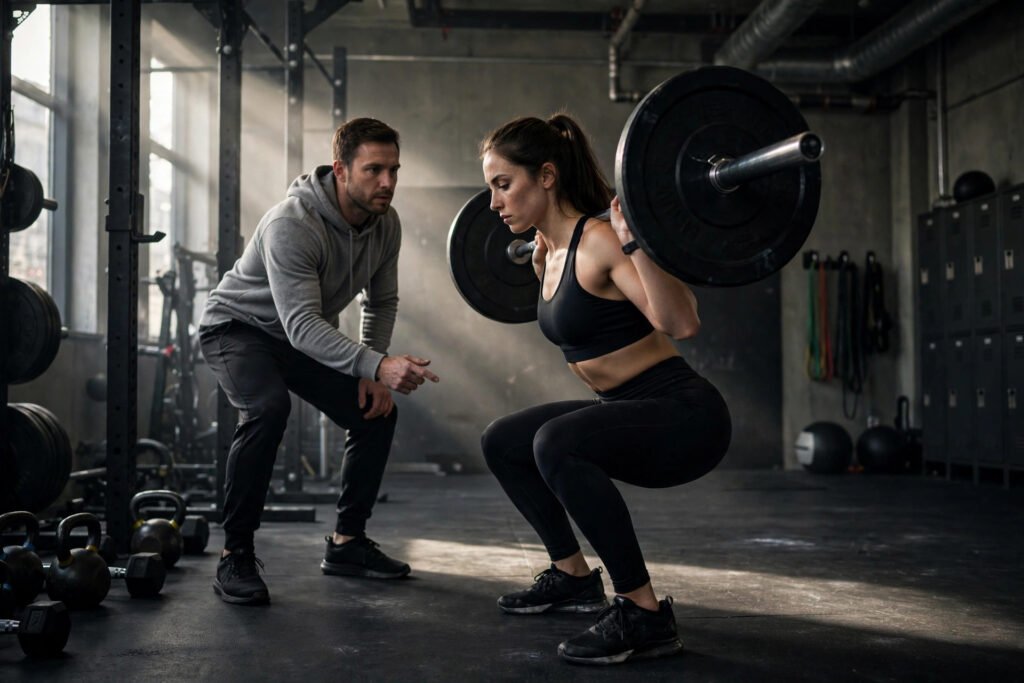
The squat is the king of lower-body exercises — and the movement most associated with knee pain in American gyms. “Squats are bad for your knees” is one of fitness’s most persistent myths, right alongside “deadlifts destroy backs.” The reality from biomechanics research: properly performed squats strengthen the structures that protect knees. Improperly performed squats — too much weight, collapsed knees, atrocious depth control — absolutely can hurt them.
This guide teaches proper squat form specifically through the lens of knee safety: the mechanics that protect the joint, the mistakes that endanger it, how to adapt the squat to your body, and when knee pain means “fix your form” versus “see a professional.”
What proper squat form looks like (the checklist)
- Stance: feet roughly shoulder-width apart, toes turned out 15–30 degrees. Your ideal stance width depends on hip anatomy — wider hips generally need wider stances. There’s no universal “correct” width, only the width that lets your knees track over your toes.
- Initiation: break at the hips and knees simultaneously — think “sit between your heels,” not “knees forward” or “butt back” exclusively. Both joints bend together in a natural squat.
- Knee tracking: knees travel in line with the toes — not caving inward (valgus collapse, the number one knee-danger pattern), not forced artificially outward. A useful cue: “spread the floor apart with your feet.”
- Torso: chest up, back flat or naturally arched, gaze forward or slightly down. Torso angle varies with proportions — long-femured lifters lean more, and that’s fine.
- Depth: descend until hip crease is at or below knee level (parallel or below) — if you can maintain form. Partial squats to a box are perfectly valid while building mobility.
- Ascent: drive through the whole foot (imagine pushing the floor away), keep knees tracking over toes, and squeeze glutes at the top without hyperextending the lower back.
The knee myths, corrected
“Knees must never pass toes.” The most damaging squat myth ever taught. Restricting forward knee travel forces excessive hip hinge and forward torso lean, which dramatically increases lower-back and hip stress — trading imaginary knee danger for real back danger. In a natural deep squat, knees passing toes is normal biomechanics; Olympic weightlifters’ knees travel far past their toes under enormous loads with some of the lowest knee-injury rates in sport. What matters isn’t knee position — it’s knee tracking (in line with toes) and progressive loading.
“Deep squats damage knees.” Research shows compressive forces on the knee actually decrease past 90 degrees in some analyses, and deep squats build strength through full range — which protects knees in real life. The caveat: depth should be earned through mobility, not forced. If your heels lift or your lower back rounds (“butt wink”) at depth, squat to the depth you own and build mobility separately.
“Squats are bad for arthritic knees.” Major guidelines recommend quadriceps strengthening — including squats in appropriate doses — for knee osteoarthritis. Strong quads offload the joint. The dose makes the medicine: shallow, pain-free ranges first, progressing as tolerated.
The five form mistakes that hurt knees
1. Knee valgus (caving inward). The big one — knees collapsing toward each other under load, common with weak glutes. It concentrates force on the inner knee structures and ACL. Fix: “knees out” cue, lighter weight, glute strengthening (clamshells, lateral band walks), and possibly a slightly wider stance.
2. Too much weight, too soon. Form degrades under excessive load, and degraded form under heavy load is where injuries happen. If your knees cave, your heels lift, or your back rounds, the weight is too heavy — regardless of what your program says.
3. Heels lifting off the floor. Usually ankle mobility, sometimes stance. Elevated heels shift load forward onto the knees excessively. Fix: ankle mobility work, weightlifting shoes with a raised heel, or a slightly wider stance.
4. Bouncing out of the bottom. Using the stretch reflex violently at depth spikes joint forces. Control the descent (2–3 seconds down), pause briefly, then drive up. The bounce isn’t strength — it’s borrowed momentum with interest.
5. Asymmetric shifting. Favoring one leg — common after old injuries — loads one knee disproportionately. Film yourself from the front; if you shift, address it with single-leg work (split squats, step-ups) before adding barbell load.
For lifters managing existing knee issues alongside training, our guide to the best exercises for people with bad knees covers the joint-friendly movements that build knee resilience.
Adapting the squat to your body
Long femurs / tall lifters: wider stance, more forward knee travel, possibly low-bar position — all normal adaptations, not form errors.
Limited ankle mobility: weightlifting shoes (0.75-inch heel) are the simplest fix; goblet squats with a counterbalance also work beautifully.
Knee pain history: start with box squats to a comfortable depth, tempo squats (slow eccentrics build tissue tolerance), and front-loaded goblet squats (more upright torso, friendlier to knees and backs). Progress depth and load only as symptoms allow.
Home lifters: goblet squats, Bulgarian split squats, and dumbbell front squats are outstanding knee-friendly options that need minimal equipment — see building muscle at home without a gym for programming them.
When knee pain means “see a professional”
Fix-your-form pain: dull ache during squats that resolves within hours, mild stiffness the next day that warms up, discomfort that improves as you warm up. See-a-professional pain: sharp or catching pain, swelling during or after sessions, pain that worsens across weeks despite form fixes and deloads, locking/giving way, or pain that limits daily activities like stairs. A sports physical therapist can assess your squat in one session and identify whether the issue is form, mobility, load management, or structural.
Conclusion
Proper squat form for knee safety comes down to: stance that lets knees track over toes, simultaneous hip-and-knee break, no valgus collapse, controlled depth you actually own, and loads your form can handle. Forget “knees behind toes” — track the real risk factors (caving knees, excessive load, bouncing, asymmetry) and the squat becomes what the research says it is: one of the best things you can do for your knees, not a threat to them. For authoritative guidance, see the NSCA squat technique resources and the Mayo Clinic.
Frequently Asked Questions
What is proper squat form to avoid knee injury?
Feet shoulder-width with toes out 15–30°, break at hips and knees together, keep knees tracking in line with toes (no caving inward), descend with control to parallel or your comfortable depth, and drive up through the whole foot.
Should your knees go past your toes when squatting?
Yes, it’s normal and safe — restricting forward knee travel increases back stress without protecting knees. What matters is that knees track in line with the toes, not their forward position.
Are deep squats bad for your knees?
No — research shows deep squats are safe when performed with good form and appropriate loads. Squat to the depth you can control without heel lift or back rounding, and build depth gradually with mobility work.
Why do my knees cave in when I squat?
Usually weak glutes (especially glute medius) and/or excessive weight. Fix with the “knees out” cue, lighter loads, and accessory work like clamshells and lateral band walks. A slightly wider stance often helps immediately.
Can I squat with knee arthritis?
Often yes — quad strengthening including squats is recommended for knee osteoarthritis. Start with shallow, pain-free ranges (box squats, mini-squats), keep pain at 3/10 or below during exercise, and progress depth and load as tolerated.