
How to Build Muscle at Home Without a Gym
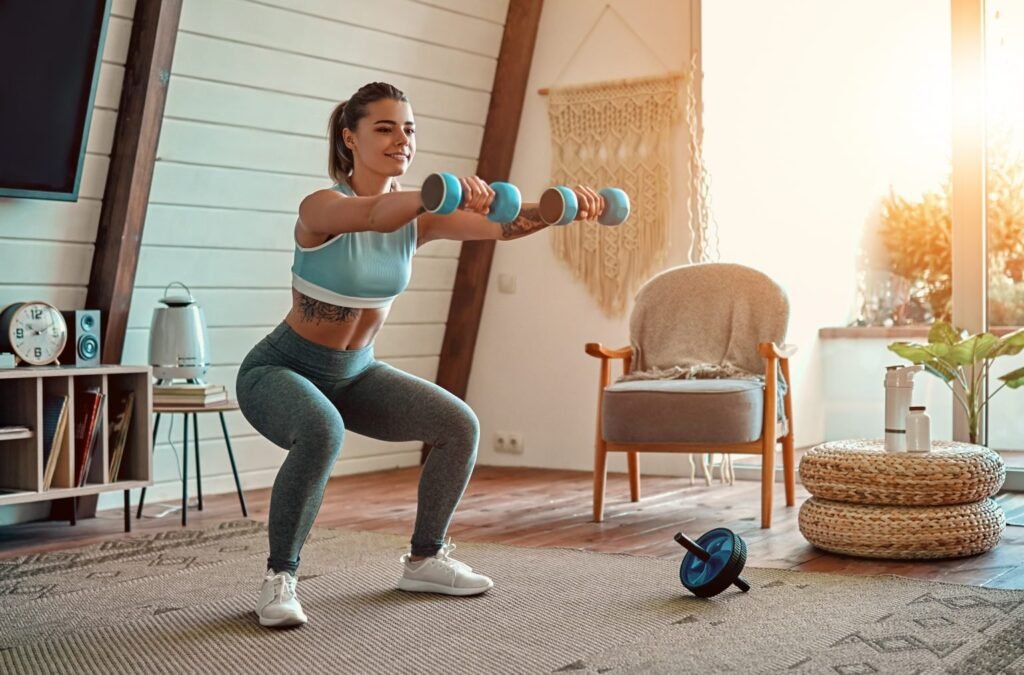
You don’t need a gym membership, a squat rack, or anyone grunting next to you to build real muscle. Your body is the original resistance machine, and with the right approach it can take you surprisingly far. If you’re asking how do I build muscle at home without a gym, maybe the gym is too expensive, too far, too intimidating, or just not your thing. All valid. I’ve trained at home for long stretches, and the results genuinely surprised me — here’s the complete playbook.
How to Build Muscle at Home Without a Gym
Muscle growth comes down to three requirements: progressive tension (challenging your muscles a bit more over time), adequate protein, and recovery. None of these require a gym. What most home trainers get wrong is doing the same easy routine forever — ten regular push-ups, three times a week, for a year, maintains but doesn’t build. The fix is progression: harder variations, more reps, slower tempos, shorter rests. Your muscles don’t know whether resistance comes from a barbell or your own bodyweight; they only know whether the challenge is increasing.
The Healthline guide to building muscle at home confirms what home-training communities have known for years: with progressive programming, bodyweight training produces legitimate hypertrophy, especially in the first couple of years.
Your Home Workout Blueprint
Train each major movement pattern 2–3 times per week. Here’s your exercise menu, easiest to hardest:
- Push (chest, shoulders, triceps): wall push-ups → incline push-ups (hands on couch) → standard push-ups → diamond push-ups → decline push-ups (feet raised) → archer push-ups → one-arm progressions. There’s a variation for every level.
- Pull (back, biceps): this is the tricky one at home. A doorway pull-up bar ($30, no screws needed for most) is the single best home-gym investment. No bar? Sturdy table rows (lie under a solid table, pull your chest up), towel rows around a closed door, or resistance band rows.
- Legs (quads, glutes, hamstrings): bodyweight squats → Bulgarian split squats (rear foot on couch — these are brutally effective) → walking lunges → single-leg box squats → Nordic curl negatives for hamstrings (kneel, lower slowly, use hands to push back up).
- Core: planks, dead bugs, hollow-body holds, and mountain climbers. Skip the hundred-crunch routines; anti-extension and stability work builds more useful strength.
- Shoulders: pike push-ups → raised pike push-ups, progressing toward handstand push-up variations against a wall.
A simple full-body session: pick one push, one pull, one legs, one core exercise, 3 sets each, resting 60–90 seconds. Forty-five minutes, three times a week. That’s the program. Everything else is optimization.
The $50 Home Gym (Optional but Powerful)
Bodyweight alone works, but a few cheap tools dramatically expand your options: a doorway pull-up bar, a set of resistance bands with handles, and one adjustable dumbbell or kettlebell. That’s genuinely enough equipment to train every muscle progressively for years. Buy used — home fitness gear floods secondhand markets every February. What you don’t need: the ab roller collection, the vibrating platforms, the elaborate cable systems gathering dust in infomercials.
Eat Like You Mean It
Training provides the stimulus; food provides the building material. Aim for roughly 0.7–1 gram of protein per pound of bodyweight daily — for a 170-pound person, that’s 120–170 grams. Spread it across 3–4 meals with 30–50 grams each: eggs, Greek yogurt, chicken, fish, beans, lentils, tofu, protein powder if needed. You don’t need to eat perfectly; you need to eat enough, consistently. People trying to build muscle while eating like a bird are the number-one reason home programs “don’t work.”
Meal timing is less critical than total intake, but having protein and carbs around your workout helps. What to eat before and after a workout covers the practical details. And don’t fear carbs — they’re your training fuel, and under-fueled workouts produce underwhelming muscle.
Recovery: Where Growth Actually Happens
Muscles don’t grow during workouts; they grow during recovery between them. Sleep 7–9 hours — growth hormone does its best work in deep sleep, and short sleep measurably blunts muscle-building. Don’t train the same muscles hard two days in a row; the full-body 3x/week schedule builds rest in automatically. Manage overall stress, since chronically high cortisol works against muscle growth. Soreness is normal when starting or progressing; sharp joint pain is not — learn the difference and respect it.
Track your progress visibly: a notebook or phone note with exercises, sets, and reps. When you can do 3 sets of 12 comfortably, move to the harder variation — that’s progressive overload in action. Photos every month show changes the mirror hides. And on the weeks motivation evaporates, these strategies for staying motivated will carry you through. Pair training days with a daily walk for active recovery and the habit stacks beautifully.
Common Home-Training Mistakes
Avoid these and you’ll outpace most gym-goers: mistake one — no progression. Doing the same routine for months maintains, never builds. Add reps, slow the tempo, shorten rests, or move to harder variations every 2–3 weeks. Mistake two — skipping legs. Legs are half your muscle mass; training only push-ups and abs builds a lopsided physique and leaves growth hormones’ biggest trigger untapped. Mistake three — junk volume. Thirty sloppy push-ups beat fifty sloppy ones; form quality determines whether the target muscle or your joints take the load. Mistake four — program hopping. Switching routines every two weeks means never adapting to anything. Pick the simple program above and run it for three months minimum. Mistake five — ignoring pain signals. Muscle burn is fine; joint pain is a stop sign. Train around injuries, not through them.
The Practical Takeaway
Start this week: three full-body sessions built on push-up, row, squat, and core variations, progressing to harder versions as you adapt. Eat enough protein, sleep like it’s your job, and track your numbers. Add a pull-up bar and resistance bands when you’re ready. In six months of consistent home training, you’ll be visibly, measurably more muscular — no membership required. The best gym is the one you’ll actually use, and yours is already paid for.






