Regenerative Braking Explained: What It Feels Like to Drive
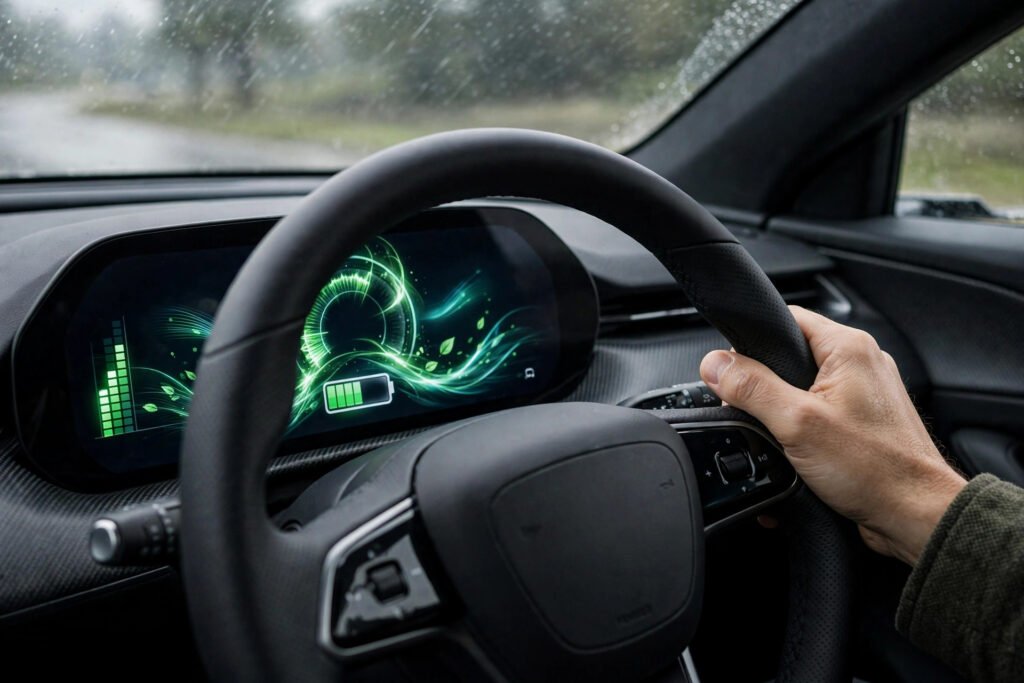
The first time you lift off the accelerator in an electric car, something strange happens: the car slows down firmly, as if an invisible hand is pressing the brake — and a little gauge shows energy flowing back into the battery. No, nothing’s wrong. That’s regenerative braking, the technology that turns your car’s momentum back into electricity instead of wasting it as heat. It’s standard on every EV and hybrid sold in America, it changes how driving feels, and understanding it makes you a better, more efficient driver. Here’s what regenerative braking is, the physics behind it, and what it actually feels like from the driver’s seat.
The Physics: Turning Motion Back Into Electricity
Every moving car carries kinetic energy — and conventional brakes throw it away. When you press the brake pedal in a gas car, friction pads clamp the rotors, converting all that motion into heat that dissipates into the air. It’s effective but wasteful: in city driving, where you’re constantly slowing down, a huge share of your fuel’s energy ends as brake heat. Regenerative braking flips the electric motor into reverse: instead of using electricity to create motion, it uses motion to create electricity, acting as a generator. The resistance of generating that electricity is what slows the car — and the captured energy flows back into the battery, extending your range.
The efficiency gains are substantial. In stop-and-go city driving, regenerative braking can recapture 60–70% of the energy that would otherwise be lost to braking, which is a major reason EVs achieve such strong city efficiency ratings (often better than their highway numbers — the reverse of gas cars). On the highway, where you rarely brake, regen contributes little — which is why EV highway range is the tougher number. The Department of Energy’s EV efficiency resources explain how regenerative systems contribute to the dramatic efficiency advantage electrics hold over combustion vehicles in urban driving.
What It Feels Like: One-Pedal Driving Explained
In most EVs, regenerative braking engages the moment you lift off the accelerator — no brake pedal needed. Lift slightly, and the car slows gently; lift fully, and it decelerates firmly, often bringing you to a complete stop. This is “one-pedal driving”: the accelerator becomes both pedals, with the brake pedal reserved for hard stops and holding position. The first 10 minutes feel alien — your foot keeps hovering over the brake out of decades of habit. By day three, most drivers prefer it: smoother stops, less foot movement in traffic, and a satisfying sense of control.
The sensation varies by manufacturer. Tesla’s system is aggressive — strong deceleration on full lift-off, bringing the car to a complete stop. Some brands (Porsche, Audi in certain modes) default to a “coasting” feel closer to a gas car, with regen blended in when you touch the brake pedal. Most EVs let you adjust regen strength across multiple levels, and finding your preference is part of the new-owner ritual. One universal truth: passengers notice. Aggressive lift-off in strong regen mode produces a distinctive deceleration surge that can unsettle passengers (and their stomachs) until you learn to modulate the pedal smoothly. Smooth regen driving is a skill — lift progressively rather than abruptly, and your passengers will never know the difference. Edmunds’ EV driving guides compare how different manufacturers tune their regenerative systems.
Regen and the Brake Pedal: How They Work Together
Here’s what confuses new EV drivers: the brake pedal still exists, and the relationship between the two systems is sophisticated. In most EVs, pressing the brake pedal initially commands more regenerative braking — the car blends regen and friction brakes seamlessly, prioritizing regen until you demand more deceleration than the motor can provide. You feel a normal, progressive brake pedal; the car handles the blending invisibly. Only during hard braking does the system rely primarily on the friction brakes, just like a conventional car.
This blending creates two practical consequences. First, your friction brakes last dramatically longer — many EV owners report brake pads lasting 100,000+ miles, since regen handles the vast majority of daily deceleration. That’s real maintenance savings. Second, in an emergency, the car behaves exactly like you’re used to: stomp the pedal and you get full friction braking plus ABS, no learning curve when it matters. The one caveat: when the battery is fully charged or very cold, regen is limited (there’s nowhere to put the energy, or the battery can’t accept it quickly) — the car will feel different, more coast-like, for the first miles. Experienced EV drivers anticipate this; new owners sometimes find it alarming. It’s normal physics, not a malfunction.
Driving Efficiently With Regen: Techniques That Add Range
Regenerative braking rewards a specific driving style. The golden rule: regen recaptures energy, but not using energy in the first place is always more efficient — regen recovers 60–70%, meaning 30–40% is still lost. So the most efficient driving minimizes braking altogether: anticipate traffic flow, coast down from speed early, and maintain steady momentum. Think of regen as your safety net for the braking you couldn’t avoid, not as free energy to spend recklessly.
In practice: use the highest comfortable regen setting in city driving (maximum recapture in stop-and-go), consider lower regen on highways (where coasting efficiency can beat aggressive regen cycling), and learn your car’s “neutral” pedal position — the exact point where you’re neither accelerating nor regenerating, essentially coasting. Hypermiling techniques transfer directly: gentle acceleration, steady speeds, and reading traffic three cars ahead. These habits can add 10–15% to real-world range — the difference between comfortable arrival and range anxiety on marginal trips. And if you’re weighing whether electrified driving fits your life, factor regen’s maintenance savings (brakes lasting 100,000+ miles, no oil changes) into the total-cost math — our guide to saving for a big purchase shows how to weigh operating savings against sticker price. For the bigger efficiency picture at home, the same capture-waste-nothing philosophy applies to energy-efficient upgrades for older homes — efficiency is a mindset, not just a drivetrain.
The Bottom Line
Regenerative braking turns your electric motor into a generator during deceleration, recapturing 60–70% of braking energy back into the battery instead of wasting it as heat. It feels like strong engine braking the moment you lift off the accelerator — strange for 10 minutes, natural by day three — and enables one-pedal driving that most EV owners end up preferring. It dramatically extends brake life, boosts city efficiency, and blends seamlessly with friction brakes when you need them. It’s not just a feature; it’s the reason electric driving feels like the future.
Frequently Asked Questions
Does regenerative braking fully replace brake pads?
No, but it dramatically extends their life — many EV owners get 100,000+ miles from brake pads since regen handles most daily deceleration. Friction brakes remain essential for hard stops, emergencies, and holding the car stationary.
Why does regenerative braking feel weaker when the battery is full?
A full battery has nowhere to store recaptured energy, so the system limits regen — the car coasts more freely until you’ve used some charge. Cold batteries similarly accept charge slowly. It’s normal physics, not a fault.
Is one-pedal driving safe?
Yes — the brake pedal always works normally for hard stops and emergencies, with full ABS. One-pedal driving only changes light-to-moderate deceleration. Most drivers adapt within days and report feeling more in control.
Do hybrids have regenerative braking too?
Yes — all hybrids (Toyota Prius, Honda Accord Hybrid, etc.) use regenerative braking, though typically less aggressively than pure EVs since their batteries and motors are smaller. The principle and the efficiency benefits are identical.