What Is a Seed Phrase and How Should You Store It Safely?
Your seed phrase is the master key to your cryptocurrency — twelve or twenty-four ordinary words that can restore your entire wallet on any device, anywhere in the world. It’s also the single most attacked piece of information in crypto. Get seed phrase storage right and your funds are safe even if your phone is stolen and your house burns down. Get it wrong and everything can vanish in minutes, with no recovery possible.
Despite its importance, most beginners treat their seed phrase casually: screenshotted on a phone, saved in a notes app, or scribbled on paper that’s already fading. This guide covers what a seed phrase actually is, why it works the way it does, and exactly how to store it so it survives both thieves and time.
What a seed phrase actually is
A seed phrase (also called a recovery phrase or mnemonic phrase) is a sequence of 12, 18, or 24 words generated by your wallet when you first set it up — words like “ocean,” “ladder,” “quantum.” These aren’t random decorations. They encode your wallet’s master private key using a standard called BIP-39, drawn from a fixed list of 2,048 words.
Here’s the critical thing to understand: whoever holds the seed phrase controls the funds. Period. It doesn’t matter who bought the crypto, whose name is on the exchange account, or who has the phone. The seed phrase is ownership. Anyone who sees it — a hacker, a houseguest, a “support agent” — can sweep your wallet clean from the other side of the planet, and the transaction can’t be reversed.
Why 12 or 24 words?
More words mean more possible combinations, which means more security against guessing. Twelve words gives 128 bits of security — already effectively unguessable. Twenty-four words gives 256 bits. Either is fine against brute force; the real threats are theft and loss, not guessing.
The cardinal rules (non-negotiable)
- Never store it digitally. No screenshots, no photos, no notes apps, no cloud storage, no email drafts, no password managers. Every digital copy is a copy that can be hacked, synced, or subpoenaed. Malware specifically hunts for seed phrases on devices.
- Never share it with anyone. No legitimate support agent, exchange, or wallet company will ever ask for your seed phrase. Anyone who asks is a scammer — always, without exception. Our guide on spotting text message scams covers the social engineering tactics used to steal phrases.
- Never type it into a website. Phishing sites mimic real wallets and ask you to “restore” or “verify” by entering your phrase. The moment you do, your funds are gone.
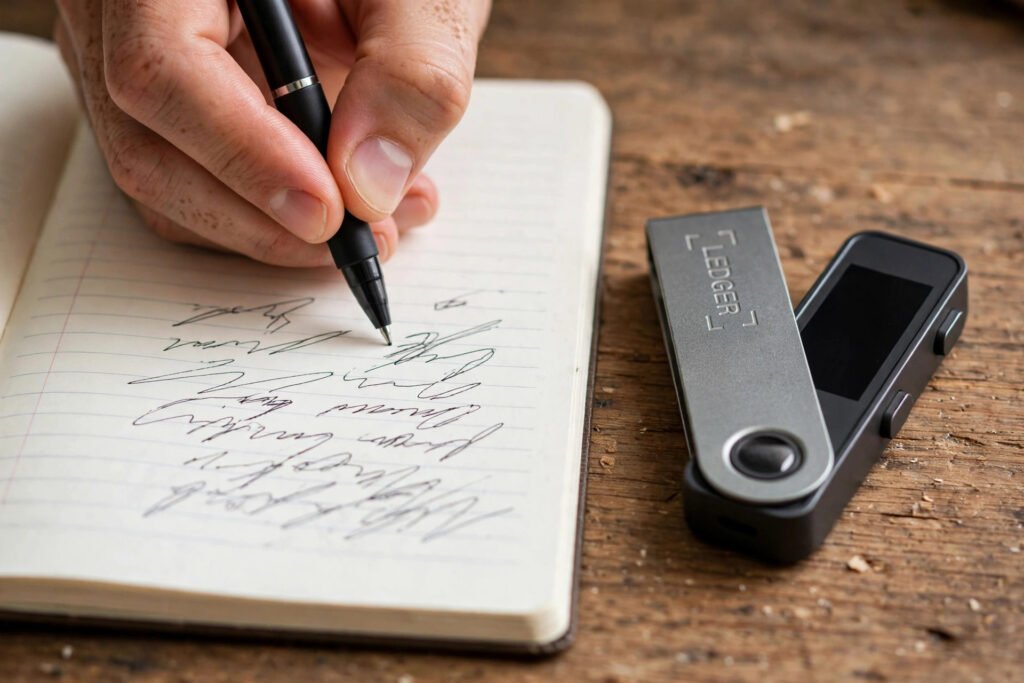
- Write it down by hand, on paper or metal, and verify it. When your wallet shows the phrase, write each word carefully, then verify by restoring in the wallet’s test flow before funding it.
How to store it safely: the tiered approach
Level 1: Paper in a safe place (minimum viable)
Write the phrase on paper with a ballpoint pen (it lasts longer than cheap ink), store it somewhere private and dry — a home safe, a locked drawer, a safe deposit box. Paper’s weakness: fire, flood, and fading. It’s better than digital, but it’s fragile.
Level 2: Metal backup (recommended for meaningful amounts)
Metal seed storage plates — small steel or titanium plates where you stamp or engrave the words — survive house fires and floods. They cost $50–$150 and are the standard recommendation for anyone holding more than pocket-change amounts of crypto. Keep the metal plate somewhere separate from your hardware wallet: never store the backup with the device it backs up.
Level 3: Geographic redundancy (serious holdings)
One copy in one location is a single point of failure — fire, theft, or natural disaster takes everything. The professional approach: two or three copies in different secure locations (home safe + safe deposit box + trusted family member’s safe). For very large holdings, consider splitting the phrase using Shamir’s Secret Sharing, where the phrase is divided into shares and any subset (e.g., 2 of 3) can reconstruct it — so no single location holds the full key.
Backing up the backup: operational security
- Test your backup. Before moving significant funds to a new wallet, restore from your written phrase on a second device to prove the backup works. Discovering a transcription error when you need the backup is a catastrophe.
- Protect against yourself. Most seed phrase losses aren’t theft — they’re owners losing or damaging their only copy. Redundancy beats cleverness.
- Plan for inheritance. If something happens to you, does anyone you trust know the phrase exists and how to use it? Crypto worth billions is estimated lost because owners died without passing on access. A sealed envelope with a trusted person or attorney, with clear instructions, solves this.
- Beware the $5 wrench attack. Physical coercion is rare but real. Don’t advertise your holdings publicly, and consider plausible-deniability features (like a decoy wallet with a small amount) if you hold significant value.
General digital hygiene matters too: secure your devices and accounts with two-factor authentication, use a password manager for your exchange passwords, and keep your phone backed up — but remember, none of that replaces proper seed phrase storage.
Common mistakes that lose people their crypto
- Screenshotting the phrase — then the photo syncs to cloud storage, where a breached account exposes it.
- “I’ll memorize it” — human memory is unreliable; stress, injury, or time erodes it. Write it down.
- Storing it in email or cloud notes — the first place attackers look.
- Keeping the only copy next to the hardware wallet — one burglary takes both.
- Not verifying the backup — a single wrong word makes the phrase useless.
- Falling for “support” scams — fake support agents are the top seed-phrase theft vector. Real support never asks.
The Consumer Financial Protection Bureau and SEC’s Investor.gov both publish warnings about crypto fraud tactics — worth reading before you hold any meaningful amount.
The bottom line
A seed phrase is simultaneously your greatest security and your greatest vulnerability: total control with zero safety net. Store it offline, on paper at minimum and metal for real amounts, in more than one secure location, never share it with anyone for any reason, and test that your backup actually works. Do those things and your crypto survives stolen phones, dead devices, and house fires alike. Skip them, and you’re one phishing message away from starting over at zero.
Frequently Asked Questions
Can I store my seed phrase in a password manager?
It’s better than a notes app but still not recommended. Password managers are high-value targets, and a compromised vault would expose both your passwords and your crypto. Offline paper or metal is the standard.
What happens if someone finds my seed phrase?
They can take all the crypto in that wallet — immediately, irreversibly, from anywhere. There is no fraud department to call and no way to reverse the transaction.
Should I split my seed phrase across multiple locations?
For large holdings, yes — either store full copies in multiple secure locations or use Shamir’s Secret Sharing to split the phrase so no single location holds everything. Never store the complete phrase in only one place.
How do I know my written backup is correct?
Restore the wallet from your written phrase on a second device (or the wallet’s verification flow) before funding it with significant amounts. This is the only proof that counts.
What if I lose my seed phrase but still have my wallet app?
Immediately create a new wallet, write down its new phrase properly, and transfer all funds to the new wallet. Don’t wait — your old wallet is one lost phone away from being unrecoverable.