Hybrid vs. Electric Car: How to Choose the Right One in 2026
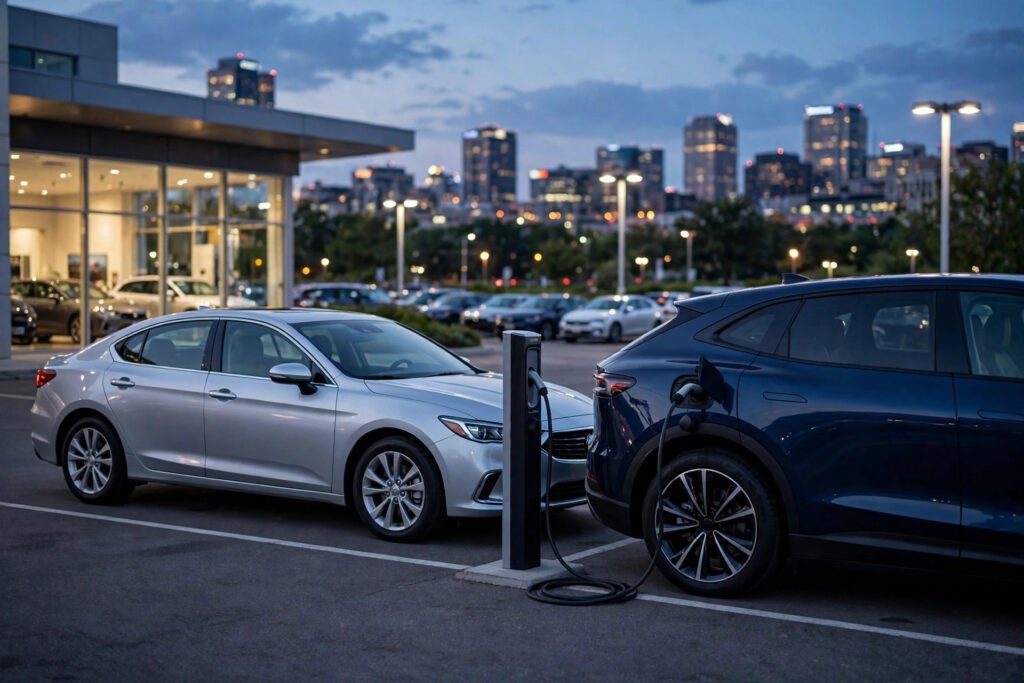
Stand in any American dealership in 2026 and the choice feels overwhelming: the reliable hybrid that sips gas, or the full electric that plugs in and never visits a gas station again? Both promise lower running costs and a smaller carbon footprint than a pure gasoline car, but they ask very different things of your daily life. The right answer isn’t about which technology is “better” — it’s about which one fits your driving patterns, your housing situation, and your tolerance for planning. Here’s how to decide with real numbers instead of marketing.
The Fundamental Difference in Daily Life
A hybrid (HEV) is a gasoline car with an electric assistant — you fuel it exactly like any car, and the electric motor recovers braking energy to cut fuel use roughly in half around town. A plug-in hybrid (PHEV) adds a bigger battery you charge at home for 25 to 50 miles of electric range before the gas engine takes over. A full electric (BEV) has no engine at all: every mile comes from the battery, which you recharge at home or at public fast chargers.
This creates the single biggest lifestyle question: can you charge at home? If you own a home with a garage or driveway, overnight charging makes EV ownership nearly effortless — you wake up to a “full tank” every morning. If you rent an apartment with street parking, charging becomes a logistics project of public chargers and planning. Be honest about this before anything else; it’s the factor that determines whether an EV feels liberating or annoying. For the environmental side of the equation, cutting your travel footprint looks different depending on which powertrain you choose.
Cost Math: Purchase Price vs. Total Ownership
Electrics still typically cost more upfront than comparable hybrids — often $5,000 to $10,000 more before incentives. But the total-cost picture flips the script:
Fuel/energy: At average US residential electricity rates (roughly 17 cents per kWh in 2026), driving electric costs the equivalent of about $1.00 to $1.50 per gallon of gas. A hybrid at 50 mpg with $3.50 gas costs about 7 cents per mile; an EV at 3.5 miles per kWh costs under 5 cents per mile. Over 12,000 miles a year, that’s a few hundred dollars annually in the EV’s favor.
Maintenance: EVs have no oil changes, no transmission servicing, no exhaust systems, and brake pads that last far longer thanks to regenerative braking. Industry analyses consistently put EV maintenance at roughly half the cost of comparable gas vehicles over five years. Hybrids sit in between — simpler than pure gas cars but still carrying engine maintenance.
Incentives: The federal EV tax credit landscape keeps shifting, but as of 2026, qualifying new EVs can still earn up to $7,500 and used EVs up to $4,000, subject to income caps and assembly requirements. Many states add their own rebates. Hybrids generally qualify for fewer or no federal credits now. Run your specific numbers with a total-cost calculator rather than guessing — managing your personal finances starts with knowing the true five-year cost, not the sticker price.
Insurance and depreciation: EVs often cost more to insure (expensive battery repairs drive premiums), though the gap is narrowing. Depreciation has been the EV’s weak spot — rapid tech improvements and price cuts have hammered used EV values, which is bad for new buyers but creates genuine bargains in the used market.
Charging Realities: Home vs. Public Costs
If you’re leaning electric, understand the two-tier charging economy. Home charging on a standard 240V setup (installation typically $500–$2,000 depending on your electrical panel) delivers the cheapest miles in transportation — usually equivalent to $1.00–$1.50 per gallon of gas at average residential rates, and far less if your utility offers time-of-use overnight pricing (some EV-specific rates drop to the equivalent of under $1/gallon). This is where EV economics shine brightest.
Public fast charging is a different story: rates of 40–60 cents per kWh are common at highway fast chargers, which works out close to gas-parity per mile — still cheaper than premium gas in most cases, but not the dramatic savings of home charging. The practical takeaway: EVs make the most financial sense when 80%+ of charging happens at home. If you’ll rely primarily on public charging, run the numbers honestly — a hybrid’s fuel costs may be comparable without the charging logistics. Factor your real charging mix into the total-cost math, not the idealized version.
Range and Road Trips: The Honest Assessment
Modern mainstream EVs deliver 250 to 320 miles of EPA-rated range, which covers roughly 95 percent of American driving days without a second thought. The remaining 5 percent — road trips — is where planning enters. America’s fast-charging network has expanded dramatically, with the Department of Energy tracking tens of thousands of public fast chargers, but rural coverage still has gaps, and charging stops add 20 to 40 minutes versus a five-minute gas fill-up.
A hybrid, by contrast, road-trips exactly like the car you already know: 500+ miles of range, five-minute refuels, zero planning. If you regularly drive long rural routes, tow heavy loads, or simply hate trip planning, the hybrid wins on convenience without question. A plug-in hybrid splits the difference beautifully for many households — electric for the daily commute, gas for the annual road trip.
Reliability and Battery Longevity in 2026
Early EV battery degradation fears have largely not materialized. Data from high-mileage fleets shows modern EV batteries typically retaining 85 to 90 percent of capacity after 100,000+ miles, and most manufacturers warranty the battery for 8 years or 100,000 miles. Hybrids have an even longer track record — Toyota’s hybrid batteries routinely last 200,000+ miles, and replacement costs have fallen substantially.
The reliability edge currently goes to conventional hybrids, which top most dependability surveys, while some EVs — particularly from newer manufacturers — have had growing pains with electronics and build quality rather than batteries. Check model-specific reliability data from Consumer Reports before committing to any particular vehicle.
The Decision Framework
Choose the full electric if: you can charge at home, drive under 200 miles on typical days, want the lowest running costs and emissions, and don’t mind 20-minute charging stops on occasional road trips.
Choose the hybrid if: you can’t reliably charge at home, take frequent long trips, tow regularly, want maximum simplicity with no behavior change, or prioritize proven long-term reliability.
Choose the plug-in hybrid if: your daily commute is under 40 miles (covering it electrically), you charge at home, but you want gas backup for longer trips without any planning.
Conclusion
The hybrid-versus-electric debate has no universal winner — it has a winner for your specific life. Home charging access is the great divider: with it, an EV’s lower running costs and effortless daily use are hard to beat; without it, a hybrid delivers most of the fuel savings with none of the logistics. Run the five-year total cost for your mileage, test-drive both back to back, and choose the car that fits the driving you actually do — not the driving you imagine.
Frequently Asked Questions
How long do EV batteries really last?
Modern EV batteries typically retain 85-90% capacity past 100,000 miles, with most warrantied for 8 years/100,000 miles. Full battery failure is rare; gradual range loss is the normal pattern.
Is it cheaper to drive electric or hybrid?
Per mile, electric is usually cheapest (equivalent of ~$1.00-1.50/gallon), hybrids next (~7 cents/mile at current gas prices). Total ownership depends on purchase price, incentives, insurance, and your mileage.
Can I own an EV without home charging?
It’s possible but significantly less convenient — you’ll depend on public chargers and workplace charging. Most EV satisfaction surveys show home charging is the biggest predictor of a happy ownership experience.
Do hybrids still make sense in 2026?
Absolutely. Conventional hybrids offer excellent reliability, no charging infrastructure needs, and roughly half the fuel use of gas cars — they’re the lowest-friction path to lower running costs.
What about plug-in hybrids — best of both worlds?
Often yes for suburban commuters: 25-50 miles of electric daily driving plus gas backup. The catch is you must actually plug in regularly, and they carry maintenance for two powertrains.