Why Does Ice Float Instead of Sinking in Water
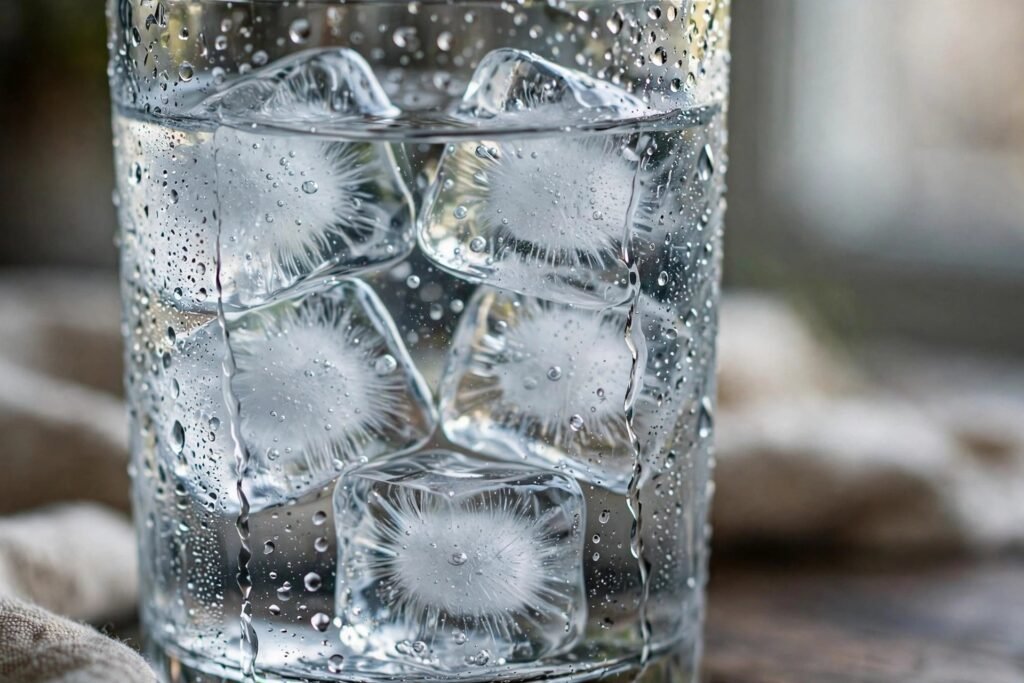
It is so ordinary you have never questioned it: ice cubes bob in your drink instead of sinking. But this unremarkable fact is one of the strangest in all of chemistry — water is virtually alone among substances in this behavior, and if it behaved “normally,” life on Earth would likely not exist. The floating ice cube is a window into hydrogen bonding, one of nature’s most consequential molecular quirks, with implications stretching from lake ecology to the search for life on other worlds.
The Anomaly: Almost Everything Else Sinks
For nearly all substances, the solid phase is denser than the liquid phase — solid sinks in its own melt. The logic is straightforward: cooling reduces molecular motion, molecules pack tighter, density increases. Paraffin sinks in melted wax; solid iron sinks in molten iron; frozen ethanol sinks in liquid ethanol. Water breaks this rule spectacularly: ice at 0°C has a density of about 0.917 g/cm³ versus liquid water’s roughly 1.000 g/cm³ — about 9 percent less dense, which is why roughly a tenth of an iceberg rides above the surface (the literal origin of “tip of the iceberg”).
The culprit is the hydrogen bond — the attraction between the partially positive hydrogen of one water molecule and the partially negative oxygen of another. Individually weak but collectively dominant, hydrogen bonds dictate water’s behavior. As water cools toward freezing, these bonds lock molecules into a specific geometry: each water molecule hydrogen-bonds to four neighbors in a tetrahedral arrangement, forming an open hexagonal lattice with significant empty space. This crystalline structure — ice Ih, the form in your freezer — is spacious by molecular standards. When ice melts, the lattice collapses, molecules pack more closely, and density increases. Expansion on freezing is the anomaly; contraction is the norm everywhere else.
Water’s Density Maximum: The Stranger Half of the Story
The weirdness runs deeper. Liquid water does not simply get denser as it cools — it reaches maximum density at 3.98°C (about 39°F), then becomes less dense as it cools further toward freezing. This density maximum, essentially unique among common liquids, arises from two competing effects: thermal contraction (cooling packs molecules tighter, raising density) versus the growing influence of open hydrogen-bonded structures (lowering density). Above 4°C, contraction wins; below 4°C, the open structures win.
This quirk drives lake thermal stratification — one of the most ecologically important phenomena most people have never heard of. In autumn, surface water cools to 4°C and sinks (being densest), displacing deeper water upward in a turnover that oxygenates the depths. As the surface cools below 4°C, it becomes less dense and stays on top, eventually freezing into an insulating lid. The National Oceanic and Atmospheric Administration documents how this stratification governs nutrient cycling in the Great Lakes and oceans worldwide — the floating-ice phenomenon scaled up to planetary ecology.
Why Floating Ice Makes Life Possible
Now the profound part. Imagine the counterfactual: ice denser than water. Lakes would freeze from the bottom up. Each winter, ice forming at the surface would sink, exposing fresh water to freeze, sinking in turn — until the entire water body froze solid. Come spring, melting would proceed slowly from the top, and in cold climates, lakes might never fully thaw. Aquatic ecosystems would be annihilated annually; the stable liquid-water habitats that nurtured early life could not persist through ice ages.
Instead, floating ice forms an insulating blanket: ice conducts heat poorly, so a frozen surface dramatically slows further heat loss from the water below. Beneath the ice, water remains liquid at 4°C — the density maximum — creating a stable winter refuge where fish, invertebrates, and microbes survive. Every temperate lake ecosystem depends on this. The same physics protects polar oceans: sea ice insulates the water beneath, maintaining the marine food webs that sustain everything from krill to whales. A 9 percent density difference, arising from molecular geometry, is load-bearing for the biosphere.
Other Ices, Other Worlds
Ice Ih is just one of at least nineteen known crystalline forms of ice. Under the crushing pressures inside icy moons like Europa and Enceladus, water forms denser ice phases (ice III, V, VI) that do sink — creating exotic possibilities like oceans sandwiched between layers of sinking and floating ice. Planetary scientists modeling these moons must account for which ice phase forms at each depth, because it determines whether liquid water — and potentially life — can persist.
This is also why the search for extraterrestrial life fixates on liquid water: it is not just a solvent (though its solvent properties are equally remarkable) but a substance whose thermal anomalies create stable, long-lived habitats. A planet with a liquid that froze bottom-up would be far less hospitable. Water’s strangeness is, as far as we can tell, a prerequisite for biology — which makes the ice cube in your glass a small ambassador from the molecular coincidences that made you possible. The same curiosity about everyday physics extends to the engineered world too — understanding how to make your home more energy-efficient in winter draws on the same thermodynamics of heat, insulation, and phase behavior.
Everyday Consequences You Can Observe
The anomaly shows up constantly once you look: pipes burst because water expands on freezing (ice’s lower density means it takes up more volume — the 9 percent expansion generates enormous pressure, enough to split metal); frost heave lifts sidewalks and foundations as soil water freezes and expands; beer bottles explode in the freezer; and the freeze-thaw cycle weathers mountains, with water seeping into cracks, freezing, expanding, and prying rock apart grain by grain. Civilization spends billions managing a molecular quirk.
You can even demonstrate the density maximum at home: a tall container of water cooled slowly will show circulation patterns reversing near 4°C — though the effect is subtle. More dramatically, the fact that hot water can sometimes freeze faster than cold (the Mpemba effect, still debated) is another reminder that water refuses to behave like a “normal” liquid. The American Chemical Society offers accessible explainers on water’s anomalous properties for readers who want to go deeper into the molecular details.
The Bottom Line
Ice floats because hydrogen bonds lock water molecules into an open hexagonal lattice with empty space, making solid water about 9 percent less dense than the liquid — a near-unique anomaly among substances. Combined with water’s density maximum at 4°C, this creates floating insulating ice that preserves liquid habitats beneath, a planetary-scale life-support mechanism. From burst pipes to Europa’s hidden oceans, the consequences radiate outward from one molecular geometry. The most ordinary thing in your glass is, chemically speaking, a miracle with a 9 percent margin.
Why This Quirk Keeps Lakes Alive
Ice floating is not just a curiosity — it is a prerequisite for aquatic life in cold climates. Because ice forms an insulating lid on top, lakes freeze downward slowly, leaving liquid water beneath where fish and microorganisms survive the winter. If ice sank, lakes would freeze solid from the bottom up, killing nearly everything each winter and making complex freshwater ecosystems impossible. The same hydrogen-bond network behind this behavior gives water its enormous heat capacity, stabilizing Earth’s climate and your body temperature alike. Water’s strangeness is load-bearing for life as we know it — which is one more reason to respect it daily, including learning the signs of dehydration before your body has to teach you the hard way.
Frequently Asked Questions
Why does ice float on water?
Hydrogen bonds arrange water molecules into an open hexagonal crystal lattice with empty space, making ice about 9% less dense than liquid water. Almost all other substances are denser as solids and sink in their own melt.
What is water’s density maximum?
Liquid water is densest at 3.98°C (39°F). Cooling below this temperature makes water less dense due to growing hydrogen-bonded open structures — which is why ice forms on lake surfaces instead of the depths.
Would life exist if ice sank?
Probably not as we know it — lakes would freeze from the bottom up, potentially solid, destroying aquatic ecosystems each winter. Floating ice insulates the liquid water below, preserving stable habitats.
Why do pipes burst in winter?
Water expands about 9% when freezing (since ice is less dense), generating enormous pressure inside confined pipes — enough to split copper and iron.
Are there other forms of ice?
Yes — at least 19 crystalline phases. Under extreme pressure (like inside icy moons), denser ice forms that do sink, creating exotic layered oceans scientists study for signs of habitability.