How Do Scientists Date Ancient Fossils and Artifacts
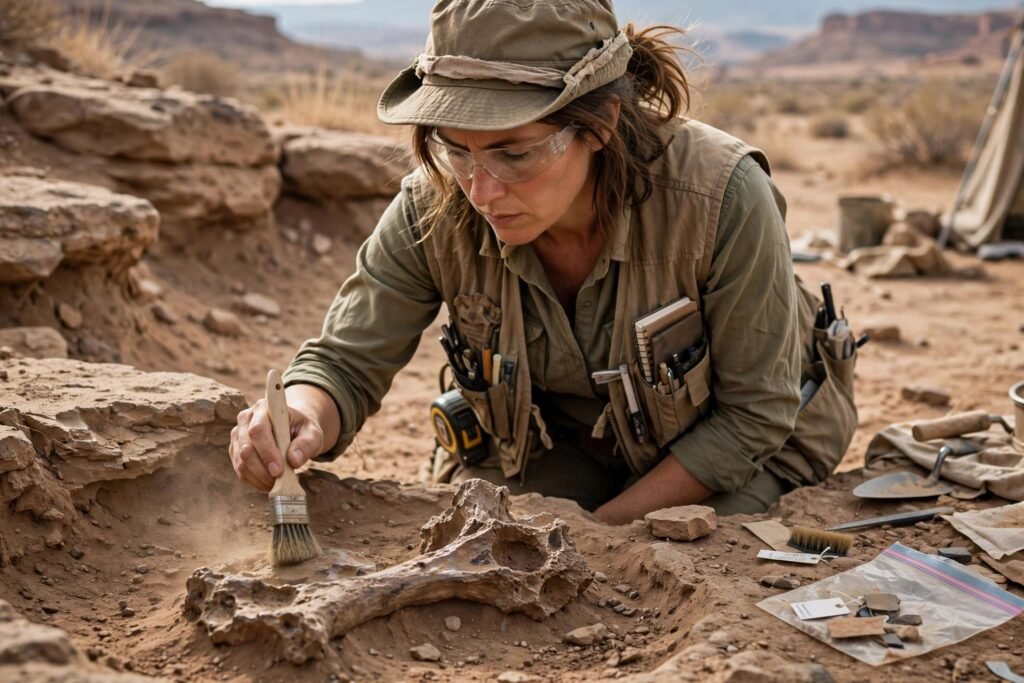
“This fossil is 68 million years old.” “This pottery shard dates to 3,200 BCE.” These statements sound impossibly precise — how could anyone know what happened millions of years before humans invented writing? The answer is one of science’s great detective stories: a toolkit of dating methods, each based on a different physical process, that cross-check each other to build timelines of deep history. No single method does it all. Together, they are remarkably reliable — and understanding how they work reveals why scientists are so confident about dates that sound like guesses.
Radiometric Dating: Clocks Built Into Atoms
The workhorse of deep-time dating is radiometric (radioactive) dating, based on a beautifully simple principle: certain atoms are unstable and decay into different atoms at a constant, unchanging rate. The “half-life” — the time for half the atoms in a sample to decay — is a physical constant, unaffected by temperature, pressure, chemistry, or time itself. Measure the ratio of parent atoms to daughter atoms, and you can calculate how long the clock has been ticking.
Different isotope systems cover different timescales: carbon-14 (half-life 5,730 years) dates organic material up to ~50,000 years — ideal for archaeological artifacts, ancient bones, and wooden objects; potassium-argon (half-life 1.25 billion years) dates volcanic rocks millions to billions of years old — the method that dated early human fossils in East Africa’s volcanic layers; uranium-lead (half-life 4.5 billion years) dates the oldest rocks on Earth and meteorites, establishing the planet’s 4.54-billion-year age. The key insight: scientists do not date the fossil directly (the original organic material is long replaced by minerals). They date the rock layers above and below it using volcanic ash beds that can be radiometrically dated — bracketing the fossil’s age between two known dates. A fossil between a 70-million-year-old ash layer and a 66-million-year-old one is 66–70 million years old. The logic is airtight even though it is indirect.
How Scientists Handle the Complications
Radiometric dating has known complications, and addressing them is what makes the science trustworthy rather than naive:
Contamination
Groundwater, modern carbon, and handling can introduce foreign isotopes. Laboratories use rigorous pretreatment — acid washes, physical cleaning, chemical separation — and run blanks and standards alongside samples. A date is only as good as its chemistry.
Calibration
Carbon-14 production in the atmosphere has varied over time (solar activity, Earth’s magnetic field changes), so raw carbon dates are calibrated against tree-ring chronologies (dendrochronology provides an exact year-by-year record going back ~14,000 years) and other independent records. The calibration curves are themselves a triumph of cross-disciplinary science.
Cross-checking
The gold standard: multiple methods on the same object or site agreeing. When potassium-argon, uranium-series, and paleomagnetic dates converge on the same age, the probability of shared systematic error collapses. Scientists trust dates because independent clocks agree — not because any single method is assumed perfect. This consilience is the strongest argument in all of historical science, and it is worth understanding as a general principle: when independent lines of evidence converge, confidence is justified. The same verify-from-multiple-angles instinct serves well beyond science — it is the same discipline behind checking whether AI gave you wrong information rather than trusting a single source.
Relative Dating: Order Without Numbers
Before absolute dates existed, geologists developed relative dating — establishing sequence without numbers, using principles that remain fundamental:
Superposition
In undisturbed rock layers, the oldest is at the bottom and the youngest at the top. Simple, powerful, and the basis of all stratigraphy.
Index fossils
Certain species lived for short, well-defined periods but spread widely geographically. Finding their fossils dates a rock layer to that species’ known window — fossils dating rocks, inverting the usual direction.
Cross-cutting relationships
A fault or intrusion cutting through rock layers must be younger than the layers it cuts. Logical, inescapable, and useful for untangling complex geology.
Relative dating built the geological time scale — the Cambrian, Jurassic, Cretaceous divisions — before radiometric methods assigned them numbers. The framework came first; the absolute dates filled it in.
Dating the Human Story: Specialized Methods
Archaeology uses additional techniques tuned to human timescales: dendrochronology (tree-ring dating — exact to the year, the gold standard where wood survives); thermoluminescence and optically stimulated luminescence (dating when pottery or sediments were last heated or exposed to light — directly dating human artifacts); obsidian hydration (measuring the water-absorption rind on freshly exposed obsidian surfaces); and increasingly, ancient DNA analysis providing relative chronologies through mutation rates.
Each method has a sweet spot of material, timescale, and precision — and archaeologists choose methods the way mechanics choose tools: the right one for the specific job. A pottery shard gets thermoluminescence; a wooden beam gets dendrochronology; associated volcanic ash gets potassium-argon. The art is in the selection and the cross-checking.
Why the Dates Are Trustworthy
Skeptics sometimes ask: how do you know decay rates were constant millions of years ago? The answer is consilience again: decay rates are grounded in fundamental nuclear physics (changing them would require rewriting physics itself, with observable consequences across astronomy and geology that we do not see); independent isotope systems with different physics agree; dates align with the stratigraphic order established independently; and the entire framework successfully predicts — oil companies find oil where the geological timeline says it should be, a multi-trillion-dollar practical validation. When a dating framework guides successful predictions across industries and disciplines, it has earned its confidence.
For those drawn to deep history firsthand, the Smithsonian’s natural history collections — including the fossil halls at the National Museum of Natural History, one of the must-see attractions in Washington DC — let you stand before specimens whose ages were determined by exactly these methods.
The Bottom Line
Scientists date ancient fossils and artifacts through radiometric clocks (carbon-14 for recent organic material, potassium-argon and uranium-lead for deep time), calibrated and cross-checked across independent methods; relative dating principles establishing sequence; and specialized archaeological techniques for human timescales. The confidence comes not from any single clever trick but from consilience — independent physical processes converging on the same dates, validated by successful prediction. Deep time is not a guess; it is one of science’s best-measured quantities.
Calibration: How Dates Get Sharper
Raw dating measurements rarely give a final answer on their own. Radiocarbon dates, for example, must be calibrated against calibration curves built from tree rings, corals, and lake sediments — because atmospheric carbon-14 levels have fluctuated over millennia. Dendrochronology (tree-ring dating) provides an independent check stretching back over 10,000 years in some regions, and when multiple methods converge on the same age, confidence soars. Contamination is the eternal enemy: a single intrusive rootlet or mishandled sample can skew results by centuries, which is why reputable labs run blanks, duplicates, and chemical pretreatment protocols. The USGS maintains excellent public resources on geologic time and dating principles for readers who want to go deeper. The takeaway: dating the past is less about one magic technique and more about cross-checking independent clocks until they agree.
Frequently Asked Questions
How does carbon dating work?
Living things absorb carbon-14 from the atmosphere; when they die, absorption stops and the carbon-14 decays with a 5,730-year half-life. Measuring the remaining ratio reveals time since death, effective up to ~50,000 years.
Can scientists date fossils directly?
Rarely — the original organic material is usually replaced by minerals. Instead, scientists date volcanic rock layers above and below the fossil using potassium-argon or uranium-lead methods, bracketing the fossil’s age.
How do we know decay rates never changed?
Decay rates derive from fundamental nuclear physics; changing them would have observable consequences across physics and astronomy that we don’t see. Independent dating methods based on different physics also agree with each other.
What’s the oldest thing ever dated?
Individual zircon crystals from Western Australia date to ~4.4 billion years, and meteorites date to ~4.56 billion years — establishing the solar system’s age. Earth itself is dated to ~4.54 billion years.
How accurate is carbon dating?
With proper calibration against tree rings and rigorous contamination control, carbon dating achieves precision of decades to centuries for recent samples — remarkable for a 50,000-year method, though less precise than dendrochronology’s exact years.