How to Avoid Injuries in Weekend Soccer Games
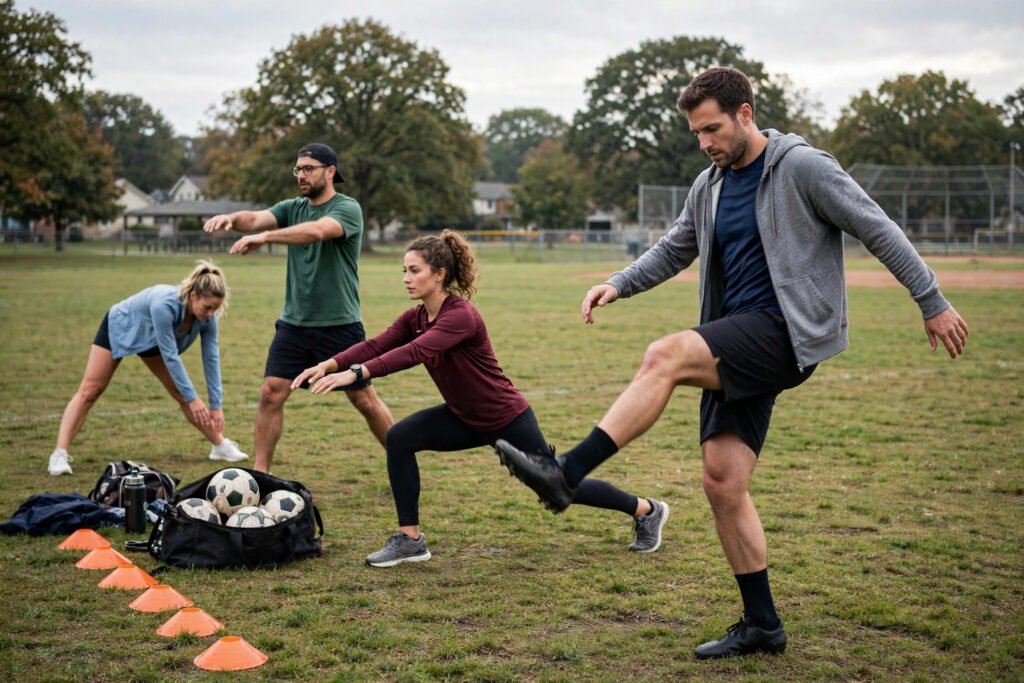
Saturday morning: you roll out of bed, pull on cleats you wear twice a month, and play 90 minutes of soccer against people half your age who play three times a week. By Sunday you’re limping. By Monday you’re googling “knee popping sound.” Welcome to weekend-warrior soccer — America’s beloved, injury-prone ritual, played in adult rec leagues from Seattle to Miami.
The statistics are sobering: adult recreational soccer produces high rates of ankle sprains, hamstring strains, knee ligament injuries, and Achilles problems — overwhelmingly because weekend players skip everything professionals do to stay healthy. You can’t train like a pro on a weekend schedule, but you can steal the five highest-leverage injury-prevention habits. Here’s how.
1. Warm up like you mean it (15 minutes, every time)
The number one injury predictor in weekend soccer isn’t age or fitness — it’s showing up and starting to sprint cold. Adult rec games famously begin with players arriving two minutes before kickoff and jogging one lap. FIFA’s 11+ warm-up program, tested in over 100,000 players, cut injuries by 30–50 percent — and it takes 15 minutes: running drills, strength and plyometric exercises (Nordic hamstring curls, single-leg squats), and balance work.
Arrive 20 minutes early and run a condensed version: 5 minutes of progressive jogging with direction changes, 5 minutes of dynamic stretches (leg swings, walking lunges, inchworms), and 5 minutes of accelerations and ball work. The teams that warm up properly don’t just get hurt less — they play better in the first 20 minutes while opponents are still waking up.
2. Strengthen the muscles that soccer destroys
Weekend soccer injuries cluster in predictable places: hamstrings (sprinting after weeks of sitting), groins (cutting and kicking), ankles (tackles and uneven fields), and knees (pivoting). Two 20-minute strength sessions per week targeting these areas cut injury risk dramatically:
- Nordic hamstring curls: the single best-proven hamstring injury prevention exercise. Start with assisted versions (push off a chair) — full Nordics are brutally hard.
- Copenhagen planks: groin and adductor strength, the area weekend players neglect most.
- Single-leg balance and hops: ankle stability and landing mechanics. Poor single-leg control predicts ankle and knee injuries.
- Glute bridges and lateral band walks: glute strength controls knee tracking during cuts — weak glutes let knees collapse inward, the classic ACL mechanism.
Knee resilience deserves special attention since knee complaints end more rec careers than anything else; our guide to the best exercises for people with bad knees covers joint-friendly strengthening in detail.
3. Respect the surface and the footwear
American rec soccer happens on everything from manicured turf to lumpy park grass with hidden holes. Ankle sprains love bad surfaces. Two fixes: wear the right cleats for the surface (firm-ground studs on grass, turf shoes — not cleats — on artificial turf; wearing long studs on turf is an ankle injury waiting to happen), and scan the field during warm-up for holes, sprinkler heads, and slick spots.
Turf deserves a special warning: artificial turf increases lower-body injury rates compared to grass in multiple studies, partly due to higher shoe-surface traction that “locks” the foot during cuts. On turf, shorter studs or turf-specific shoes and extra attention to cutting mechanics matter.
4. Manage load: the weekend-warrior trap
The classic injury mechanism: zero activity Monday–Friday, then 90 maximal minutes Saturday. Sports medicine calls this the acute-to-chronic workload problem — injury risk spikes when one week’s load massively exceeds your recent average. The fix isn’t complicated: add 1–2 midweek sessions of 20–30 minutes (a jog, a strength session, even a brisk walk). You don’t need to train like an athlete; you need to stop being completely sedentary between games. Your Saturday self will thank your Wednesday self.
Also: sub yourself off. Rec leagues allow rolling substitutions — use them proudly, because protecting your body is simply smart soccer. The injuries happen in minute 75 when your fatigued hamstrings are doing sprint work they haven’t done in a week. Fifteen minutes of rest mid-game costs you nothing and saves your season. Back issues compound the problem for desk workers; see the best exercises for lower back pain if your back seizes up after games.
5. Hydrate, fuel, and recover like it matters
Dehydrated muscles cramp and tear more easily — weekend games in summer heat are prime cramp territory. Drink 16–20 ounces in the two hours before kickoff, drink at halftime, and don’t rely on thirst. Eat a real meal 2–3 hours before (carbs plus moderate protein), not a drive-through burger 45 minutes prior.
Post-game recovery for the time-crunched: 10 minutes of easy walking or cycling within a few hours, protein-rich meal within two hours, and sleep — the actual recovery drug. Ice baths and compression gear are marginal; sleep and protein are the 80/20.
Know when to stop: the red-flag list
Play through muscle soreness; never play through these: a “pop” with immediate swelling (possible ligament tear — get assessed within days, because early diagnosis dramatically improves outcomes), inability to bear weight, numbness or tingling, calf pain that feels like being kicked (possible Achilles rupture), or any head impact with confusion, headache, or dizziness (concussion protocol — sit out, no exceptions, no “toughing it out”). Adult rec leagues have no athletic trainers watching; you are your own medical staff. Act like it.
Conclusion
Avoiding injuries in weekend soccer comes down to five habits: a real 15-minute warm-up, twice-weekly targeted strength work, correct footwear for the surface, midweek activity so Saturday isn’t a shock, and basic fueling and recovery. None require a pro’s schedule — they require a weekend warrior’s discipline. Start this week by arriving early for one proper warm-up; it’s the single change with the biggest immediate payoff. Your league fees are too expensive to spend the season on the injured list. For authoritative guidance, see the U.S. Soccer and the NATA injury prevention resources.
Frequently Asked Questions
What is the most common injury in adult recreational soccer?
Ankle sprains top the list, followed by hamstring strains, groin pulls, and knee ligament injuries. Most result from inadequate warm-ups, deconditioned muscles, and the stop-start sprinting that defines soccer — all addressable with the prevention habits above.
How should I warm up before a weekend soccer game?
Arrive 20 minutes early: 5 minutes of progressive jogging with direction changes, 5 minutes of dynamic stretches (leg swings, lunges, inchworms), and 5 minutes of accelerations plus ball work. FIFA’s 11+ program, which follows this structure, cut injuries 30–50% in large trials.
Should I wear cleats or turf shoes for rec soccer?
Match the shoe to the surface: firm-ground cleats on natural grass, turf shoes (short rubber nubs) on artificial turf. Wearing long-studded cleats on turf increases ankle and knee injury risk due to excessive traction.
How do I avoid hamstring pulls in soccer?
Nordic hamstring curls twice weekly are the best-proven prevention. Also avoid going from zero midweek activity to full-match sprinting — add even one midweek jog — and warm up thoroughly before sprinting in games.
When should I see a doctor for a soccer injury?
Immediately for any “pop” with swelling, inability to bear weight, numbness, suspected Achilles rupture (sudden calf pain like a kick), or any head impact with symptoms. For sprains and strains, see a doctor if there’s no improvement within a week of rest and basic care.