How to Check Tire Pressure (and Why It Really Matters)
It’s the most neglected 5-minute maintenance task in America: checking tire pressure. The Department of Transportation estimates that a significant share of vehicles on U.S. roads run on underinflated tires — silently wasting fuel, wearing out $800 tire sets prematurely, and compromising the handling that keeps you safe in emergencies. Meanwhile the fix is free air at most gas stations and two minutes with a $10 gauge. Here’s how to check your tire pressure correctly, what the numbers mean, and why this tiny habit matters far more than most drivers realize.
Why Tire Pressure Matters More Than You Think
Three consequences, all significant. First, safety: underinflated tires have larger, sloppier contact patches that degrade handling, increase stopping distances, and run hotter — heat being the primary cause of highway blowouts. The NHTSA attributes hundreds of crash fatalities yearly to tire-related issues, with underinflation the leading contributor. Properly inflated tires respond crisply in emergency maneuvers; soft tires wallow. In wet conditions, underinflation worsens hydroplaning. This isn’t theoretical — it’s the physics between you and the guardrail.
Second, money: underinflation by just 6 PSI (common — that’s one monthly leak cycle ignored) increases rolling resistance enough to cut fuel economy 2–3%, costing the average driver $50–$100 yearly in wasted gas. Worse, it accelerates and unevenly distributes tread wear — edge wear from underinflation can kill tires 10,000–20,000 miles early, turning a 50,000-mile tire into a 35,000-mile tire. On a $800 set, that’s $200+ wasted. Third, the TPMS reality: your Tire Pressure Monitoring System only warns at 25% below recommended pressure — by the time the light illuminates, you’ve been driving compromised for weeks. The dashboard light is a last resort, not a maintenance reminder. The National Highway Traffic Safety Administration’s tire safety information details these risks with the data behind them.
Finding Your Correct Pressure (Not the Tire’s Number)
Here’s the mistake almost everyone makes: inflating to the number molded on the tire’s sidewall. That number is the tire’s maximum safe pressure — not your car’s recommended pressure. Your car’s correct pressure is on the driver’s door jamb sticker (or in the owner’s manual), specified by the engineers who tuned your suspension for it — typically 30–35 PSI for most passenger cars, higher for trucks and SUVs. The sidewall maximum (often 44–51 PSI) is a safety limit, not a target; inflating to it gives a harsh ride, reduced traction (smaller contact patch), and uneven center wear.
Check pressure requirements for your specific load: many door stickers list two pressures — normal and full-load/high-speed. If you’re about to load the family and luggage for vacation, use the higher figure. And understand that recommended pressure assumes cold tires (more on that below). Aftermarket tires in different sizes than stock may need adjusted pressures — consult a tire professional rather than guessing. Tire health is a key indicator of any vehicle’s condition — when renting, our guide to what to know before renting a car abroad reminds you to check tires before leaving the lot.
How to Check: The 5-Minute Procedure
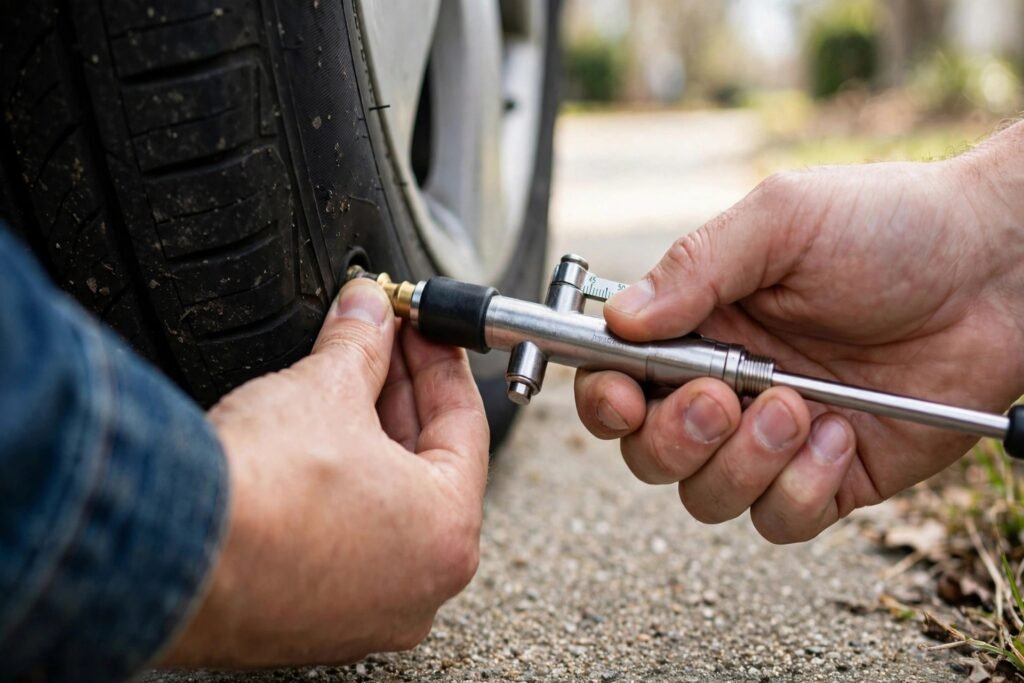
You’ll need a tire gauge — the $8–$15 pencil or digital type (digital is easier to read; dial gauges are most precise; skip the built-in gauges on gas station air hoses, which are notoriously inaccurate). Check tires “cold” — before driving or at least 3 hours after parking — because driving heats air and raises pressure 3–5 PSI, giving false-high readings. Morning in your driveway is ideal.
The procedure: remove the valve cap (don’t lose it — put it in your pocket), press the gauge firmly onto the valve stem until the hissing stops, read the pressure, and compare to the door sticker. If low, add air in short bursts, rechecking after each — gas station compressors are free or $1–$2, and many tire shops fill for free. If over, press the valve core briefly to release air. Replace the cap (it keeps dirt out of the valve). Repeat for all four tires plus the spare — spares lose pressure sitting unused and are useless flat in an emergency. Do this monthly and before long trips: it takes five minutes total once you’ve done it twice. Fold it into your departure routine with our road trip preparation guide — correct pressure is the single highest-ROI pre-trip check there is.
Seasonal Pressure Changes and Special Situations
Tire pressure drops about 1 PSI for every 10°F temperature decrease — which means the first cold snap of fall typically triggers a wave of TPMS lights as summer-inflated tires fall 4–6 PSI overnight. This is normal physics, not a leak: add air to restore recommended pressure. Check more frequently during seasonal transitions (fall and spring), when 30-degree swings are routine. In sustained winter cold, some drivers add 1–2 PSI above the sticker to compensate — reasonable within limits, but don’t exceed the tire’s maximum.
Special situations: before towing or heavy hauling, inflate to the full-load pressure on your door sticker — underinflated tires under load overheat dangerously. After any tire service (rotation, repair, replacement), verify pressures yourself — shops set them inconsistently. If one tire repeatedly loses pressure faster than others, you likely have a slow leak (nail, bead corrosion, faulty valve stem) — get it inspected rather than perpetually refilling; slow leaks become blowouts. And nitrogen fills (offered at some shops): nitrogen leaks slightly slower than air and is less temperature-sensitive, but the benefits are marginal for passenger cars — free air, checked monthly, beats expensive nitrogen checked never. AAA’s tire care resources cover these seasonal and situational adjustments in detail.
The Bottom Line
Check your tire pressure monthly with a $10 gauge, cold, against the door jamb sticker (not the sidewall maximum), and adjust with free air. This 5-minute habit prevents blowouts, sharpens handling, saves $50–$100 yearly in fuel, and extends $800 tire sets by tens of thousands of miles. Your TPMS light is a last-resort warning at 25% underinflation — not a maintenance system. The gauge in your glovebox is. Teach every new driver in your household the same routine — it’s the cheapest driving lesson with the highest safety return you’ll ever give. Five minutes, once a month, for safer stops, longer tire life, and money back in your pocket: there’s no better maintenance bargain on four wheels.
Frequently Asked Questions
How often should I check tire pressure?
Monthly, plus before long trips and during seasonal temperature transitions. Tires naturally lose 1–2 PSI monthly through the rubber, so “set and forget” guarantees gradual underinflation.
Should I inflate to the number on the tire or the door sticker?
The door sticker — always. The tire sidewall shows the maximum safe pressure, not the recommended pressure. Your car’s engineers specified the door-jamb number for your vehicle’s weight and handling.
Why does my tire pressure light come on in cold weather?
Pressure drops ~1 PSI per 10°F decrease. Fall’s first cold snap commonly drops tires 4–6 PSI overnight, triggering the TPMS warning. Add air to restore the recommended pressure — it’s physics, not a leak.
Is nitrogen better than regular air for tires?
Marginally — nitrogen leaks slightly slower and is less temperature-sensitive. But regular air (already 78% nitrogen), checked monthly, delivers virtually identical real-world results for free. Don’t pay extra for it.