Running Shoes for Flat Feet: The Modern US Guide
Flat feet and running have a complicated relationship. About 20–30 percent of American adults have flat feet (low or collapsed arches), and for years the running industry treated them as a defect requiring maximum correction. Walk into a running store, and the old script was predictable: watch you walk, declare “overpronation,” and sell you a $180 stability shoe. The modern sports medicine view is more nuanced — and more empowering.
Here’s the current understanding: flat feet alone don’t doom you as a runner, many elite runners have flat feet, and the “right” shoe is the one that keeps you comfortable and injury-free — not necessarily the most corrective one on the wall. This guide explains what flat feet actually mean for running, how to choose shoes that work, and when to seek professional help.
What flat feet actually do when you run
The arch is a spring: it loads on impact and recoils to help propel you forward. In flat feet, the arch collapses more under load (overpronation), which can increase stress on the ankles, shins, knees, and the plantar fascia. But “can” is doing heavy lifting in that sentence — many flat-footed runners pronate moderately with zero problems, because the body adapts and surrounding muscles compensate.
The distinction that matters: asymptomatic versus symptomatic flat feet. If you run in neutral shoes without pain, your flat feet are a foot shape, not a medical problem — leave them alone. If you get recurring shin splints, inner knee pain, plantar fasciitis, or Achilles issues, your foot mechanics may be contributing, and footwear plus strengthening become worth addressing. Pain is the signal; arch height alone is not.
Shoe categories: what actually matters
Running shoes fall on a support spectrum. Understanding it matters more than any brand:
- Neutral cushioned: no corrective features, maximum comfort. The right choice for flat-footed runners without pain — and the starting point for everyone.
- Stability (guidance): firmer foam or a “guide rail” on the inner edge that gently resists excessive inward roll. Worth trying if you have mild overpronation with recurring niggles.
- Motion control: maximum correction, stiff and heavy. Largely fallen out of favor — modern evidence suggests heavy correction can cause as many problems as it solves, and most specialists now reserve these for severe cases.
The paradigm shift: a landmark series of studies found that prescribing shoes based on arch type didn’t reduce injuries — and that runners were often most comfortable (and least injured) in shoes chosen by comfort alone. The current best practice: start neutral, prioritize comfort, and add support only if problems arise. When knee pain does appear, our guide to why knees hurt going up stairs helps decode what the pain pattern means.
The fitting process: how to actually buy
Shop in the afternoon. Feet swell during the day; morning fittings produce shoes that feel tight on evening runs.
Bring your old shoes. Wear patterns tell a fitter more than any gait video — heavy inner-heel wear suggests overpronation; even wear suggests your current setup works.
Thumb’s width of space. You need roughly a half-inch (thumbnail’s width) between your longest toe and the shoe’s end. Running shoes should be a half to full size larger than dress shoes.
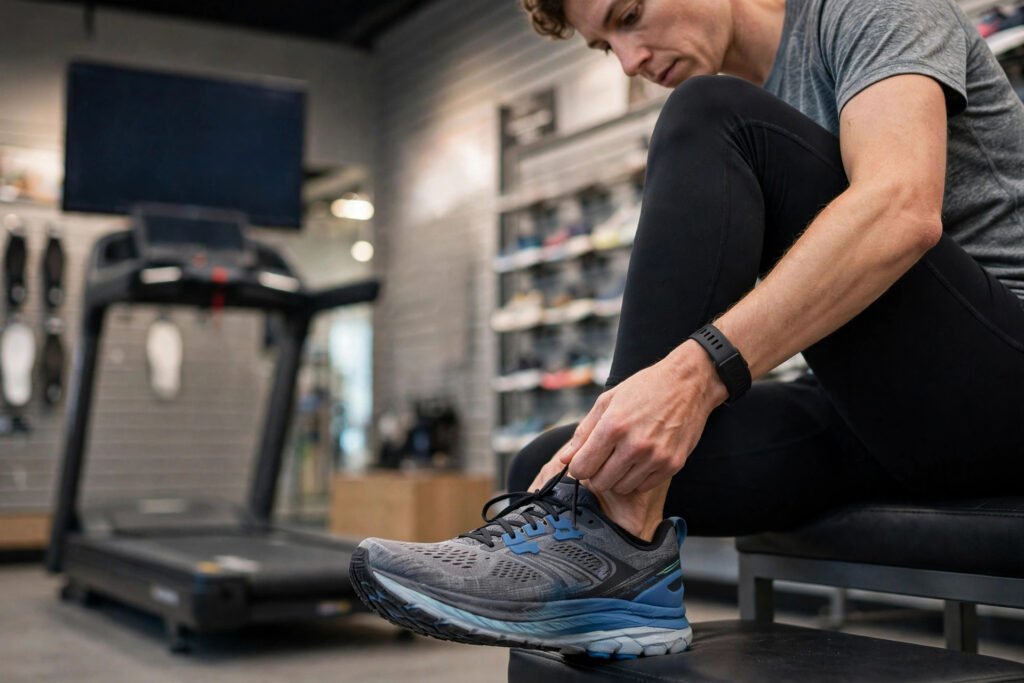
Run in them. Any decent American running store (Fleet Feet, Road Runner Sports, local specialty shops) has a treadmill or lets you jog the block. Walk-out-and-buy is how bad choices happen.
Comfort is the metric. The shoe that feels best in the store is, more often than not, the shoe that keeps you healthiest. Trust the feeling over the feature list.
Budget reality: good running shoes cost $130–$180 in the US. Replace them every 300–500 miles — worn-out midsoles are a stealth injury cause, and flat-footed runners often compress foam faster on the inner edge.
Strengthening: the fix shoes can’t provide
Shoes manage symptoms; strengthening addresses the cause. The arch is supported by muscles — particularly the posterior tibialis and the small intrinsic foot muscles — and these respond to training like any other muscle:
- Short-foot exercises: try to “scrunch” the arch upward without curling your toes, hold 5 seconds, 10 reps per foot. Directly trains arch-supporting muscles.
- Calf raises with inversion emphasis: rise onto your toes while pressing through the big-toe side — strengthens the posterior tibialis.
- Towel scrunches and marble pickups: old-school intrinsic foot strengthening that still works.
- Single-leg balance: 30–60 seconds per leg, progressing to eyes-closed. Builds the proprioception flat feet often lack.
Ten minutes, three times weekly, produces noticeable arch control within 6–8 weeks. This is the intervention with the best long-term payoff — stronger feet need less shoe. For knee-specific strengthening to pair with foot work, see the best exercises for people with bad knees.
When to see a professional
See a sports podiatrist or physical therapist if: pain persists despite shoe changes and 6–8 weeks of strengthening; you have one flat foot and one normal arch (asymmetry suggests something beyond genetics); you develop bunions, hammertoes, or rapidly worsening symptoms; or you can’t run more than a few miles without significant pain. Custom orthotics help a subset of runners — they’re worth the $300–$600 when prescribed for a diagnosed problem, not as a default purchase for a foot shape.
Flat feet and other sports: beyond running
The flat-feet conversation usually centers on running, but the same principles apply across activities. Court sports (tennis, basketball, pickleball) demand lateral stability that flat feet can compromise — there, a stability shoe with a wider base often helps more than it does for straight-ahead running. Hiking with a loaded pack magnifies arch collapse, making aftermarket insoles or supportive boots worth considering for backpackers. And for lifters, flat feet complicate squats: collapsing arches let knees cave inward under load. The fix is usually a combination of foot-strengthening work and heeled lifting shoes or a slightly wider stance, not expensive orthotics. Whatever your sport, the hierarchy stays the same: comfort first, targeted support only for real symptoms, and strength work as the long-term solution.
Conclusion
Choosing running shoes for flat feet in America starts with a reframe: flat feet are a foot shape, and pain — not arch height — is what needs fixing. Start with comfortable neutral shoes fitted in the afternoon with room in the toe box, add stability features only if niggles appear, strengthen your feet and calves consistently, and see a specialist for persistent or asymmetric problems. The best shoe for your flat feet is the one that disappears on your run. For authoritative guidance, see the American Podiatric Medical Association and the RRCA shoe guidance.
Frequently Asked Questions
Do flat feet need stability running shoes?
Not automatically. Start with neutral cushioned shoes chosen for comfort. Add stability features only if you develop recurring pain (shin splints, knee pain, plantar fasciitis) that suggests overpronation is causing problems.
Can flat-footed people run marathons?
Absolutely — many successful marathoners have flat feet. What’s required is the same as for any runner: gradual mileage buildup, appropriate shoes, and attention to strengthening. Flat feet alone are not a barrier to any distance.
How often should flat-footed runners replace shoes?
Every 300–500 miles, same as other runners — possibly on the earlier end, since flat feet can compress midsole foam asymmetrically. Track mileage in an app; sudden new aches in old shoes usually mean the foam is done.
Do orthotics help flat feet for running?
Custom orthotics help some runners with diagnosed, persistent problems — but they’re not a default need for the foot shape alone. Try proper shoes and 6–8 weeks of foot strengthening first; pursue orthotics through a sports podiatrist if pain persists.
What exercises strengthen flat feet for running?
Short-foot (arch scrunch) exercises, calf raises with big-toe emphasis, towel scrunches, and single-leg balance work — 10 minutes, three times weekly. Most runners notice improved arch control within 6–8 weeks.