How Do I Get Into Esports as a Complete Beginner
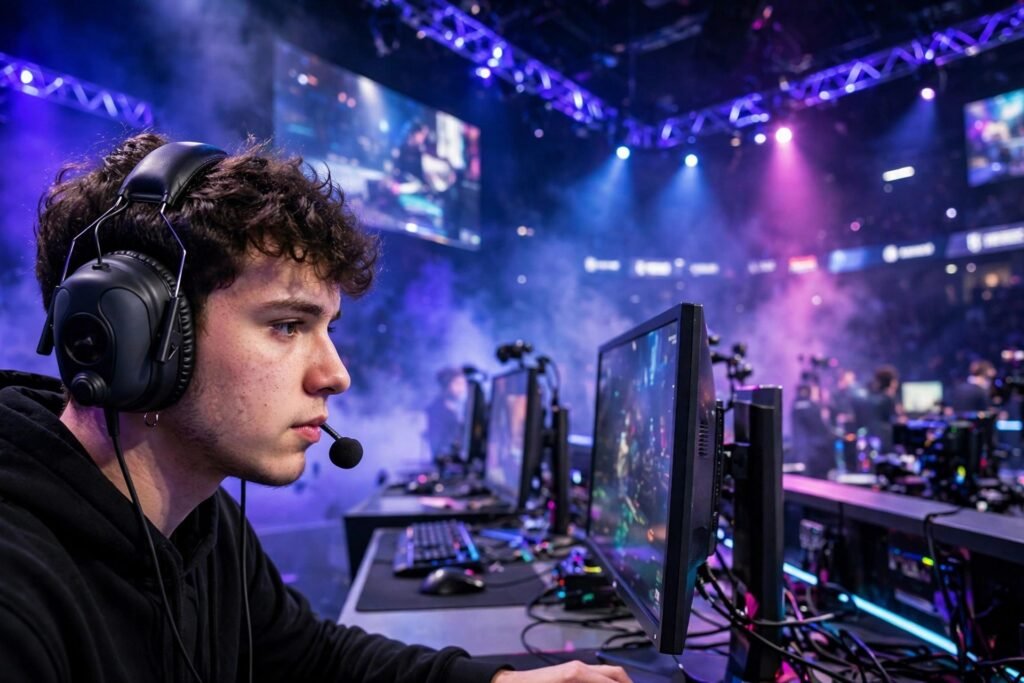
Esports fills arenas, pays million-dollar prize pools, and offers college scholarships — and it looks impenetrable from the outside. Where do you even start? The path from “I play games” to “I compete” is actually well-trodden, with entry points at every level from casual tournaments to professional leagues. This is the complete beginner’s roadmap: choosing your game, building skill, finding competition, and understanding what the journey really demands.
Step 1: Choose Your Game (and Commit)
The most important early decision is also the simplest: pick ONE game. Esports skill is deeply game-specific — thousands of hours in Valorant transfer minimally to League of Legends. Choose based on: genuine enjoyment (you’ll play thousands of hours; pick what you’d play anyway), scene accessibility (games with robust amateur infrastructure — Valorant, League of Legends, Rocket League, Counter-Strike 2, and Super Smash Bros. all have deep grassroots scenes), and your natural strengths (tactical thinking → MOBAs and tactical FPS; raw mechanics → aim-heavy FPS; creativity → fighting games).
Commit for at least a year. Game-hopping is the number one beginner mistake — every switch resets your progress to zero while competitors compound theirs. The game you pick matters less than the depth of your commitment to it.
Step 2: Build Fundamentals (Months 1–6)
Before competing, build the mechanical and knowledge foundation:
Master the basics deliberately
Aim trainers for FPS players, last-hitting drills for MOBA players, movement tech for fighting/platform games — 20–30 minutes of focused drills daily. Watch educational content (not just entertainment streams): pro guides, VOD reviews, and coaching videos teach the why behind plays. And play ranked seriously — ranked ladders are the primary skill-building environment, offering matched opponents and measurable progress.
Learn the game’s deeper systems
Every competitive game has layers invisible to casual players: economy management (CS2/Valorant), wave management (League), rotation timing (Apex), frame data (fighting games). Study these systematically — guides, wikis, and coaching content exist for all of them. Beginners who skip fundamentals hit hard plateaus; beginners who build them climb steadily.
Develop the competitive mindset early
Review your losses (save replays; watch deaths and ask “what information did I miss?”); separate ego from improvement (the goal is learning, not winning — paradoxically, this wins more); and build tilt resistance now (competitive gaming is emotional regulation training — the players who manage frustration climb; those who don’t, don’t).
Step 3: Enter Competition (Months 3–12)
You don’t need to be amazing to start competing — you need to be committed. The entry ladder:
Online tournaments and ladders
Start here: FACEIT and ESEA leagues (CS2), Valorant’s Premier mode (Riot’s official path-to-pro pipeline — genuinely the most accessible route in esports), Rocket League’s ranked tournaments, Smash’s local brackets via start.gg. These cost nothing, run constantly, and provide real competitive experience. Expect to lose — early tournament play is education, not achievement.
Find a team
Team games require teams, and finding the right one is a skill: Discord servers for your game’s competitive scene (the primary team-finding venue), r/RecruitCS and game-specific LFT (looking-for-team) channels, and school/university clubs (the most underrated entry point — structured, supportive, and increasingly scholarship-linked). Choose teammates for attitude and schedule compatibility over raw skill — a committed Diamond team improves faster than a flaky Immortal one.
Local LANs and collegiate
In-person events (local LANs, college tournaments) offer irreplaceable experience: playing under pressure, with teammates beside you, against real opponents. The collegiate scene is booming — hundreds of US colleges now field esports teams, many with scholarships. If you’re school-aged, this is the highest-value competitive avenue available. The Twitch esports directory and Esports.net track the competitive calendar across titles.
Step 4: Understand the Realities
Before dreaming of arenas, absorb the honest picture:
The time commitment
Serious amateur competition demands 20–30+ hours weekly — a part-time job’s worth. Professional aspiration demands 40–60. This must fit around school, work, and health; the players who sustain it longest are those who balance, not those who grind unsustainably.
The odds
Professional esports has athletic-level selectivity — tens of thousands compete for hundreds of salaried positions. Pursue it with the same clear-eyed commitment you’d bring to any elite athletic dream: extraordinary effort, genuine love of the process, and a parallel plan (education, career skills) running simultaneously.
Health and sustainability
Repetitive strain injuries, sleep disruption, sedentary health effects, and burnout end more careers than skill plateaus. The professionals with longevity treat their bodies like athletes: exercise, sleep discipline, ergonomic setups, and scheduled breaks. Your career length is a health management problem as much as a skill problem.
Alternative Paths in the Ecosystem
Playing professionally is one path among many in the esports ecosystem: coaching and analysis (every serious team needs them — a viable career with longer shelf life than playing); broadcasting and casting (the esports commentary world needs knowledgeable voices); event production and operations; content creation around competitive scenes; and collegiate administration as programs professionalize. Many who start aiming to compete find their lasting place adjacent to competition — and these roles often pay more reliably. The broader lesson applies beyond esports: profitable side hustles in and around gaming reward the same dedication as playing itself.
The Bottom Line
Get into esports as a beginner by: choosing one game and committing for a year, building fundamentals through deliberate practice and ranked play, entering free online tournaments and leagues (Valorant Premier, FACEIT, start.gg brackets), finding a team through Discord and school clubs, and understanding the honest realities of time, odds, and health. Start competing before you feel ready — the scene rewards participation, and every pro was once a beginner losing their first tournament. The only wrong move is waiting.
Finding Your First Team
Solo ranked grinds only go so far — organized team play is where esports actually lives, and finding a team is a social skill as much as a gaming one. Start in your game’s official Discord: most competitive titles have LFT (looking-for-team) channels segmented by rank and region. Post honestly about your rank, role, schedule, and goals — teams would rather have an honest silver than a lying diamond. Amateur leagues (various per game and region) run structured seasons with real schedules, which is the closest thing to the pro experience available to beginners. Expect tryouts: most teams will run a few sessions before committing, and you should evaluate them too — a toxic team will stall your growth faster than any skill gap. If approaching strangers feels daunting, working on networking effectively as an introvert pays dividends far beyond gaming. School and college programs are another on-ramp with built-in structure. Your first team will not be your last; treat it as education, compete hard, and the network you build becomes the real career asset.
Frequently Asked Questions
How do I start competing in esports?
Pick one game, build fundamentals for a few months, then enter free online tournaments (FACEIT, ESEA, Valorant Premier, start.gg brackets). You don’t need to be amazing — committed beginners are welcome at the entry level.
What age is too late for esports?
There’s no hard limit, but professional peaks cluster around 17-25 depending on the game. Collegiate and amateur competition welcomes all ages, and adjacent careers (coaching, casting) have no age ceiling.
How many hours do pro gamers practice?
Typically 8-12 hours daily for professionals — but serious amateurs progress well on 20-30 hours weekly. Quality and consistency matter more than raw hours.
Can esports get me a college scholarship?
Yes — hundreds of US colleges now offer esports scholarships, ranging from partial to full. The collegiate scene is one of the most accessible competitive avenues for school-aged players.
Do I need a team to compete?
For team games, eventually yes — but start with solo ranked and open tournaments. Find teammates through game Discords, LFT channels, and school clubs, prioritizing attitude and schedule over raw skill.