Do You Need a Wheel Alignment? Signs, Costs, and Timing
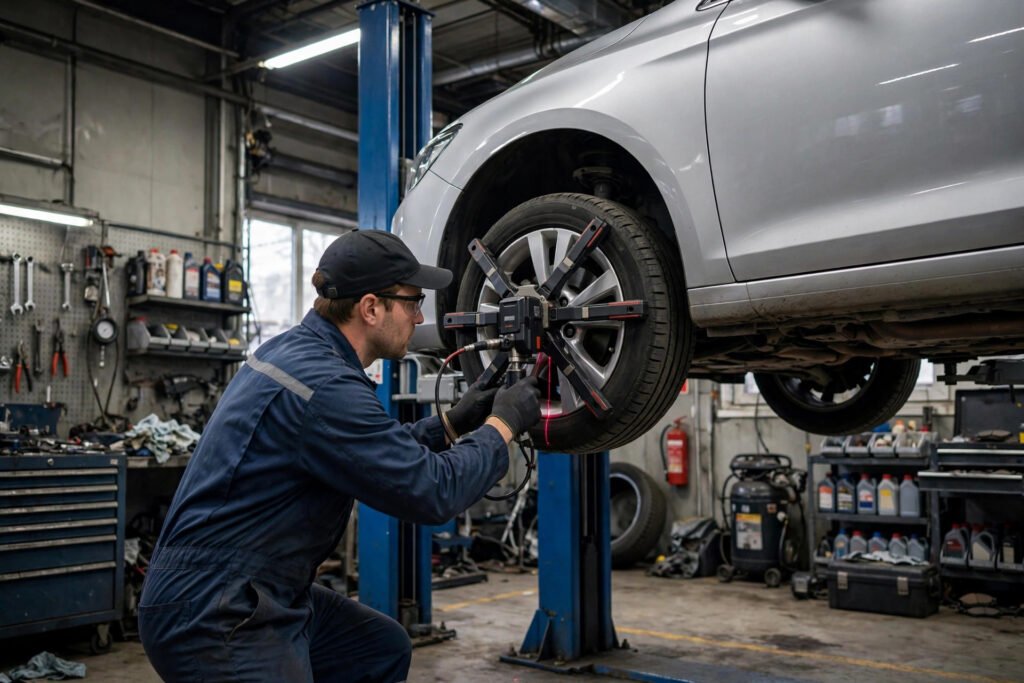
Your car pulls slightly to the right. The steering wheel sits crooked when you’re driving straight. Your front tires are wearing bald on one edge while the other edge looks new. These are your car’s way of telling you the wheels aren’t pointing where they’re supposed to — and ignoring them costs you money in tires, fuel, and eventually suspension parts. Wheel alignment is one of the most misunderstood maintenance items in America: drivers either ignore it until tires are ruined or pay for it every oil change when they don’t need it. Here’s how to know if you actually need a wheel alignment, what it costs, and how to avoid paying for one you don’t need.
What Wheel Alignment Actually Is
Despite the name, alignment isn’t about the wheels — it’s about the suspension angles that position them. Three measurements matter: camber (the wheel’s inward or outward tilt viewed from the front), toe (whether the wheels point slightly inward or outward viewed from above, like pigeon-toed or duck-footed), and caster (the steering axis angle that affects stability and steering feel). When these angles drift from factory specifications — due to potholes, curb strikes, worn suspension parts, or just mileage — the tires don’t roll straight. They scrub, drag, and wear unevenly.
Misalignment costs you in three ways. First, tires: uneven wear can destroy a $800 set of tires in 15,000 miles instead of 50,000. Second, fuel: dragging tires increase rolling resistance, costing you 2–5% in fuel economy — real money over a year of American driving. Third, safety and comfort: poor alignment affects handling, braking stability, and steering response, particularly in emergency maneuvers or bad weather. The National Highway Traffic Safety Administration’s tire safety resources emphasize that properly maintained tires — including alignment — are fundamental to vehicle safety, not optional luxuries.
The Five Signs You Need an Alignment
Sign one: the vehicle pulls to one side on a straight, flat road. Test this safely on an empty stretch — briefly loosen your grip (don’t let go) and see if the car drifts. Consistent pulling indicates a toe or camber problem, though it can also signal uneven tire pressure or a dragging brake, so check pressure first (it’s free). Sign two: the steering wheel is off-center when driving straight. If the wheel sits rotated a few degrees while the car tracks straight, your alignment is off — this is one of the most reliable indicators.
Sign three: uneven or rapid tire wear. Run your hand across the tread (carefully — check for exposed steel first): feathering (tread blocks worn smooth on one side, sharp on the other) indicates toe problems; wear concentrated on the inner or outer edge indicates camber issues; cupping or scalloped dips suggest worn suspension plus alignment problems. Sign four: the steering feels loose, wanders, or vibrates — particularly vibration that changes with speed. Sign five: you’ve hit something significant — a deep pothole, a curb at speed, or been in even a minor collision. Any meaningful impact can knock alignment out of spec instantly. These same tire checks apply when evaluating any vehicle — our guide to what to know before renting a car abroad covers inspecting a car before you commit, a habit that pays off whether you’re renting or buying.
When You Don’t Need One (Save Your Money)
Here’s what tire shops won’t volunteer: most cars don’t need alignment on a schedule. Unlike oil changes, alignment isn’t mileage-based maintenance — it’s condition-based. If your car tracks straight, the wheel is centered, and tires wear evenly, paying for an alignment is paying for a measurement that confirms what you already know. Many shops push alignments with every tire rotation or oil change as pure upsell; a reputable shop will show you the before-and-after spec printout, and if the “before” was already in spec, you didn’t need the service.
The legitimate triggers are specific: new tire installation (protect your investment — align when you mount new rubber), suspension work (any strut, control arm, tie rod, or ball joint replacement changes geometry and requires realignment), the symptoms listed above, and after significant impacts. Some drivers in pothole-heavy regions benefit from annual checks, but a check is not a service — many shops check alignment free with other work, charging only if adjustment is needed. Before a long drive, fold an alignment check into your broader preparation using our road trip planning guide — catching tire issues before 2,000 highway miles saves both money and roadside misery.
What It Costs and How to Not Get Ripped Off
A standard two-wheel (front-end) alignment runs $75–$150; a four-wheel alignment (needed for most modern cars with adjustable rear suspension) runs $100–$200. Prices vary by region and shop type — dealerships charge the most, independent shops less, tire chains often run promotional pricing. Be skeptical of the $39.99 alignment special: it typically covers only toe adjustment (the quick, easy angle) while ignoring camber and caster, or it’s a loss-leader to find worn parts to upsell.
Protect yourself with these rules. Always ask for the before-and-after printout showing your car’s measurements against factory specifications — this is standard on modern alignment machines, and refusal to provide it is a red flag. If the shop says you need suspension parts before aligning, get a second opinion on expensive claims; worn parts do genuinely prevent proper alignment, but “you need $800 in parts” is also a classic upsell. Ask whether the quote is for two-wheel or four-wheel — some shops advertise the cheaper price, then discover your car “needs” the four-wheel service. And consider lifetime alignment packages ($150–$250 at tire chains) only if you drive in pothole country and will actually use them; for most drivers, paying per-need is cheaper. AAA’s car care guidance offers additional benchmarks for fair maintenance pricing.
The Bottom Line
You need a wheel alignment when your car pulls, the steering wheel sits crooked, tires wear unevenly, the steering feels wrong, or you’ve hit something hard — not on a calendar schedule. Expect to pay $75–$200, always demand the before-and-after spec printout, and align when mounting new tires or after suspension work. It’s condition-based maintenance: learn the symptoms, skip the upsells, and your tires (and wallet) will last dramatically longer. If you drive rough roads daily, get a quick free alignment check once a year — catching drift early beats replacing a ruined set of tires every time.
Frequently Asked Questions
How often should I get a wheel alignment?
There’s no fixed schedule — it’s condition-based. Get one when you notice symptoms (pulling, uneven wear, off-center wheel), when mounting new tires, after suspension work, or after hitting a major pothole or curb.
How long does a wheel alignment take?
Typically 45–90 minutes for the alignment itself. If the shop finds worn suspension parts that must be replaced first, the total visit takes longer.
Can I drive with bad alignment?
Short term, yes — but it destroys tires fast, wastes fuel, and degrades handling and braking. Prolonged driving on badly misaligned wheels can also damage suspension components, turning a $150 service into a $1,000+ repair.
Does alignment affect gas mileage?
Yes — misaligned wheels increase rolling resistance, typically costing 2–5% in fuel economy. On 12,000 miles a year, that’s $50–$150 in wasted fuel, on top of accelerated tire wear.