Is Your Pet Overweight? How to Tell and Fix It Safely at Home
Here’s an uncomfortable statistic: the majority of dogs and cats in America are overweight or obese — surveys by the Association for Pet Obesity Prevention have repeatedly found over half of dogs and nearly 60% of cats exceed healthy weight. And most of their owners have no idea. We love our pets, and we express it with food — but those extra pounds aren’t cosmetic. Obesity in pets is linked to diabetes, arthritis, heart disease, certain cancers, and a measurably shorter life: one landmark lifespan study found overweight dogs lived nearly two years less than their lean counterparts. Here’s how to assess your pet honestly and fix it without a battle.
The Honest Assessment: Is My Pet Overweight?
The hands-on tests (do these right now)
The rib check: run your hands along your pet’s ribcage with light pressure. You should easily feel the ribs under a thin fat covering — like feeling knuckles through a thin glove. If you have to press firmly to find ribs, your pet is overweight. If you can’t feel them at all, that’s obesity.
The overhead view: look down at your pet from above. You should see a visible waist — an hourglass tuck behind the ribs. A straight line from ribs to hips (or worse, bulging outward) means excess weight. Dogs should also show an abdominal tuck from the side — the belly should rise up behind the ribcage, not hang level or sag.
The numbers: ask your vet for your pet’s ideal weight and body condition score (BCS 1–9 scale; 4–5 is ideal). Then weigh monthly — for cats and small dogs, a baby scale; for large dogs, weigh yourself holding them and subtract. The scale doesn’t lie, even when the mirror is kind.
Why owners miss it
Weight gain is gradual — a pound a month is invisible day to day but devastating over a year. We also normalize it: when most pets at the dog park are chunky, chunky looks normal. And breeds deceive: a “big-boned” Labrador is usually just an overfed Labrador. Trust the rib check over your eyes.
Why It Matters: The Health Costs
Excess weight isn’t just aesthetics. In dogs, obesity dramatically increases the risk of cranial cruciate ligament tears ($3,000–$5,000 surgeries), worsens arthritis, and predisposes to diabetes and respiratory compromise — especially in flat-faced breeds. The AVMA’s pet obesity resources and PetMD’s pet weight-loss plans both emphasize that even modest weight loss measurably improves outcomes. In cats, obesity is the primary risk factor for diabetes mellitus, causes hepatic lipidosis (fatty liver) risk during any appetite loss, and makes grooming impossible, leading to skin disease. Across species, fat tissue isn’t inert — it’s metabolically active, promoting chronic inflammation. The two-years-shorter lifespan finding isn’t a scare tactic; it’s published research. For perspective on healthy targets, a healthy rate of weight loss in people is 1–2 pounds weekly — pets need their own scaled version (below), but the principle of gradual, sustainable loss is identical.
The Weight-Loss Plan That Actually Works
Step 1: Vet visit and target weight
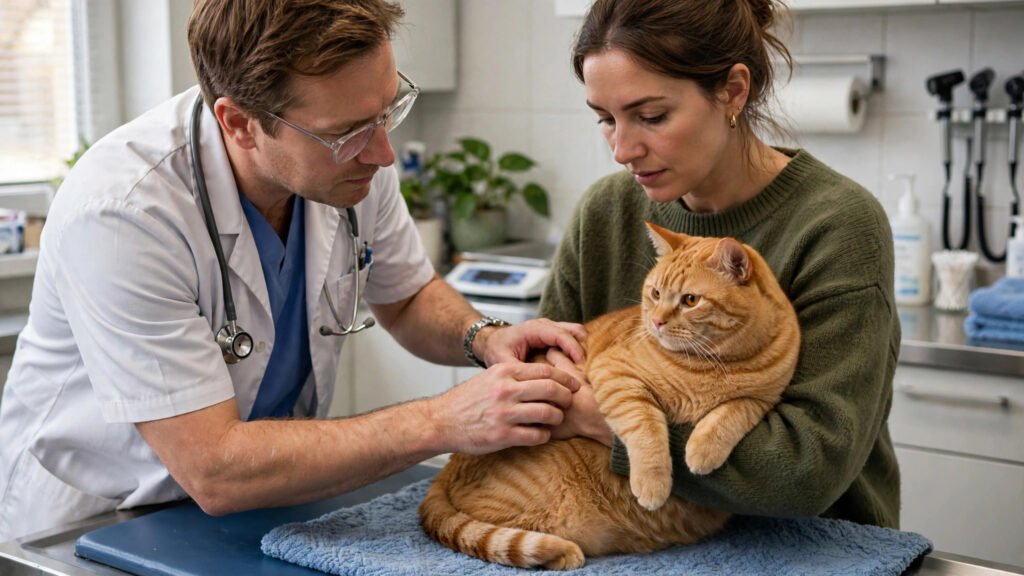
Rule out medical causes first — hypothyroidism in dogs and fluid-weight from heart disease can mimic simple obesity. Get a target weight and a daily calorie number from your vet. This matters because pet food bag guidelines are notoriously generous (they’re written for intact, active animals, and most pets are neutered couch-dwellers needing 20–30% less).
Step 2: Measure everything
The level scoop from the bag is a lie — studies show owners over-pour by up to 50%. Use an actual measuring cup or, better, a kitchen scale. Count treats: they should be under 10% of daily calories, and those training treats add up shockingly fast. Audit the household — the pet’s weight-loss plan fails if one family member keeps slipping table scraps. Everyone commits or no one does.
Step 3: Feed for the target weight, not the current weight
Calculate portions for the weight your pet should be, creating a gentle deficit. For most pets, that’s 20–30% fewer calories than maintenance at current weight. Consider a veterinary weight-management formula — they’re designed to keep pets full on fewer calories with proper nutrition, which beats simply feeding less of a calorie-dense food.
Step 4: Add movement gradually
An obese pet can’t start with marathon walks — joints and cardiovascular fitness need gradual building. Start with two short daily walks, increasing 5 minutes weekly. For cats: interactive play sessions (wand toys, 10 minutes twice daily), food puzzles that make meals earned through movement, and vertical space. Swimming is superb for arthritic obese dogs. The goal is consistency, not intensity — the best diet approach for fat loss always pairs nutrition with activity, and that applies on four legs too.
Step 5: Track and adjust monthly
Weigh monthly. Target 1–2% of body weight loss per week for dogs, 0.5–2% for cats (cats must lose slowly — rapid weight loss triggers fatty liver disease). Plateau for a month? Reduce calories another 10% or add activity. This is a 6–12 month project, not a 6-week one.
Mistakes That Sabotage Pet Weight Loss
Crash dieting the cat. Never severely restrict a cat’s food abruptly — obese cats that stop eating risk hepatic lipidosis, which is life-threatening. Slow and vet-supervised.
The treat loophole. “Just a little cheese” three times a day can be 200+ calories — for a cat needing 250 daily, that’s nearly doubling intake. Switch to low-calorie treats (baby carrots, green beans for dogs) or use kibble from the measured daily ration as treats.
Free-feeding. The all-day buffet makes portion control impossible. Scheduled meals, measured portions, food picked up after 20 minutes.
Giving up at the plateau. Weight loss slows as the pet gets lighter (smaller body needs fewer calories). Adjust, don’t abandon.
Conclusion
Pet obesity is an epidemic of love — we overfeed because we care. But the kindest thing you can do for an overweight pet is also the hardest: measure the food, count the treats, add the walks, and hold the line when those eyes beg. Do the rib check today, get a target weight from your vet this month, and start the gradual plan. In a year, you’ll have a leaner, more energetic pet with years added to her life — and that’s worth more than every treat you didn’t give.
Frequently Asked Questions
How do I tell if my pet is overweight?
Feel the ribs (should be easy to feel under thin fat), look for a visible waist from above and an abdominal tuck from the side. Your vet can assign a body condition score (ideal is 4-5 out of 9).
How much should I feed my overweight pet?
Feed for the target weight, not current weight — typically 20-30% fewer calories than current maintenance. Get the exact calorie target from your vet; bag guidelines usually overestimate.
How fast should a pet lose weight?
1-2% of body weight per week for dogs; 0.5-2% for cats (slower — rapid loss risks fatty liver disease in cats). Expect a 6-12 month journey for significant loss.
Can an overweight cat lose weight safely?
Yes, but slowly and with veterinary supervision. Never crash-diet a cat — abrupt food restriction in obese cats can trigger life-threatening hepatic lipidosis.
Do I need special diet food?
Veterinary weight-management formulas help — they’re designed for satiety on fewer calories with complete nutrition. They’re often more effective than simply feeding less regular food.