How Long Car Batteries Really Last in Hot Climates
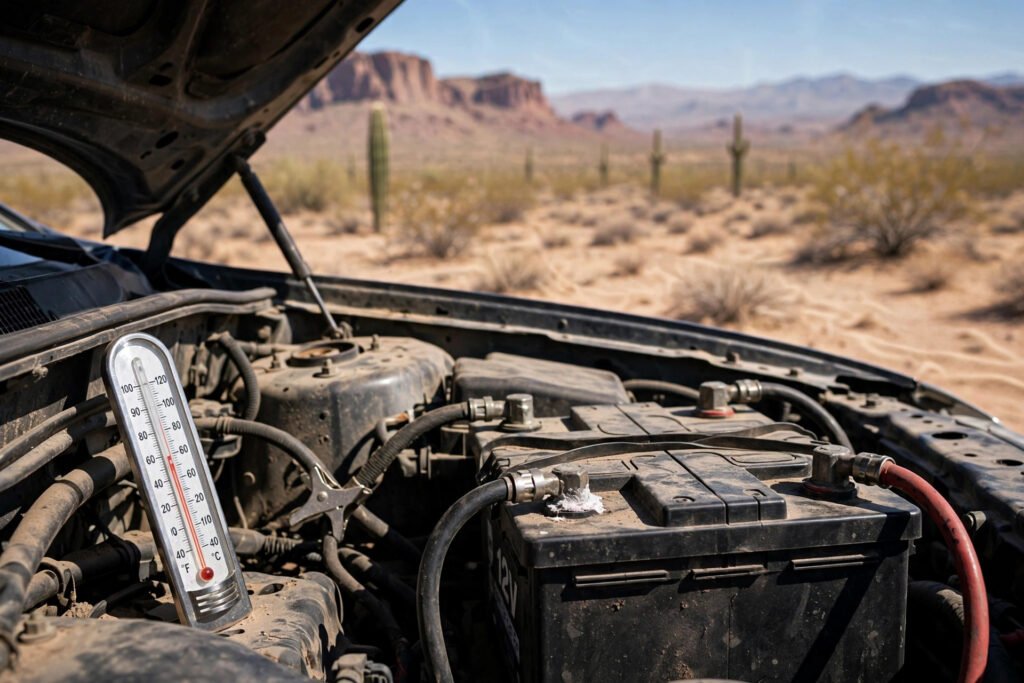
If you live in Phoenix, Las Vegas, Houston, or Miami, you’ve lived this story: the car starts fine in the morning, you run errands at noon, and by 3 p.m. in a sun-baked parking lot — click, click, nothing. Heat is the silent assassin of car batteries, and in America’s hottest states, batteries die years earlier than the national average. While a battery in Minnesota might last five or six years, the same battery in Arizona is doing well to see three. Here’s how long car batteries actually last in hot climates, why heat kills them, and how to squeeze every possible month out of yours.
The Numbers: What to Realistically Expect
Nationally, the average car battery lasts 3–5 years, with premium batteries sometimes reaching 6 in mild climates. In hot climates — the Sun Belt states where summer highs routinely exceed 100°F — realistic life drops to 2–3 years for standard batteries, 3–4 for premium AGM (absorbent glass mat) types. Fleet data from AAA, which responds to millions of battery-related calls annually, consistently shows battery failures clustering in extreme heat regions and peaking during summer months — heat doesn’t just shorten battery life, it times the failure for the most miserable possible moment.
Several factors compound the heat penalty. Short-trip driving is brutal: the starter drains the battery, and trips under 15 minutes don’t let the alternator fully recharge it — chronic undercharging in heat accelerates plate degradation. Vehicles with heavy electrical loads (aftermarket stereos, dashcams running in parking mode, phone chargers left plugged in) drain reserves faster. And age stacks with heat multiplicatively: a 3-year-old battery entering an Arizona summer is living dangerously, while the same battery in Oregon has years left. AAA’s battery testing and replacement guidance recommends testing annually after year two in hot climates — a free 5-minute test at most auto parts stores that predicts failure before it strands you.
Why Heat Destroys Batteries (The Chemistry)
Understanding the enemy helps you fight it. Inside your battery, lead plates sit in sulfuric acid electrolyte, and the chemical reactions that store and release energy accelerate with temperature — which sounds good until you learn the destructive reactions accelerate too. Heat speeds up the corrosion of the positive grid (the battery’s internal skeleton), evaporates the water from the electrolyte (exposing plates to air, which kills them), and accelerates sulfation — the buildup of lead sulfate crystals that permanently reduces capacity.
The cruel irony: heat damage is cumulative and invisible, but the failure appears in a moment. A battery weakened by two Phoenix summers can still start the car on a mild morning — then fail completely when asked to crank a heat-soaked engine at 115°F, when the starter needs maximum current and the battery has minimum capacity. Cold gets the reputation as the battery killer because failures surface on winter mornings, but battery engineers will tell you heat does the killing and cold merely exposes the corpse. Parking in shade or a garage isn’t just comfort — it measurably extends battery life by reducing the peak temperatures the case endures daily.
Maximizing Battery Life in the Heat: What Actually Works
Start with the battery itself: in hot climates, buy for heat tolerance, not just cold-cranking amps (a northern metric). AGM batteries handle heat and vibration significantly better than conventional flooded batteries — they cost 40–60% more but often last a full year longer in the Sun Belt, making them the better value where it counts. Check the manufacturing date before buying (a sticker with month/year) — never buy a battery that’s been sitting on the shelf for 6+ months, especially in a hot warehouse. Fresher is better.
Then manage the environment and usage. Park in shade or garages whenever possible — a battery baking at 150°F inside a closed car degrades far faster than one at 100°F in shade. Use a battery insulation kit or heat shield if your vehicle didn’t come with one (many manufacturers include them; check yours is intact). Keep terminals clean and tight — corrosion increases resistance, making the battery work harder; a $5 wire brush and annual cleaning prevents this. Minimize short trips when possible, or take the long way home occasionally to let the alternator fully recharge. And if the car sits for weeks (snowbirds, second vehicles), use a battery maintainer/trickle charger — letting a battery self-discharge in heat for a month can permanently damage it. When you’re preparing for summer driving season, fold battery testing into your broader prep with our road trip preparation guide — a dead battery 200 miles from home is the most preventable of road trip disasters. These habits matter for any vehicle you depend on, including rentals in hot climates: review what to know before renting a car abroad and its pre-rental inspection checklist before driving off the lot.
Knowing When Replacement Time Has Come
Don’t wait for the click of death. The warning signs: slow engine cranking (that labored rrrr-rrr-rrr instead of a crisp start), dimming headlights at idle that brighten when you rev, the battery warning light, swollen or bloated battery case (heat damage made visible — replace immediately), corroded terminals that return quickly after cleaning, and age — any battery past 3 years in a hot climate is on borrowed time regardless of symptoms. Electrical gremlins (flickering lights, glitchy infotainment, warning lights appearing randomly) often trace to a weak battery before anything else.
Get free testing annually after year two: auto parts stores will load-test your battery in minutes, measuring its actual cranking capacity against its rating. Replace proactively when capacity drops below 70–80% — a $150–$250 planned replacement beats a $150 tow plus a $250 emergency battery plus a ruined afternoon. When buying, match the group size exactly (fit matters — a loose battery vibrates, and vibration kills), prioritize fresh manufacture dates and strong warranties (3-year free replacement is the benchmark), and consider the upgrade to AGM if you’re in sustained extreme heat. Keep the receipt and warranty paperwork — in hot climates, you’ll use that warranty more often than drivers elsewhere, which is precisely why buying from a national chain with locations everywhere matters. Consumer Reports’ car battery ratings test real-world performance and are worth consulting before you buy.
The Bottom Line
In America’s hot climates, expect 2–3 years from a standard car battery and 3–4 from a premium AGM — roughly half the life of the same battery in mild regions. Heat accelerates corrosion, evaporation, and sulfation invisibly, then kills suddenly on the hottest day. Fight back with AGM batteries, shade parking, clean terminals, annual free testing after year two, and proactive replacement before failure. The battery will die — in the heat, that’s physics. Whether it strands you in a parking lot at 115°F or gets swapped calmly in your driveway is entirely your choice.
Frequently Asked Questions
Does heat or cold kill car batteries faster?
Heat does the killing, cold exposes it. High temperatures accelerate the chemical degradation (corrosion, water loss, sulfation) that permanently weakens batteries; cold then reveals the weakness because engines need more cranking power in winter. Hot-climate batteries die younger.
How can I test my car battery at home?
A $20 multimeter gives a rough voltage check (12.6V+ fully charged, engine off), but voltage alone doesn’t reveal capacity loss. For a real answer, get a free load test at any auto parts store — it measures actual cranking performance in minutes.
Are expensive AGM batteries worth it in hot climates?
Usually yes. AGMs cost 40–60% more but resist heat and vibration better, typically lasting an extra year in the Sun Belt. The cost-per-year often beats conventional batteries where heat is the primary killer.
Why did my battery die suddenly with no warning?
Because heat damage is cumulative and invisible — capacity erodes silently until it drops below what the starter needs on a hot day. This is why proactive testing and age-based replacement beat waiting for symptoms in hot climates.