Renting vs. Buying Right Now: The Honest Math for 2026
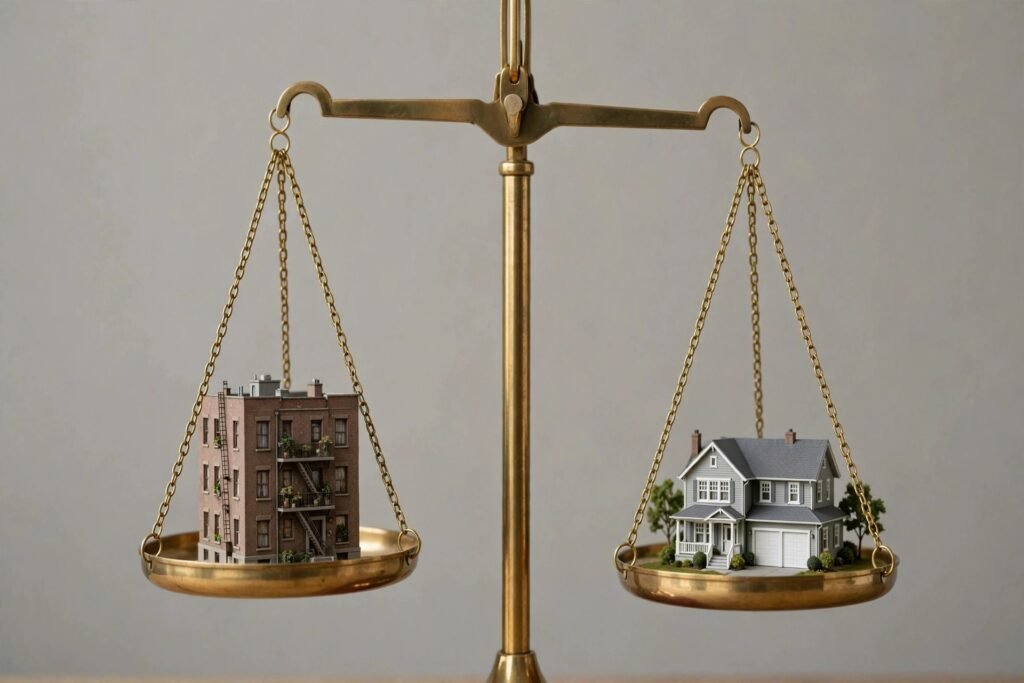
Rent or buy? It’s the defining money question for millions of Americans right now, and the honest answer is more nuanced than either camp admits. The “renting is throwing money away” crowd ignores transaction costs, maintenance, and flexibility. The “buying is a trap” crowd ignores forced savings, payment stability, and decades of wealth data. The truth: the right choice depends on your timeline, your market, your finances, and your life — and there’s actual math to settle it. Here’s how to run the numbers for 2026 and make the decision with confidence instead of slogans.
The Real Cost Comparison (Beyond Mortgage vs. Rent)
Most people compare monthly rent to monthly mortgage payment and stop there. That’s like comparing cars by sticker price alone. The true cost of owning includes: mortgage principal and interest, property taxes, homeowner’s insurance, HOA fees, maintenance (budget 1–2% of home value annually), and the opportunity cost of your down payment (money that could have been invested). The true cost of renting includes: rent, renter’s insurance, and any non-refundable fees — but also the flexibility to move cheaply and the freedom from surprise $15,000 repair bills.
The key metric is the price-to-rent ratio: divide a home’s price by its annual rent for a comparable property. Ratios below 15 generally favor buying; above 20 generally favor renting; 15–20 is the gray zone where timeline decides. In 2026, many American markets sit in that gray zone or above it, thanks to elevated prices meeting higher mortgage rates. But national averages lie — your specific neighborhood’s ratio is what matters, and it varies enormously even within a metro area. Calculate it for the actual homes and rentals you’re considering, not from headlines. The National Association of Realtors’ market data can help you find local price and rent trends to ground your math.
The 5% Rule: A Quick Sanity Check
For a fast, sophisticated estimate, use the 5% rule popularized by financial analysts: the unrecoverable costs of owning (the money you never get back) roughly equal 5% of the home’s value per year — about 3% for property taxes, maintenance, and insurance, plus 2% for the opportunity cost of your down payment. If 5% of the home’s price exceeds the annual rent for a comparable place, renting is likely cheaper; if rent exceeds 5% of the price, buying likely wins. On a $400,000 home, 5% is $20,000/year or $1,667/month — if comparable rent is $1,400, renting wins on pure cost; if rent is $2,000, buying wins.
This rule isn’t perfect — it ignores principal paydown (forced savings), appreciation, tax benefits, and rent inflation — but it’s directionally powerful and takes 30 seconds. The factors it omits mostly favor buying over long timelines, which is why timeline is the ultimate tiebreaker. Over 2–3 years, transaction costs (roughly 8–10% round-trip to buy and sell) almost always make renting cheaper. Over 7–10 years, ownership’s forced savings and payment stability almost always win. The breakeven typically lands around 4–6 years depending on the market. Anyone telling you there’s a universal answer is selling something — probably a house, or clicks.
The Case for Buying Right Now
Buying wins when your timeline is long, your finances are solid, and the local math works. The wealth-building mechanics are real: each mortgage payment builds equity through principal paydown (slowly at first, faster over time), appreciation compounds on the full home value (not just your down payment — 3% appreciation on a $400,000 home is $12,000 gained on an $80,000 investment), and your housing payment stabilizes while rents historically rise 3–5% annually. Over a decade, the renter’s payment grows relentlessly while the owner’s (fixed-rate) stays flat — that divergence is where ownership’s wealth effect lives.
Buying also makes sense for life reasons math can’t capture: stability for kids in schools, freedom to renovate and customize, a hedge against being priced out of your own neighborhood, and the psychological security of ownership. And in markets where buying costs are close to renting, the forced-savings aspect alone justifies it — many homeowners build more wealth through principal paydown than they ever would through disciplined investing, simply because the mortgage enforces the discipline. If you’re buying, make the purchase work harder with our guide to saving for a big purchase, which covers structuring your finances for ownership’s true costs.
The Case for Renting Right Now
Renting wins when flexibility matters, timelines are short, or the local math is ugly. If you might move within 3–5 years for career, relationships, or uncertainty, renting avoids the transaction-cost shredder that eats short-term ownership returns. If buying in your market costs 40–50% more monthly than renting a comparable place, that gap invested diligently can outperform ownership — the math is uncomfortable for buy-at-all-costs advocates, but it’s real in high price-to-rent markets.
Renting also wins on risk and simplicity. No $20,000 roof surprises. No property tax reassessments. No being trapped in an underwater mortgage if you need to relocate during a downturn. For people with variable income, uncertain careers, or a desire to stay mobile, renting isn’t settling — it’s the rational choice, and the stigma around it is a marketing artifact of the real estate industry. Renters can also live better locations for less: the apartment in the walkable neighborhood you’d never afford to buy. And if you’re renting by choice while building wealth elsewhere, make the rental genuinely work for you — making a small apartment feel bigger is a small upgrade with outsized daily-life returns. Bankrate’s rent-vs-buy calculators let you model both paths with your actual numbers.
Making Your Decision: The Framework
Answer four questions honestly. One: will I stay 5+ years? (Yes favors buying; no favors renting.) Two: is the monthly cost of owning (all-in: mortgage, taxes, insurance, maintenance reserve) within 20–30% of comparable rent? (Close favors buying; far apart favors renting.) Three: are my finances solid — down payment, closing costs, emergency fund intact, stable income? (Yes enables buying; no mandates waiting regardless of market.) Four: does my life need stability or flexibility right now? (Stability favors buying; flexibility favors renting.)
Three or four answers pointing the same direction is your answer. Split decisions mean the gray zone — where either choice is defensible and the tiebreaker is which regret you’d rather live with. And remember the meta-truth: the rent-vs-buy decision matters far less than the savings decision. A renter who invests the difference diligently builds wealth; a buyer who stretches into an unaffordable payment builds stress. The housing choice is the vehicle; your savings rate is the engine.
The Bottom Line
In 2026 America, renting vs. buying has no universal winner — only winners for specific situations. Buy when your timeline exceeds five years, the local price-to-rent math is reasonable, your finances are solid, and your life wants stability. Rent when your horizon is short, the ownership premium is steep, your finances need strengthening, or flexibility is the priority. Run your actual numbers with the 5% rule and price-to-rent ratio, ignore the slogans from both camps, and choose the path your real life — not someone else’s ideology — supports.
Frequently Asked Questions
Is renting really throwing money away?
No. Rent buys housing, flexibility, and freedom from maintenance risk — real value. Whether it “wastes” money depends on the local price-to-rent ratio and your timeline, not on moral judgments about renting.
How long do I need to stay for buying to beat renting?
Typically 4–6 years, with 5+ as the common rule of thumb. Shorter stays get eaten by ~8–10% round-trip transaction costs; longer stays let appreciation, principal paydown, and rent inflation work in your favor.
What is the 5% rule in rent vs. buy?
A quick test: unrecoverable ownership costs run ~5% of home value yearly (taxes, maintenance, insurance, opportunity cost). If annual rent is below 5% of the home’s price, renting is likely cheaper; above 5%, buying likely wins.
Should I buy if I can barely afford the payment?
No. Stretching into an unaffordable payment is the fastest path to financial stress and foreclosure risk. Wait, strengthen your finances, and buy when the payment fits comfortably — the market will still be there.