Dark Matter Explained: What It Is and Why It’s Invisible
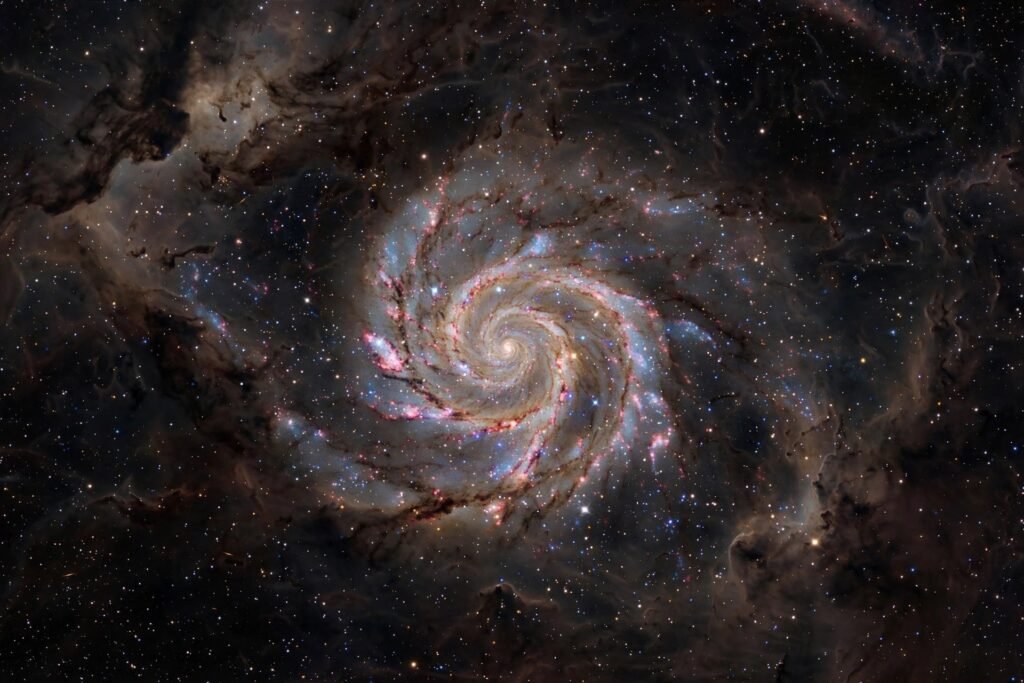
Here is a humbling fact: everything you have ever seen — every star, planet, person, and galaxy — accounts for less than 5% of the universe. The rest is invisible: about 27% is dark matter, and 68% is dark energy. Dark matter is the more concrete mystery — we can map where it is, measure how much there is, and watch its gravitational effects — yet after a century of searching, no one has directly detected a single particle of it. What is this invisible stuff, how do we know it is there, and why can’t we see it?
This guide explains the evidence, the leading theories, and the state of the hunt for the universe’s missing mass.
The Evidence: How We Know It’s There
Dark matter was not hypothesized on a whim — it was forced on physics by observations that visible matter cannot explain:
1. Galaxies spin too fast. In the 1970s, Vera Rubin measured stars orbiting the outskirts of galaxies and found them moving far too fast — by visible mass alone, they should fly off into space, like a carousel spinning so fast riders are flung outward. Something invisible provides the extra gravitational glue. This “galaxy rotation problem” was the smoking gun.
2. Gravitational lensing reveals invisible mass. Massive objects bend light; by mapping how light from distant galaxies is distorted, astronomers can weigh the intervening matter — and consistently find five to six times more mass than visible matter accounts for. The Bullet Cluster — two colliding galaxy clusters — is the iconic case: the visible gas (seen in X-rays) was stripped and left behind, but the gravitational lensing stayed with the invisible component, which passed through cleanly. Dark matter mapped, separated from normal matter, in plain view.
3. The cosmic microwave background demands it. The baby photo of the universe — the cosmic microwave background, beautifully explained in acclaimed cosmology documentaries — encodes the universe’s composition: its fluctuation patterns only match models containing ~27% dark matter. Without it, the early universe’s structure could not have formed as observed.
4. Galaxies could not have formed without it. Normal matter alone, buffeted by radiation pressure in the early universe, could not have clumped fast enough to build galaxies. Dark matter’s gravity provided the scaffolding — invisible frameworks into which normal matter fell. Computer simulations of cosmic structure only produce realistic universes when dark matter is included.
Why We Can’t See It: The Nature of the Invisibility
“Dark” does not mean black — it means non-interacting with light. Normal matter is visible because its particles carry electric charge: electrons absorb, emit, and scatter photons. Dark matter, whatever it is, appears to lack electric charge entirely — photons pass through it as if it were not there. It also appears to interact with normal matter only through gravity (and possibly the weak nuclear force), making it extraordinarily elusive.
Think of it this way: you are trying to detect something that does not shine, reflect, absorb, or block light; passes through planets like they are not there; and announces itself only by its gravitational pull on visible things. It is like mapping wind by watching trees bend — possible, but you will never see the wind itself. NASA’s astrophysics programs (NASA science) summarize the evidence and the ongoing search.
The Suspects: What Could Dark Matter Be?
The leading candidates fall into three families:
WIMPs (Weakly Interacting Massive Particles). The long-time favorite: hypothetical particles with mass but only weak-force and gravitational interactions. Elegant theories (like supersymmetry) predicted them naturally, and their expected abundance matched observations beautifully — the “WIMP miracle.” Decades of increasingly sensitive underground detectors have found nothing, progressively ruling out the most promising WIMP territory. The favorite is on the ropes, but not out.
Axions. Hypothetical ultra-light particles, originally proposed to solve a different physics puzzle (the strong-CP problem). Axions would be so light that trillions pass through you every second. Dedicated experiments (like ADMX) are hunting them with exquisite sensitivity — the search is active and narrowing.
Sterile neutrinos and primordial black holes. Heavier neutrinos that do not interact normally; or black holes formed in the Big Bang’s first instants, ranging from asteroid-mass to stellar-mass. Gravitational-wave detectors and microlensing surveys are testing the black-hole hypothesis — so far, they can account for only a fraction of dark matter at most.
The radical alternative: maybe it is not matter at all. Modified gravity theories (like MOND — Modified Newtonian Dynamics) propose that our understanding of gravity breaks down at galactic scales, and no invisible matter is needed. MOND explains galaxy rotation curves beautifully but struggles with the Bullet Cluster and the CMB — observations that dark matter handles naturally. Most physicists bet on particles, but the debate is genuinely alive.
The Hunt: How Scientists Are Searching
Three complementary strategies: Direct detection — massive underground vats of liquid xenon (shielded from cosmic rays by kilometers of rock) waiting for a dark matter particle to bump an atom. Experiments like LUX-ZEPLIN are the most sensitive ever built — and have found nothing yet, which itself is valuable data, ruling out vast territories. Indirect detection — space telescopes hunting the gamma rays or antimatter that dark matter annihilations might produce in dense regions like the galactic center. Tantalizing hints appear periodically; none has survived scrutiny so far. Production — smashing particles at CERN’s Large Hadron Collider hoping to create dark matter particles and detect their absence (missing energy). The LHC has found no new physics yet — a profound result in itself.
The null results are not failures — they are map-making. Every excluded region narrows where dark matter can hide. The next generation of detectors, with orders of magnitude more sensitivity, will probe the remaining hiding spots within the decade.
Dark Matter vs. Dark Energy: Don’t Confuse Them
Despite the names, they are unrelated mysteries. Dark matter (27%) clumps via gravity and holds galaxies together — it is missing mass. Dark energy (68%) is uniformly spread and drives the universe’s accelerating expansion — it is missing energy, possibly a property of empty space itself. One pulls things together; the other pushes everything apart. Both are called “dark” only because we cannot see them.
Conclusion
Dark matter is the universe’s greatest confirmed mystery: we know it is there from galaxy rotations, gravitational lensing, the cosmic microwave background, and cosmic structure — we can map it, weigh it (27% of everything), and watch it shape the cosmos — yet we cannot see it because it does not interact with light, and we have never directly detected a particle of it. The leading suspects (WIMPs, axions, sterile neutrinos) are being hunted by the most sensitive instruments ever built, in deep mines, in space, and in particle colliders. Whether the answer is an undiscovered particle or a revolution in our understanding of gravity, finding it will rewrite physics — and it makes excellent trivia night material in the meantime. The invisible majority of the universe is waiting to be identified — and the hunt is one of the most exciting frontiers in all of science.
Frequently Asked Questions
What is dark matter made of?
Unknown — that is the mystery. Leading candidates include WIMPs, axions, and sterile neutrinos (hypothetical particles), or possibly primordial black holes. Decades of searches have not yet directly detected any of them.
How do we know dark matter exists if we can’t see it?
Through its gravity: galaxies spin too fast for their visible mass, gravitational lensing reveals 5–6× more mass than visible matter, the cosmic microwave background requires it, and cosmic structure could not have formed without it. Multiple independent lines of evidence converge.
Could dark matter just be regular matter we can’t see?
No — ordinary “dark” objects (black holes, dim stars, rogue planets, dust) have been inventoried and account for only a small fraction. The required amount and its behavior (passing through itself in cluster collisions) demand something fundamentally different.
What’s the difference between dark matter and dark energy?
Dark matter (27% of the universe) clumps gravitationally and holds galaxies together. Dark energy (68%) is spread uniformly and accelerates cosmic expansion. They are unrelated phenomena sharing only the word “dark” (meaning unseen).
Will we ever directly detect dark matter?
Possibly within the decade — next-generation detectors will probe the remaining viable hiding spots for leading candidates. But it is also possible the answer requires new physics beyond current theories. Either outcome would be revolutionary.