Best Home Workout Routine for Building Muscle
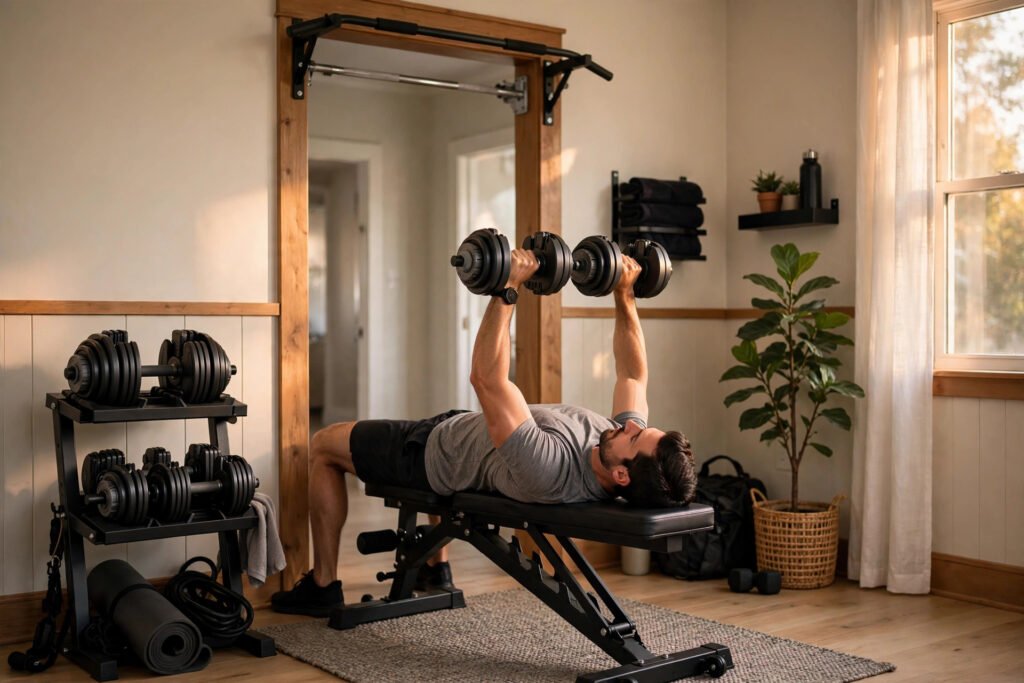
Gym memberships in America average $50+ a month, personal training costs a fortune, and the nearest decent gym might be 30 minutes away. Meanwhile, your living room is sitting there, rent already paid. The question isn’t whether you can build muscle at home — it’s whether you know how to program it. Because the physiology doesn’t care where you train: muscle grows in response to progressive tension, adequate protein, and recovery. Your zip code is irrelevant.
This guide gives you the complete home muscle-building system: the minimal equipment that covers everything, the full-body routine that drives growth, the progression method that replaces adding gym plates, and the nutrition that makes it all work. No gym required — ever.
The minimal equipment that builds maximal muscle
You don’t need a home gym that looks like a fitness influencer’s garage. Three purchases cover 95 percent of effective home training:
- Adjustable dumbbells (up to 50–90 lbs per hand): the single best home investment. Quality sets run $250–$400 in the US and replace an entire dumbbell rack. Everything below is built around them.
- Adjustable bench: flat-to-incline, $150–$250. Unlocks pressing variations, rows, and Bulgarian split squats.
- Pull-up bar (doorway): $30–$60. The best upper-body pulling exercise needs no machine.
Total: under $700 for a setup that lasts a decade — roughly one year of a mid-range gym membership. Optional later additions: resistance bands ($30, great for warm-ups and accessory work), a kettlebell ($50–$100, swings and goblet squats), and a weight vest for progressing bodyweight moves. Start with the big three; add only when you’ve outgrown them, which takes most lifters 1–2 years.
The routine: full-body, 3 days a week
For home lifters, full-body sessions three times weekly beat body-part splits — you hit every muscle 3× per week (the frequency research favors for growth) with built-in recovery days. Here’s the template; alternate A and B sessions:
Workout A: goblet squats (or dumbbell front squats) 3×8–12, dumbbell bench press 3×8–12, one-arm dumbbell rows 3×8–12 per side, Romanian deadlifts 3×10–15, standing overhead press 2×8–12, planks 3×45–60 sec.
Workout B: Bulgarian split squats 3×8–12 per leg, incline dumbbell press 3×8–12, pull-ups (or band-assisted) 3×max, dumbbell Romanian deadlifts 3×10–15, lateral raises 2×12–15, dead bugs 3×10 per side.
Sessions run 45–60 minutes. Rest 90 seconds between sets of big movements, 60 for accessories. The exercise selection is deliberate: every session hits legs, push, pull, hinge, and core — the five patterns that build a complete physique. Our detailed guide to building muscle at home without a gym expands on programming these patterns across training phases.
Progressive overload without a full plate rack
The gym’s advantage is micro-loading — adding 2.5 pounds whenever you want. At home, you replicate progression with a hierarchy of methods:
- Add reps first: work a weight from 8 reps to 12 reps across sets before increasing load. This “rep range” progression works for months.
- Add sets: go from 3 sets to 4 on stalled lifts — more weekly volume drives growth when load can’t increase.
- Slow the tempo: 3-second eccentrics (lowering phases) increase time under tension dramatically with the same weight.
- Increase range of motion: deficit Bulgarian split squats, deep goblet squats — more stretch under load, more growth stimulus.
- Then add weight: when adjustable dumbbells jump 5+ pounds per hand, use the methods above to bridge the gap first.
Track everything in a notebook or app. Home lifters who don’t log workouts inevitably do the same weights for months and wonder why nothing changes. The log is the program.
Nutrition: the half of muscle-building that happens in the kitchen
Training provides the stimulus; food provides the material. The two numbers that matter:
Protein: 0.7–1 gram per pound of body weight daily. A 180-pound lifter needs 130–180g. Spread across 3–4 meals with 30–50g each — the body uses protein more efficiently in divided doses. Affordable American staples: eggs, Greek yogurt, chicken thighs, canned tuna, cottage cheese, whey protein ($0.75–$1 per 25g serving — the cheapest protein in the grocery store).
Calories: to build muscle efficiently, eat slightly above maintenance — a 200–300 calorie surplus. Too big a surplus just adds fat; too little stalls growth. Expect 0.5–1 pound of weight gain per week; faster means you’re overeating, slower (or losing) means eat more. Timing matters less than totals, but a protein-rich meal within a few hours of training is sensible — see what to eat before and after a workout for the details.
The home-training advantages nobody mentions
Home lifters actually have edges over gym-goers: zero commute (the number one adherence killer), no waiting for equipment, no gym anxiety, and total control over music, temperature, and schedule. The research on exercise adherence is clear — reducing friction matters more than optimizing programming. A good-enough program done consistently at home beats a perfect program skipped because the gym is 25 minutes away in traffic.
The honest limitations: maximal leg loading is harder at home (a 90-pound dumbbell goblet squat has limits), and spotting heavy bench presses solo requires caution — use dumbbells (droppable) and conservative loads on pressing. For 95 percent of lifters chasing a strong, muscular physique, these limits never actually bind.
One final home advantage: training frequency. Because there’s no commute, home lifters find it far easier to add a fourth weekly session or a 15-minute accessory day — extra volume that compounds over months. Many of the most consistent lifters in America train in garages precisely because the barrier to “just one more session” is a walk down the hallway, not a drive across town.
Conclusion
Building muscle at home in America takes three equipment purchases, a full-body routine done three times weekly, a progression system based on reps-then-load, and protein at 0.7–1g per pound in a slight surplus. That’s the complete formula — no gym, no excuses, no missing pieces. The lifters who transform at home aren’t the ones with the best equipment; they’re the ones who train consistently for two years while everyone else is still driving to the gym. For authoritative guidance, see the ACSM resistance training guidelines and the CDC muscle-strengthening guidance.
Frequently Asked Questions
Can you build muscle at home without a gym?
Absolutely. Muscle responds to progressive tension, not locations. With adjustable dumbbells, a bench, and a pull-up bar, you can train every major movement pattern effectively. Studies show home-based resistance programs produce comparable muscle and strength gains to gym training when programming is equivalent.
What is the best home workout routine for building muscle?
A full-body routine 3 days per week alternating two sessions (A/B), covering squat, hinge, push, pull, and core patterns with dumbbells. Hit 3–4 sets of 8–12 reps per movement, rest 60–90 seconds, and progress by adding reps before adding weight.
How much protein do I need to build muscle at home?
0.7–1 gram per pound of body weight daily, spread across 3–4 meals. A 180-pound person needs roughly 130–180g. Prioritize affordable staples like eggs, Greek yogurt, chicken thighs, and whey protein.
What home gym equipment is worth buying first?
Adjustable dumbbells (the highest-ROI purchase), an adjustable bench, and a doorway pull-up bar — under $700 total. Add resistance bands and a kettlebell later. Skip gimmicky all-in-one machines until you’ve trained consistently for a year.
How long until I see muscle growth training at home?
Strength gains in 4–8 weeks, visible muscle changes in 8–12 weeks — the same timeline as gym training, since the physiology is identical. Consistency and progressive overload determine results, not the venue.