Synthetic vs. Regular Oil: What’s the Real Difference?
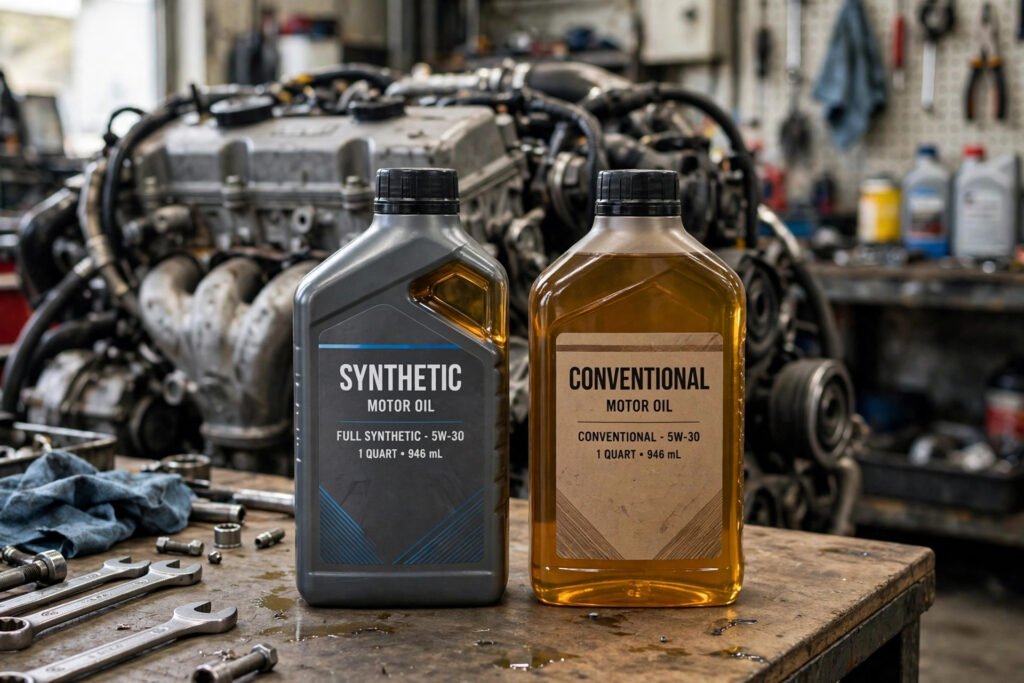
You’re at the quick-lube, and the question comes with a $40 price difference attached: conventional or synthetic? The technician extols synthetic’s virtues; your wallet eyes the conventional price; your owner’s manual says something you can’t quite remember. Is synthetic oil actually better, or is it the premium-gas scam in liquid form? The answer is refreshingly clear-cut: synthetic oil is genuinely superior in measurable ways — but whether it’s worth the premium depends on your car, your climate, and your driving. Here’s the real difference, without the sales pitch.
What Each Oil Actually Is
Conventional (regular) oil is refined directly from crude petroleum — a cocktail of naturally occurring hydrocarbon molecules in varying shapes and sizes, with additives blended in for protection. It works, and it worked fine for decades. Synthetic oil is engineered: its base molecules are chemically synthesized (or severely refined and restructured) into uniform, purpose-built structures with tailored additives. Think of conventional as lumber milled from whatever trees grew, and synthetic as engineered lumber designed molecule by molecule for the job.
This molecular uniformity is the entire story. Uniform molecules flow more consistently at temperature extremes, resist breaking down under heat and shear, and leave fewer deposits. Synthetic blends (the middle shelf) mix conventional and synthetic base stocks — better than conventional, not as good as full synthetic, priced in between. The American Petroleum Institute’s motor oil standards (the API “donut” on every bottle) certify that all three types meet minimum performance specs for their rating — the differences are in how far they exceed those minimums and for how long they maintain performance.
Where Synthetic Genuinely Wins
Cold starts: synthetic flows at temperatures where conventional thickens dramatically. At -20°F, conventional 5W-30 can be nearly solid while synthetic pours freely — and since most engine wear happens in the first seconds after startup (before oil fully circulates), this is synthetic’s biggest real-world advantage for northern drivers. Heat resistance: turbocharged engines — increasingly common in America — cook oil at temperatures that break conventional down faster; synthetic’s thermal stability is why most turbo manufacturers require it. Extended intervals: full synthetic safely runs 7,500–10,000+ miles between changes (follow your manual, not the 3,000-mile myth), versus 3,000–5,000 for conventional — fewer changes, less waste oil, less of your Saturday gone.
Engine cleanliness: synthetic’s uniform chemistry and better additive packages produce measurably fewer sludge and varnish deposits over 100,000+ miles — engines torn down after synthetic-only lives are visibly cleaner inside. Fuel economy gets a small but real benefit (1–2%) from reduced internal friction. And manufacturer requirements are the trump card: if your manual specifies synthetic (increasingly common — most new cars sold in America now do), using conventional risks warranty issues and genuinely suboptimal protection. This isn’t upselling; it’s engineering. AAA’s motor oil research has confirmed synthetic’s performance advantages in controlled testing.
The Honest Cost Math
Let’s price it fairly — per mile, not per change. A conventional oil change: $40–$60 every 4,000 miles = roughly 1.25¢/mile. A full synthetic change: $75–$110 every 8,000 miles = roughly 1.15¢/mile. The per-mile cost is nearly identical because synthetic’s longer intervals offset its higher price — and that’s before counting your time (half as many shop visits) and the reduced engine wear. The “$40 premium” framing is misleading; the honest framing is “about the same money for better protection and half the hassle.”
Where conventional still makes sense: older, high-mileage engines that burn or leak oil (pouring expensive synthetic into an engine that consumes a quart every 1,000 miles is pouring money on the ground — though high-mileage synthetics with seal conditioners are a legitimate middle option), very low-mileage garage queens where oil gets changed annually by time rather than miles, and extreme budget situations where the choice is conventional changed on time versus synthetic changed late (on-time conventional beats overdue synthetic every time). When you’re evaluating a vehicle’s long-term running costs, oil requirements are one factor among many — and so is financing, which is why improving your credit score to qualify for a loan matters before you buy. And if you’re budgeting car ownership overall, our framework for saving for a big purchase applies the same per-mile thinking to every vehicle expense.
Myths and Mistakes to Avoid
“You can’t switch between conventional and synthetic.” False — they’re fully compatible, and switching causes no harm whatsoever. Millions of drivers switch to synthetic at 100,000 miles with excellent results. “Synthetic causes leaks in old engines.” Mostly myth — early synthetics (1980s) could shrink old seals, but modern formulations include seal conditioners; what actually happens is synthetic’s better flow reveals existing leaks that sludge was plugging, which is information, not damage. “All synthetics are equal.” No — look for the API certification donut and your manufacturer’s specific spec (like GM’s dexos or VW’s 502.00); off-brand “synthetic” without certifications is a gamble.
The biggest mistake isn’t choosing wrong — it’s changing late. The finest synthetic in the world, run 15,000 miles past its interval, protects worse than basic conventional changed on schedule. Set reminders, follow your manual’s interval for your driving conditions (severe service — short trips, extreme temperatures, dusty conditions, towing — means shorter intervals for any oil type), and check your dipstick monthly. Oil is your engine’s blood; the brand matters less than the habit.
Reading the Bottle: Viscosity Grades Demystified
That “5W-30” on the bottle is the viscosity grade — the oil’s thickness at cold and hot temperatures — and it matters as much as synthetic versus conventional. The number before the W (winter) rates cold flow: 0W flows better cold than 5W, which beats 10W. The second number rates viscosity at operating temperature: 30 is thinner than 40. Your manufacturer specifies a grade (increasingly 0W-20 for fuel economy) because the engine’s tolerances, oil pump, and variable valve timing are engineered around it. Using a thicker grade “for protection” in a modern engine designed for 0W-20 can actually increase wear by slowing cold circulation and confusing variable valve timing systems. The rule is simple: use the exact viscosity grade your manual specifies, in the best oil type your budget allows. Grade first, synthetic-versus-conventional second — getting the grade wrong while buying premium synthetic is the most expensive way to do oil changes incorrectly.
The Bottom Line
Full synthetic oil is genuinely better than conventional — superior cold flow, heat resistance, cleanliness, and longer intervals — at roughly the same per-mile cost once intervals are factored in. Use what your manual specifies (increasingly synthetic), switch freely without fear, and prioritize on-time changes over oil snobbery. The $40-per-change debate misses the point: it’s not about the price of the oil, it’s about the price of the engine it’s protecting.
Frequently Asked Questions
Can I switch from conventional to synthetic oil?
Yes — completely safe at any mileage. The oils are fully compatible. Many drivers switch to synthetic at high mileage with excellent results; consider high-mileage synthetic formulations with seal conditioners for engines over 75,000 miles.
How often should I change synthetic oil?
Follow your owner’s manual — typically 7,500–10,000 miles for full synthetic under normal conditions, less for severe service (short trips, extreme temperatures, towing). Ignore the outdated 3,000-mile rule for modern oils.
Is synthetic blend worth it?
It’s a reasonable middle ground — better protection than conventional at a moderate premium. But full synthetic’s per-mile cost is nearly identical when intervals are factored in, making it the better value for most drivers.
Does synthetic oil improve gas mileage?
Slightly — typically 1–2% from reduced internal friction. It’s real but small; don’t buy synthetic for fuel savings alone. Buy it for engine protection, cold-start performance, and longer change intervals.