Electric Cars for Commuters: Are They Worth It in 2026?
You drive 40 miles round-trip to work, five days a week, watching gas prices swing and maintenance bills stack up. An electric car promises to slash your commuting costs to pennies — but the sticker price is higher, charging sounds complicated, and range anxiety whispers every time you imagine the battery gauge dropping. For daily commuters — the drivers who rack up predictable, repetitive miles — EVs make the strongest financial case of any buyer profile. But “strongest case” isn’t “always worth it.” Here’s the honest math on whether an electric car is worth it for American commuters in 2026.
The Commuter’s Math: Fuel Savings Are Real and Large
Let’s quantify the core advantage. The average American commuter drives about 12,000–15,000 miles yearly. At 28 mpg and $3.50/gallon, that’s $1,500–$1,875 in annual fuel. An efficient EV uses roughly 0.30 kWh per mile; at the national average residential electricity rate of about $0.17/kWh, those same miles cost $610–$765 — a savings of roughly $900–$1,100 yearly. But commuters with time-of-use electricity rates (charging overnight at $0.08–$0.12/kWh, available from many utilities) cut fuel costs to $290–$540 yearly — savings of $1,000–$1,500 annually versus gas. Over a 10-year ownership, that’s $10,000–$15,000 in fuel savings alone.
Maintenance savings stack on top: no oil changes ($50–$100 each, 2–3x yearly for commuters), no transmission services, no spark plugs or timing belts, and brake pads lasting 100,000+ miles thanks to regenerative braking. Industry analyses consistently estimate EV maintenance at roughly half the cost of comparable gas cars — another $3,000–$5,000 over a decade for high-mileage commuters. Combined fuel and maintenance savings of $13,000–$20,000 over 10 years is the financial engine of the commuter EV case. The Department of Energy’s vehicle cost calculators let you model these numbers with your specific mileage and local electricity rates.
The Purchase Price Problem (and How Incentives Fix It)
The math above only works if the purchase price doesn’t erase the savings. New EVs still carry a premium over comparable gas cars — typically $5,000–$10,000 before incentives, though the gap narrows yearly as battery costs fall. Federal tax credits (up to $7,500 for qualifying new EVs, with income and price caps, plus credits for used EVs) can eliminate most of the premium — but verify your specific vehicle’s eligibility, as requirements around assembly location and battery sourcing change. Many states add their own rebates ($1,000–$7,500), and utilities often offer charger installation rebates.
The used EV market is the commuter’s secret weapon: 2–3 year old EVs with 30,000–50,000 miles often sell for 40–50% below original MSRP — depreciation far steeper than gas cars — while retaining 85–95% of battery capacity. A used EV at $18,000–$22,000 with the fuel savings above is arguably the best commuting value in America right now. When budgeting, factor the total purchase with our framework for saving for a big purchase — the down payment math works the same, but the monthly operating savings change the affordability picture dramatically. And compare against efficient gas options too — remembering that financing affects total cost as much as fuel, so improving your credit score to qualify for a loan pays off regardless of powertrain.
Charging: The Make-or-Break Factor
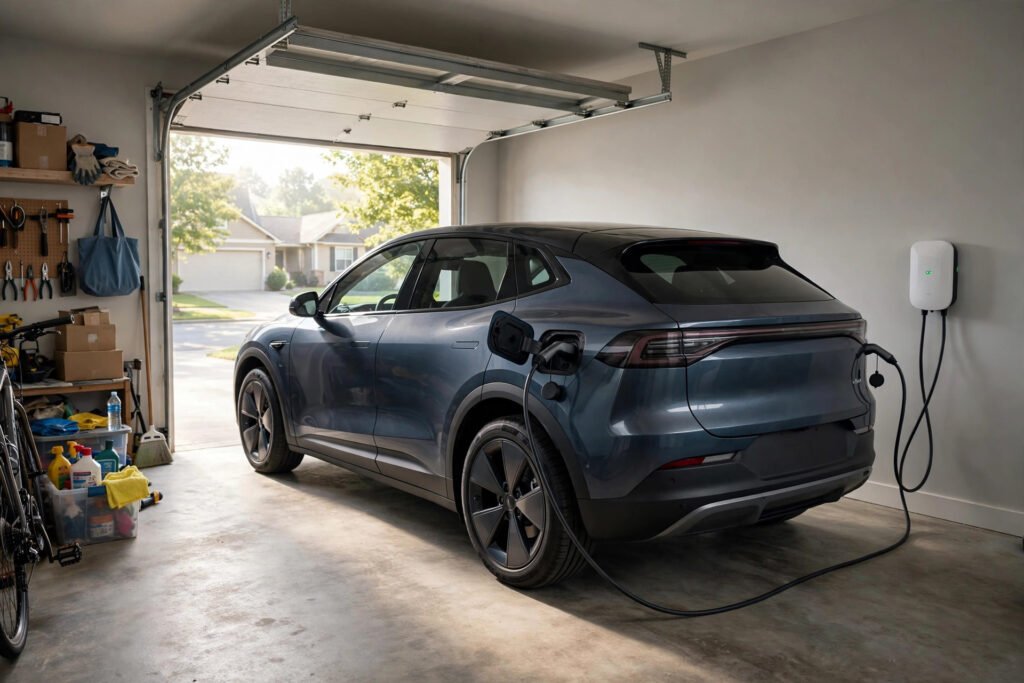
Here’s the truth the brochures gloss over: EV ownership happiness correlates almost entirely with home charging access. If you own your home (or rent with a garage/driveway where you can install a Level 2 charger for $500–$2,000), commuting electrifies beautifully — plug in at night like a phone, wake to a “full tank” every morning, never visit a gas station again. Level 1 charging (standard wall outlet) even suffices for many commuters: it adds 3–5 miles of range per hour, or 40–60 miles overnight — enough for the average 40-mile round-trip commute.
Without home charging, the equation gets harder. Public charging costs 2–4x home rates (eroding the fuel savings), requires 20–45 minute sessions at fast chargers weekly, and introduces genuine inconvenience — apartment dwellers without workplace charging should think carefully. Workplace charging changes everything: free or cheap charging at work effectively makes commuting fuel-free. Before buying, map your reality: home charging available? Workplace charging? Fast chargers on your route as backup? If the answer to the first two is no, an EV commuter life is possible but friction-filled — a plug-in hybrid (30–50 miles of electric range for the commute, gas for everything else, no charging anxiety) may be the smarter bridge. Edmunds’ EV charging guides detail real-world charging costs and logistics.
Range, Batteries, and the Commuter’s Actual Needs
Range anxiety is largely a mismatch between imagined needs and actual driving. The average American commute is about 40 miles round-trip; even the most affordable new EVs offer 200+ miles of range — five days of commuting on one charge. Cold weather reduces range 20–40% (battery chemistry plus cabin heating), so winter commuters in northern states should size accordingly — a 250-mile rated EV still covers a 60-mile winter commute with huge margin. Battery degradation is the other worry: real-world data shows modern EV batteries losing roughly 1–2% capacity yearly, meaning 85–90% capacity after a decade — far better than early fears suggested.
The commuter-specific advantages go beyond money: HOV/carpool lane access for EVs in many states (a life-changing perk in Los Angeles, the Bay Area, or Northern Virginia traffic), silent operation that makes commutes genuinely less stressful, instant torque that makes merging effortless, and pre-conditioning (warming or cooling the car while plugged in, using wall power instead of battery). These quality-of-life factors don’t appear in spreadsheets but dominate owner satisfaction surveys — EV commuters consistently report they could never go back, and it’s the daily experience, not the math, they cite.
When It’s NOT Worth It for Commuters
Honesty requires the counter-cases. If you can’t charge at home or work, the friction may outweigh the savings — public-charging-dependent EV ownership is the one scenario with consistent owner complaints. If your commute is very short (under 15 miles round-trip), the fuel savings shrink to a few hundred dollars yearly, extending the payback period beyond reason — a used efficient gas car wins. If you need the vehicle for frequent long road trips beyond charging infrastructure comfort, the planning overhead is real (though America’s fast-charging network expands monthly).
And if you’re replacing a paid-off reliable gas car: the greenest and cheapest car is often the one you already own. Trading a functional paid-off Camry for a $35,000 EV to “save on gas” is financial theater — the savings never catch the purchase price within a reasonable horizon. The EV commuter case is strongest when you’re buying a car anyway and choosing between powertrains, not when you’re inventing a reason to buy. Run your specific numbers — mileage, electricity rates, incentives, charging access — and let the math, not the marketing, decide.
The Bottom Line
For daily commuters with home or workplace charging who are buying a car anyway, electric vehicles are worth it in 2026: $10,000–$20,000 in fuel and maintenance savings over a decade, a better daily driving experience, and used-EV values that make entry affordable. Without reliable charging access, or for very short commutes, or when replacing a paid-off car unnecessarily — the case weakens considerably. Match the technology to your charging reality and your actual mileage, verify incentives for your situation, and you’ll know whether the electrons beat the gasoline for your commute.
Frequently Asked Questions
How much does it cost to charge an EV at home?
At the national average of ~$0.17/kWh, a full charge of a typical 60 kWh battery costs about $10 for 200+ miles. Time-of-use overnight rates ($0.08–$0.12/kWh) cut that roughly in half. Home charging is 2–4x cheaper than public fast charging.
How long do EV batteries last?
Real-world data shows 1–2% annual capacity loss for modern EVs — roughly 85–90% capacity after 10 years. Most manufacturers warranty batteries for 8 years/100,000 miles. Battery replacement is rarely needed within a normal ownership period.
Can I commute in an EV without home charging?
It’s possible but friction-filled: public charging costs more and takes time. Workplace charging makes it workable. Without either, a plug-in hybrid is usually the smarter choice for commuters.
Are used EVs a good buy?
Often excellent — 2–3 year old EVs depreciate 40–50% while retaining 85–95% battery capacity. Have the battery health checked before purchase, verify remaining warranty, and you’ll get most of the EV advantage at half the price.