Is Cloud Gaming Actually Good Enough to Replace Consoles
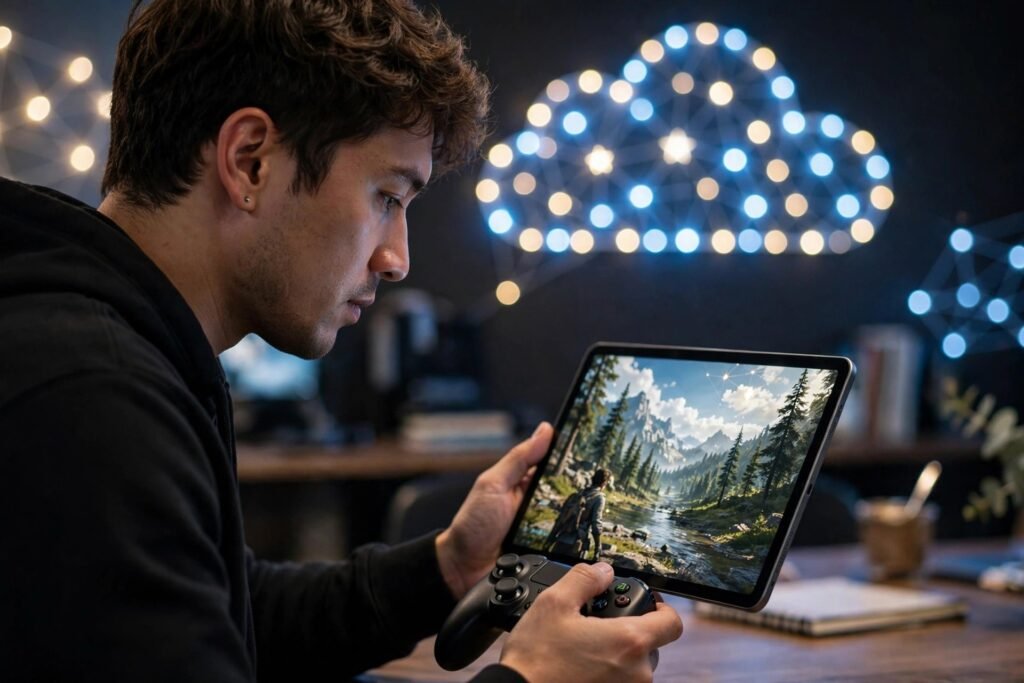
The pitch is seductive: no $500 console, no downloads, no updates — just click and play the latest games on any screen, streamed from a distant data center. Cloud gaming has been “the future” for over a decade, through OnLive’s collapse, Stadia’s shutdown, and the current generation of Xbox Cloud Gaming, GeForce Now, and Amazon Luna. So where does it actually stand in 2026? Is cloud gaming good enough to replace consoles — for whom, for which games, and under what conditions? The honest answer is a carefully qualified “it depends,” and the qualifications are the interesting part.
How Cloud Gaming Works (and Why Latency Is Everything)
Cloud gaming runs the game on a remote server and streams the video to your device, sending your inputs back upstream. The round trip — your button press traveling to the data center, the game rendering the frame, the video compressing and returning — adds latency on top of the game’s native input lag. Total latency is the sum: your input device + network round trip + server processing + video encode/decode + display lag. On a local console, this chain is ~20–50ms. On cloud gaming with a good connection, it is ~60–120ms. On a bad connection, 200ms+ — unplayable for anything demanding.
This physics is non-negotiable: light-speed limits mean a server 1,000 miles away adds ~10ms round trip minimum, and real networks add far more. No codec or optimization repeals geography. Cloud gaming quality is therefore primarily a function of your distance to the nearest data center and your connection’s stability — which is why the experience varies so dramatically between users and why “is it good enough?” has no universal answer.
Where Cloud Gaming Genuinely Works Now
The use cases that shine
Trying games instantly: Click-to-try without 100GB downloads is transformative for discovery — sampling Game Pass titles via cloud before committing to a download is the single best current use case. Playing on weak hardware: A Chromebook or old laptop running Cyberpunk 2077 at high settings via GeForce Now is genuine magic — the server does the heavy lifting. Travel and secondary screens: Hotel TVs, tablets, phones — cloud gaming extends your library to every screen you own. Turn-based, strategy, and narrative games: Genres where 100ms of latency is irrelevant play essentially identically to local — this is a huge and underappreciated segment.
The services, honestly assessed
GeForce Now offers the best raw performance (RTX-class servers, up to 4K/120fps on top tiers) and lets you play games you own on Steam/Epic — but the free tier queues and session limits push toward paid tiers, and publisher opt-outs create library gaps. Xbox Cloud Gaming (included with Game Pass Ultimate) has the best library value — hundreds of games, no separate purchase — but caps at 1080p/60fps with variable quality. Amazon Luna and PlayStation Plus Premium streaming fill niches. None is categorically “best” — the right choice depends on which games you play and what you already own.
Where It Still Falls Short
Competitive and latency-sensitive gaming
For competitive FPS, fighting games, and rhythm games — anything where 50ms decides outcomes — cloud gaming is not a replacement. The added latency is perceptible to experienced players and decisive at high levels. Local hardware remains mandatory for serious competitive play, and this is a physics constraint, not an engineering backlog.
Visual quality and consistency
Video compression artifacts — macroblocking in dark scenes, softness during fast motion, occasional resolution drops — mean cloud gaming rarely matches local visual fidelity moment-to-moment, even when the headline specs (4K, 120fps) sound equivalent. On a phone screen, imperceptible; on a 65-inch TV, noticeable to discerning eyes. Stability matters too: a single network hiccup produces a visible stutter that local gaming never has.
Ownership and preservation
Stadia’s shutdown — with Google refunding purchases — demonstrated the existential risk: when a cloud service dies, your library dies with it. You own nothing; you rent access. For players who value game preservation and ownership, this is disqualifying regardless of technical quality. The Verge’s gaming coverage has documented how this concern shapes enthusiast attitudes more than any latency number.
The Requirements: What “Good Enough” Actually Demands
Cloud gaming’s minimum viable setup is more demanding than marketing suggests: 25+ Mbps stable (not just peak — sustained, uncongested bandwidth); wired Ethernet or excellent Wi-Fi (Wi-Fi variability is the number one quality killer — if your Wi-Fi is slow in certain rooms, cloud gaming will suffer there); low-latency connection (under ~40ms ping to the data center — test this specifically, as raw bandwidth without low latency is insufficient); unlimited data (cloud gaming consumes 10–20GB per hour at high quality — data caps make it ruinously expensive); and 5GHz Wi-Fi or Wi-Fi 6 minimum for wireless play. Understanding your connection’s real characteristics — including the difference between 5G and 5G Ultra Wideband for mobile cloud gaming — is prerequisite to judging whether the experience will satisfy you.
So: Can It Replace Consoles?
The segmented verdict:
Yes, for: casual and variety gamers
If you play single-player adventures, RPGs, strategy games, and indies — sampling broadly rather than competing intensely — cloud gaming on a good connection is genuinely sufficient. The value proposition (no hardware cost, instant access, play anywhere) outweighs the compromises.
Not yet, for: competitive players and fidelity enthusiasts
Latency-sensitive multiplayer, fighting games, and anyone with a high-end display who notices compression artifacts still need local hardware. The gap is narrowing but physics-limited.
The emerging consensus: hybrid, not replacement
The most likely future is not cloud replacing consoles but complementing them — local hardware for the main setup, cloud for everything else. Xbox’s strategy embodies this: console for the living room, cloud for every other screen. The question is shifting from “either/or” to “which where” — and for that question, cloud gaming’s answer gets better every year.
The Bottom Line
Cloud gaming in 2026 is genuinely good enough to replace consoles for casual, variety, and narrative gaming on a solid connection — and transformative for weak hardware and multi-screen play. It is not good enough for competitive latency-sensitive gaming, does not match local visual consistency, and carries ownership risks that matter. Judge it against your connection (wired, low-latency, unlimited data) and your genres, not against the marketing. The future is hybrid: the console for the main event, the cloud for everything else.
The 5G Factor
Cloud gaming’s future may be mobile rather than living-room. 5G networks, at their best, deliver the low latency and high bandwidth that make phone-based cloud gaming genuinely playable — turning any smartphone into a portable console with a controller clip. Carriers and cloud providers are investing heavily here because the addressable market dwarfs console ownership. The catch remains consistency: real-world 5G varies wildly by location, congestion, and whether you are on true mid-band/ultra-wideband or rebranded 4G. The Verge’s ongoing cloud gaming coverage tracks this evolution closely. For now, treat mobile cloud gaming as a promising complement — great for travel and commutes — while fixed-line connections remain the gold standard for serious sessions at home.
Frequently Asked Questions
What internet speed do I need for cloud gaming?
25+ Mbps sustained (not just peak), under ~40ms ping to the data center, and ideally unlimited data — cloud gaming uses 10-20GB per hour at high quality. Wired Ethernet beats Wi-Fi for stability.
Which cloud gaming service is best?
GeForce Now (best performance, play your Steam library), Xbox Cloud Gaming (best value via Game Pass), or PlayStation Plus Premium (PlayStation exclusives). The right choice depends on which games you play.
Is cloud gaming good for competitive FPS?
No — the added 40-80ms of network latency is perceptible and decisive at competitive levels. Local hardware remains mandatory for serious competitive play.
What happens to my games if a cloud service shuts down?
You lose access — Stadia’s shutdown demonstrated this (Google refunded purchases, but libraries vanished). Cloud gaming is rented access, not ownership. This is the fundamental trade-off.
Can I cloud game on my phone?
Yes — and phones are arguably cloud gaming’s best screen, since compression artifacts are invisible at that size. You’ll want a controller clip and a solid 5G or Wi-Fi connection.