How to Jump-Start a Dead Battery Safely by Yourself
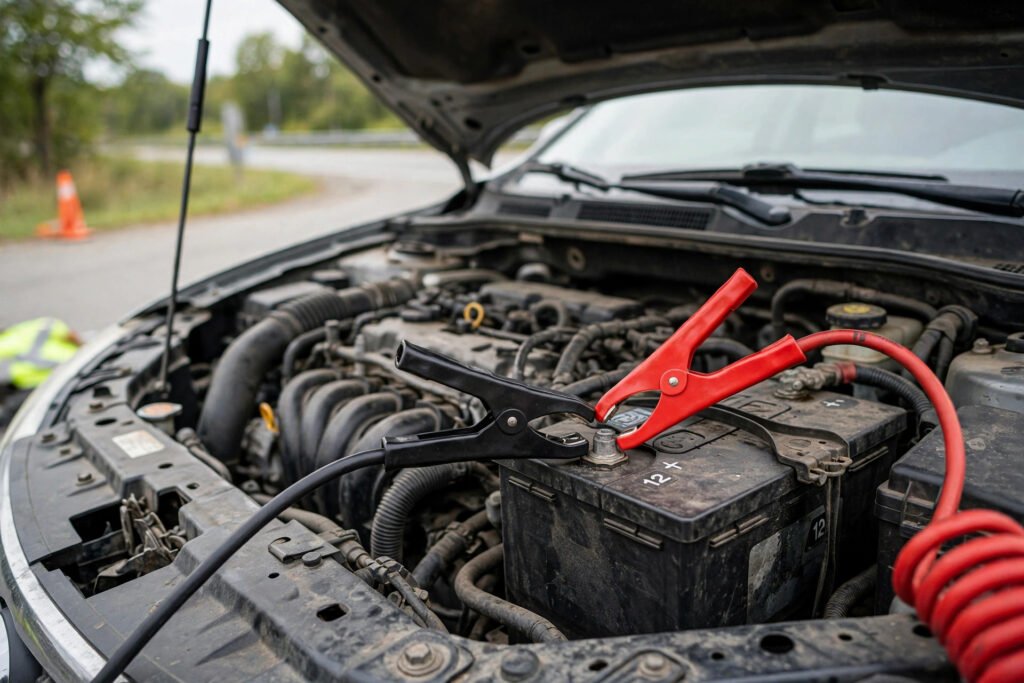
Click. Click-click-click. Silence. Your battery is dead, you’re alone, and the jumper cables in your trunk have been there since 2019, still in the package. Jump-starting a car is one of those skills every American driver assumes they’ll figure out in the moment — and the moment is exactly when mistakes happen. Done right, it’s a 5-minute fix. Done wrong, it can fry electronics, explode a battery, or injure you. Here’s the complete, safe procedure for jump-starting a dead battery by yourself, plus what to do when there’s no second car in sight.
What You Need (and the Solo Driver’s Secret Weapon)
The traditional method needs: jumper cables (thicker gauge is better — 4-gauge or 6-gauge handles current safely; those skinny freebie cables struggle), a second vehicle with a charged battery, and safety glasses if you have them (battery acid and sparks are a bad combination near eyes). But here’s the solo driver’s upgrade: a portable jump starter pack ($60–$120). These lithium battery packs — roughly the size of a paperback — deliver enough cranking amps to start most cars, hold a charge for months, include USB ports for phones, and eliminate the need for a second car entirely. For anyone who drives alone regularly, it’s the single best emergency investment in car ownership.
Keep either option accessible, not buried: cables or the jump pack should be reachable without unpacking the trunk. Check the jump pack’s charge every 3–6 months (they self-discharge slowly). And know your battery’s location before you need it — most are under the hood, but some cars (many BMWs, some Chryslers, certain Audis) hide them in the trunk or under seats, with remote jumper terminals under the hood. Your owner’s manual shows the exact locations and any model-specific precautions. AAA’s emergency preparedness guidance recommends this kind of pre-crisis familiarization for all roadside scenarios. Edmunds’ car emergency preparedness guides also recommend keeping cables or a jump pack accessible rather than buried under cargo.
The Safe Jump-Start Procedure: Step by Step
Position the working car close enough for cables to reach, both engines OFF, both cars in Park (or Neutral for manuals) with parking brakes set. Turn off all electronics in both cars — headlights, radio, chargers — to protect sensitive systems from voltage spikes. Now the critical sequence — cable order matters enormously, so follow it exactly:
1. RED to DEAD: Connect one red clamp to the dead battery’s positive (+) terminal. 2. RED to DONOR: Connect the other red clamp to the working battery’s positive (+) terminal. 3. BLACK to DONOR: Connect one black clamp to the working battery’s negative (−) terminal. 4. BLACK to METAL: Connect the final black clamp to an unpainted metal surface on the dead car’s engine block or frame — a bolt, bracket, or designated grounding point — at least 18 inches from the battery. This last step is the safety-critical one: batteries emit hydrogen gas, and the final connection can spark — making that spark away from the battery prevents ignition. Start the working car and let it run 2–3 minutes. Then try starting the dead car. If it doesn’t start within 15 seconds of cranking, stop — wait two minutes and try once more. If it still won’t start, the problem likely isn’t just the battery (could be the starter, alternator, or a completely destroyed battery), and continued attempts risk damage.
After It Starts: The Part Everyone Gets Wrong
Your car is running — don’t celebrate by immediately driving off. Let it idle for a few minutes, then disconnect cables in exact reverse order: black from metal, black from donor, red from donor, red from dead. (Reverse of installation — this keeps sparks away from batteries at every step.) Now the critical part most people botch: drive the car for at least 20–30 minutes, ideally at highway speeds, to let the alternator recharge the battery. Idling in the driveway barely charges it; five minutes of idling then shutting off often means another dead battery tomorrow.
Then diagnose why it died. Batteries don’t usually die without reason: was a light left on (dome light, trunk light)? Is the battery simply old (3+ years in hot climates, 5+ elsewhere)? Or is something draining it — a failing alternator, parasitic draw from aftermarket electronics, or corroded connections? If the battery dies again within days despite driving, get it tested free at any auto parts store — a load test reveals whether the battery is done or the charging system is at fault. Replacing a dying battery proactively ($150–$250) beats another roadside episode. And fold battery health into your broader trip readiness with our road trip preparation guide — verifying the battery before departure is the cheapest travel insurance there is.
When There’s No Second Car: Your Options
Alone with traditional cables and no donor car? You have options. First, the portable jump pack described above — if you own one, this scenario is already solved: connect red to positive, black to negative (or ground), power on the pack, start the car. Second, roadside assistance: AAA, your insurer’s roadside coverage, or your car manufacturer’s assistance program will dispatch a jump — keep the number in your phone, not just on a card in the glovebox. Third, ask a stranger: most people will help, and with your cables and this article’s procedure fresh in mind, you can direct the process safely even if they’ve never done it.
What about push-starting (manual transmissions only)? It works — ignition on, second gear, clutch in, get rolling to 5–10 mph, release the clutch — but it’s hard alone (you need a hill or helpful pushers) and impossible on automatics. What about those “battery revive” tricks online (aspirin in cells, Epsom salt solutions)? Skip them — they’re folk remedies that risk chemical damage for negligible benefit. And never attempt to jump a battery that’s visibly damaged: cracked case, leaking fluid, or a swollen/bloated shape means replace, don’t jump — damaged batteries can explode, and no roadside trick is worth that risk. Battery and charging health are key reliability factors in any vehicle — including rentals, so review what to know before renting a car abroad and check the battery before driving off the lot.
Safety Warnings Worth Taking Seriously
Batteries contain sulfuric acid and produce hydrogen gas — respect both. Never smoke or create open flames near a battery. Never connect the final black clamp to the dead battery’s negative terminal (that’s the explosion-risk mistake). Never jump a frozen battery (if the case is bulging from ice, it can explode — let it thaw or replace it). Remove metal jewelry from your hands — a wrench bridging terminals can weld itself and burn you severely. And if the battery is hot, hissing, or smelling strongly of rotten eggs (hydrogen sulfide), step back and call for professional help — those are signs of a battery in dangerous failure, not a routine dead battery.
The Bottom Line
Jump-starting safely by yourself means: engines off, electronics off, cables in the exact order (red-dead, red-donor, black-donor, black-to-metal-ground), start the donor, wait, start the dead car, then reverse the order and drive 20–30 minutes to recharge. Better yet, carry a $60–$120 portable jump pack and skip the second car entirely. Diagnose the underlying cause afterward — dead batteries are symptoms, and the fix is a test, a replacement, or finding the drain. It’s a 5-minute skill that turns a crisis into an errand.
Frequently Asked Questions
What order do jumper cables go in?
Red to dead battery positive, red to donor positive, black to donor negative, black to unpainted metal on the dead car (away from the battery). Remove in exact reverse order. This sequence keeps sparks away from battery hydrogen gas.
Can I jump-start a car by myself with no other car?
Yes — with a portable lithium jump starter pack ($60–$120). Connect red to positive, black to ground, power on, and start. It’s the best solo-driver emergency tool and also charges phones.
How long should I drive after a jump-start?
At least 20–30 minutes, preferably at highway speeds. Idling barely recharges the battery — sustained driving lets the alternator do its job. Short trips after a jump often lead to another dead battery.
Why does my battery keep dying after jump-starts?
Either the battery itself is worn out (test it free at any parts store), the alternator isn’t charging properly, or something is draining it while parked (lights left on, aftermarket electronics, parasitic draw). Repeated jump-starts without diagnosis just postpone the real fix.