Is Your Transmission Failing? Warning Signs to Watch
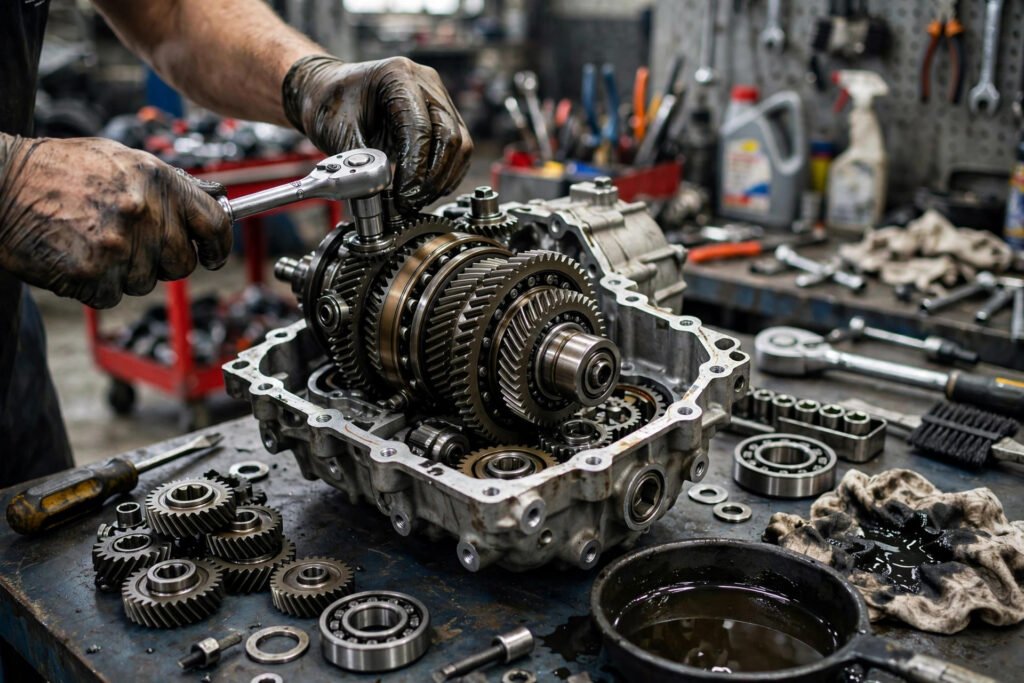
Of all the expensive words in car ownership, “transmission” might be the scariest. A transmission replacement costs $3,000–$7,000 — more than many used cars are worth — and failures rarely arrive without warning. Your transmission has been sending signals for weeks or months: the slight hesitation between gears, the whine you noticed but dismissed, the fluid you never checked. Learning to read these warnings is the difference between a $300 service that saves the transmission and a $5,000 replacement that totals the car. Here’s how to know if your transmission is failing, what’s actually wrong, and what to do at each stage.
The Warning Signs, Ranked by Urgency
Delayed engagement: you shift into Drive or Reverse and nothing happens for 2–3 seconds before the gear clunks in. This is one of the earliest and most reliable signs of transmission trouble — low fluid, worn seals, or internal pressure loss. Don’t ignore it; it’s the transmission equivalent of chest pain. Slipping gears: the engine revs but the car doesn’t accelerate proportionally, or gears spontaneously slip into neutral while driving. This is dangerous as well as damaging — a slipping transmission can leave you powerless in traffic.
Rough or hard shifting: shifts that jerk, clunk, or hesitate instead of engaging smoothly. Some harshness is normal in certain vehicles (many trucks shift firmly by design), but a change from your car’s normal behavior is the signal. Strange noises: whining, humming, or buzzing that changes with vehicle speed (distinct from engine-speed noises) often indicates transmission pump or bearing wear; clunking during shifts suggests worn mounts or internal damage. Warning lights: the check engine light with transmission-related codes, or a dedicated transmission temperature warning — overheating destroys transmissions fast, so a temp warning means pull over safely and let it cool. Burning smell: the acrid odor of overheating transmission fluid means the fluid has broken down and internal damage is occurring — this needs immediate attention. Each of these is your car filing a report — learning to read automotive warning signs is a skill, much like recognizing when a laptop is overheating before permanent damage occurs.
The Fluid Check: Your 2-Minute Diagnostic
Transmission fluid is the cheapest diagnostic tool you own. For cars with a dipstick (increasingly rare — many modern transmissions are “sealed,” a design choice that serves manufacturers more than owners): with the engine warm and running, in Park, pull the dipstick, wipe, reinsert, and read. Healthy fluid is translucent pinkish-red with a slightly sweet smell. Brown or dark fluid means it’s oxidized and overdue for service. Black fluid with a burnt smell means internal damage is already occurring — service immediately. Milky pink fluid means coolant contamination (a serious problem requiring prompt repair). Metal particles or glitter in the fluid mean internal components are disintegrating.
Low fluid level is itself a diagnosis: transmissions are sealed systems that shouldn’t consume fluid, so low level means a leak — find and fix it, because running low destroys transmissions faster than almost anything. For sealed transmissions without dipsticks, you’re dependent on shop diagnostics, which makes following the service schedule even more critical. Note the service controversy: some manufacturers claim “lifetime fluid,” but transmission specialists overwhelmingly recommend service every 30,000–60,000 miles — “lifetime” often means “lifetime of the warranty,” not the car. Fresh fluid is the cheapest transmission insurance in existence.
What Repairs Cost (and When to Repair vs. Replace vs. Walk Away)
The cost ladder: transmission fluid service (drain, filter, refill): $150–$300 — preventive, always worth it. Solenoid replacement (electrical shift controls): $300–$800 — common fix for shifting issues. Torque converter: $800–$2,000 — the fluid coupling between engine and transmission. Transmission rebuild (disassemble, replace worn parts, reassemble): $2,500–$4,500 — essentially a remanufactured transmission in your case. Full replacement with new or remanufactured unit: $3,000–$7,000+ depending on vehicle — at the top end exceeding many cars’ values.
The decision framework: if the car’s value exceeds the repair cost by a comfortable margin and the rest of the vehicle is sound, repair it — a $3,500 rebuild on a $12,000 car with 80,000 miles is rational. If the repair approaches or exceeds the car’s value, the math turns against you — sell or scrap unless the car has exceptional sentimental or practical value. Always get the diagnosis from a transmission specialty shop, not a general repair chain: transmission work is the most misdiagnosed area in auto repair, and specialists with proper diagnostic equipment distinguish $400 solenoid jobs from $4,000 rebuilds that generalists conflate. Get two opinions on any quote over $1,500. AAA’s transmission service guidance provides benchmarks for fair pricing. Edmunds tracks typical transmission repair costs by vehicle — useful for sanity-checking any quote against market reality.
Prevention: Making Transmissions Last
Most transmission failures are earned through neglect, not bad luck. Service the fluid on schedule — every 30,000–60,000 miles for conventional automatics, per your manual for CVTs (which are particularly fluid-sensitive). Never tow beyond your rated capacity — overloading cooks transmissions. Come to a complete stop before shifting between Drive and Reverse — the clunk you feel is the transmission absorbing abuse. Use the parking brake on hills instead of letting the transmission’s parking pawl hold the car’s weight (that tiny metal pin isn’t designed for the job).
Address small symptoms immediately: the $250 fluid service that fixes early slipping beats the $4,000 rebuild that results from ignoring it for six months. Keep the cooling system healthy — the transmission cooler is often integrated with the radiator, so cooling system neglect becomes transmission neglect. And when buying used, transmission health is a top inspection priority: a pre-purchase inspection should include a transmission evaluation, fluid check, and test drive specifically listening for the symptoms in this article. Because a transmission replacement can exceed the car’s value, our guide to saving for a big purchase stresses budgeting for the worst case, not just the sticker price — the cheapest transmission repair is a car that doesn’t need one.
The Bottom Line
Your transmission is failing when you notice delayed engagement, slipping gears, rough shifting, speed-dependent whining, warning lights, or burnt-smelling fluid — and the fluid dipstick is your fastest diagnostic. Caught early, transmission problems often resolve with $150–$800 services; ignored, they become $3,000–$7,000 replacements. Service fluid every 30,000–60,000 miles, fix small symptoms immediately, get specialty-shop diagnoses for big quotes, and apply the repair-vs-value math coldly. Transmissions rarely die without warning — they just die on drivers who weren’t listening.
Frequently Asked Questions
How long do transmissions usually last?
Modern automatic transmissions typically last 150,000–200,000+ miles with proper fluid service. Neglected transmissions can fail under 100,000 miles. CVTs are more fluid-sensitive and vary more by manufacturer.
Is it worth fixing a transmission on an old car?
It depends on the math: if the repair cost is well below the car’s value and the rest of the vehicle is sound, yes. If a $4,000 rebuild goes into a $3,500 car, the money is usually better applied to a replacement vehicle.
Can low transmission fluid cause permanent damage?
Yes — running low starves internal components of lubrication and cooling, causing rapid wear. Since transmissions shouldn’t consume fluid, low level means a leak that needs fixing, not just topping off.
What does “lifetime transmission fluid” mean?
Often “lifetime of the powertrain warranty,” not the vehicle. Most transmission specialists recommend service every 30,000–60,000 miles regardless of “lifetime” claims — fresh fluid is cheap insurance against the most expensive repair your car can need.