How Do I Improve My Aim in First-person Shooter Games
You lose the duel. Again. The enemy strafes, you drag your crosshair through where they were half a second ago, and the killcam shows the ugly truth: your aim is the bottleneck. In first-person shooters, aim is the fundamental skill — positioning, game sense, and teamwork all multiply it, but nothing compensates for its absence. The good news: aim is one of the most trainable skills in gaming, with well-understood methods borrowed from motor learning science. Here’s the complete guide.
Foundation First: Settings and Hardware
Before practicing a single flick, fix the fundamentals — bad settings make good aim impossible:
Sensitivity: lower than you think
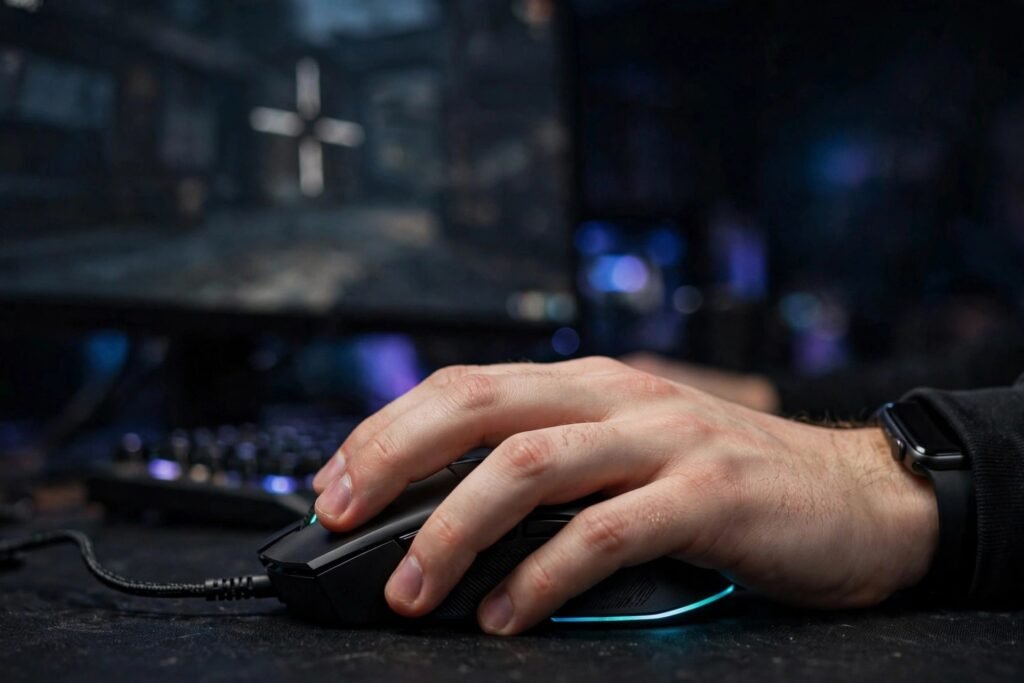
Most beginners play on sensitivities far too high, sacrificing precision for the ability to spin quickly. The standard: you should be able to do a comfortable 180° turn while keeping fine control for micro-adjustments. Measure in cm/360° (centimeters of mouse movement for a full turn) — most professionals use 25–50 cm/360°, far lower than casual defaults. Lower it gradually (10–15% at a time) over weeks, not all at once. Your mousepad needs to be large — this is non-negotiable for low sensitivity.
The rest of the setup
Disable mouse acceleration (Windows “enhance pointer precision” and in-game accel — acceleration destroys muscle memory by making identical movements produce different results); use your monitor’s native resolution and the game’s highest stable framerate (aim degrades measurably below 60fps; 144Hz+ is the competitive standard); ensure your polling rate is maxed (1000Hz mice are standard); and position yourself ergonomically — arm aiming (whole forearm moves) for large adjustments, wrist for micro-corrections. Hardware beyond this has diminishing returns: a $150 mouse does not out-aim a $50 one in trained hands, though a terrible sensor or a tiny pad genuinely caps you.
The Practice Method: Deliberate, Structured, Consistent
Aim training works like physical training — structured, progressive, consistent beats marathon grinding:
Use an aim trainer (15–20 minutes daily)
KovaaK’s or Aim Lab offer scenario-based drills isolating each aiming sub-skill. The routine: 5 minutes of smooth tracking (following moving targets — builds the continuous control used in tracking-heavy games), 5 minutes of flicking (fast target acquisition — the Valorant/CS skill), 5 minutes of target switching (multiple targets — the Apex/Overwatch skill), and 5 minutes of your weakest scenario. Consistency beats duration — 15 focused minutes daily outperforms 2 hours on Sunday. Motor learning research is clear: distributed practice builds durable skill; cramming builds fatigue.
Practice in-game, not just in trainers
Trainers build raw mouse control; games demand aim under pressure, with movement, abilities, and stress. Split practice: aim trainer for mechanics, deathmatch (not competitive matches) for application — deathmatch gives maximum engagements per minute without rank anxiety. Avoid practicing in ranked: the stress impairs learning, and losing while “practicing” tilts you into bad habits.
One sensitivity, forever (mostly)
Constant sensitivity-switching prevents muscle memory consolidation. Pick one, commit for at least a month, and only adjust for genuine ergonomic reasons. The pros who switch constantly are the exception proving the rule — and even they mostly stick to one.
The Sub-Skills: What “Aim” Actually Comprises
“Aim” is not one skill but several, and diagnosing your weakness focuses practice:
Crosshair placement (the highest-ROI skill)
Keeping your crosshair at head height, pre-aimed at likely enemy positions, so duels require micro-adjustments rather than large flicks. This is game sense expressed as aim — and it improves faster than raw flicking while winning more duels. Study one map at a time: learn the common angles, and keep the crosshair there preemptively. Most players’ biggest aim leak is not mouse control but crosshair placement.
Counter-strafing and movement
In tactical shooters (CS2, Valorant), you are wildly inaccurate while moving — the skill is stopping precisely before shooting (counter-strafing). Practice the rhythm: strafe, counter-strafe, shoot, in one fluid motion. In movement shooters (Apex, Quake), the skill inverts: maintaining accuracy while moving fluidly, using strafes to dodge while tracking.
Spray control and burst discipline
Learn your main weapon’s recoil pattern (they are fixed in most tactical shooters — genuinely memorizable) and whether to spray, burst, or tap at each range. Most beginners spray at ranges where bursting wins — discipline beats pattern memorization.
The Mental Game: The Overlooked Multiplier
Aim degrades under stress — elevated heart rate, tunnel vision, and rushed decisions destroy the fine motor control you built in practice. The fixes: warm up before competitive play (10–15 minutes of deathmatch, not straight into ranked); manage tilt actively (two losses in a row → break; aim training while tilted builds tilted habits); breathe — literally (slow exhales between rounds regulate arousal); and review, don’t just grind (watch your deaths: were you aiming badly, or positioned badly? Most “aim diff” complaints are positioning diffs).
Audio is part of aim too — hearing the enemy first means pre-aiming before the duel starts. If your Bluetooth headphones keep cutting out, you are losing the information war before the aim duel begins — and in tactical shooters, network quality matters as much as hardware, which is why understanding the difference between 5G and 5G Ultra Wideband (and your home connection’s real performance) is part of competitive preparation.
Realistic Expectations and Timelines
Aim improves on a predictable curve: settings fixes produce immediate gains (days); crosshair placement produces fast tactical gains (2–4 weeks of conscious practice); raw mouse control improves steadily over months; and the final 10 percent — the difference between good and elite — takes years. Most players plateau not from talent limits but from unstructured practice: grinding ranked without drills, switching sensitivities, and never diagnosing specific weaknesses.
Track progress objectively: aim trainer scores over time (same scenarios, weekly benchmarks), headshot percentage trends (not single sessions), and duel win rate in deathmatch. Improvement is real but gradual — the players with the best aim are usually just the ones who practiced deliberately the longest. There are no shortcuts, but there are also no mysteries: the method is known, and it works.
The Bottom Line
Improve FPS aim by: fixing settings first (low sensitivity, no acceleration, high framerate), practicing deliberately 15–20 minutes daily in aim trainers plus deathmatch, mastering crosshair placement (the highest-ROI sub-skill), learning movement-shooting rhythm for your game, managing the mental game (warmup, tilt control, audio awareness), and tracking progress over months. Aim is motor learning — structured, consistent, patient practice is the entire secret.
Hardware Matters Too
Technique has a ceiling set by your gear. A mouse with a flawless sensor (most modern gaming mice qualify) removes hardware as a variable — but the bigger upgrade is often the monitor: moving from 60Hz to 144Hz+ makes tracking visibly smoother and measurably improves reaction performance, with diminishing returns beyond 240Hz for most players. RTINGS tests monitors rigorously for response time and input lag, which is worth checking before buying. Keep your mousepad large and clean, disable mouse acceleration in Windows (the classic aim-killer), and make sure your frame rate is stable — stuttering frames destroy muscle memory faster than any setting. PC Gamer’s hardware guides track the current value picks. None of this replaces practice, but practicing on responsive hardware means every hour builds real skill instead of fighting your setup.
Frequently Asked Questions
What sensitivity should I use for FPS games?
Lower than default — most pros use 25-50 cm/360°. You should manage a comfortable 180° turn with fine micro-adjustment control. Lower gradually (10-15% at a time) and commit to one sensitivity for at least a month.
Are aim trainers worth it?
Yes — 15-20 minutes daily in KovaaK’s or Aim Lab builds raw mouse control efficiently. But combine with in-game deathmatch practice, since trainers don’t teach aim under game pressure.
What’s more important: aim or game sense?
They multiply each other, but crosshair placement (game sense expressed as aim) improves fastest and wins the most duels. Raw flicking matters less than being pre-aimed at the right angle.
How long does it take to get good aim?
Settings fixes: days. Crosshair placement: 2-4 weeks. Solid mouse control: 2-3 months of daily practice. Elite levels: years. Consistent deliberate practice is the entire differentiator.
Does hardware matter for aim?
Basics matter (decent sensor, large pad, 144Hz+ monitor, stable framerate). Beyond that, diminishing returns — a $150 mouse doesn’t out-aim a $50 one in trained hands. Fix settings and practice before upgrading gear.