Expensive vs. Drugstore Skincare: What’s Actually Worth It?
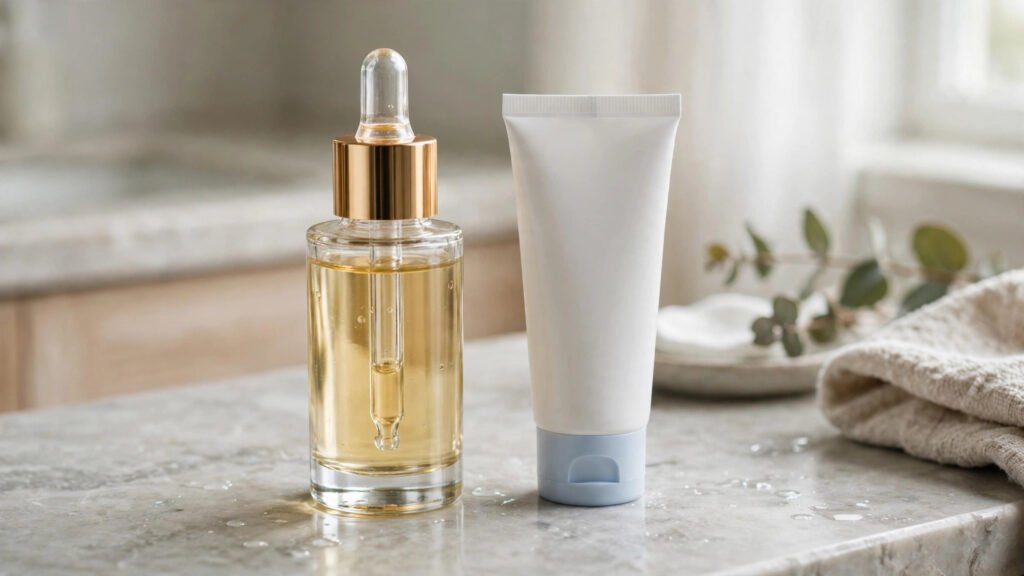
The $180 serum and the $14 serum both list niacinamide. One comes in a weighted glass bottle with a French name; the other sits on a drugstore shelf between the bandages and the greeting cards. Is the expensive one actually better — or are you paying $166 for packaging and fantasy? This is the most practical question in American skincare, and the answer is refreshingly evidence-based: sometimes yes, usually no, and the difference is almost never what the marketing claims. Here’s how to know when to splurge and when to save, ingredient by ingredient.
What You’re Actually Paying For (The Cost Breakdown)
A skincare product’s price reflects: ingredient costs (often 5–15% of retail), formulation R&D, packaging, marketing and advertising (frequently the largest share for luxury brands), retailer margins, and brand positioning. The uncomfortable truth: in prestige skincare, marketing and packaging routinely cost more than the formula inside. A $150 cream might contain $8 of ingredients in a $12 jar with $60 of advertising behind it.
This doesn’t mean expensive products are scams — formulation expertise, elegant textures, and stabilized actives cost real money. But it means price is a terrible proxy for effectiveness. The question is never “is it expensive?” but “does the formula justify it?”
Where Drugstore Wins (Save Your Money)
Cleansers. A cleanser sits on your skin for 60 seconds and goes down the drain. Expensive cleansers are the worst value in skincare — a gentle, effective drugstore cleanser does the identical job. Save here, always.
Basic moisturizers. The core moisturizing ingredients — glycerin, ceramides, hyaluronic acid, petrolatum, niacinamide — are cheap commodities. Drugstore moisturizers with these ingredients match or beat luxury creams in independent testing with remarkable consistency. The barrier doesn’t know what the jar cost.
Sunscreen. Heavily regulated, rigorously tested, and excellent at every price point in the US market. A $12 drugstore SPF 50 protects identically to a $60 one (same testing standards). Spend the savings on using enough of it — quantity matters more than brand.
Simple single-ingredient products. Hyaluronic acid serum, niacinamide serum, squalane oil — these are commodity ingredients where formulation complexity is minimal. The drugstore version is chemically equivalent to the luxury version in most cases.
Where Spending More Can Be Justified
Vitamin C (L-ascorbic acid). Notoriously unstable — it oxidizes on exposure to light and air, turning from effective to useless (or irritating). Good stabilization, airless packaging, and proper pH formulation cost money. Cheap vitamin C serums that arrive already oxidized are worse than nothing. This is the category where formulation expertise most justifies price — though excellent mid-range options exist; you don’t need the $180 one specifically.
Retinoids. Prescription tretinoin (often $20–$40 with insurance or via telehealth) outperforms every OTC retinol at any price — the smart “splurge” here is a dermatologist visit, not a luxury retinol. Among OTC retinols, encapsulation technology and concentration accuracy vary, and reputable mid-range brands tend to be more reliable than the cheapest options.
Complex formulations. Products combining multiple actives at effective concentrations with proper pH and stability — these require real formulation skill. But evaluate the specific product, not the price tier: many mid-range ($25–$45) brands formulate excellently.
Texture and compliance. The honest luxury advantage: elegant textures you’ll actually use daily. The best product is the one you apply consistently — if a luxurious texture is what gets you to wear sunscreen daily, that’s real value. Just recognize you’re paying for compliance, not chemistry.
How to Evaluate Any Product (The 60-Second Method)
Ignore the front of the package entirely. Flip it over: check the ingredient list order — ingredients are listed by concentration; the starred actives should appear in the first half, not the last line. Look for concentrations — reputable brands state them (10% niacinamide, 15% vitamin C); vague “contains” claims hide fairy-dusting. Check the packaging — airless pumps and opaque bottles protect actives; jars expose everything to air and fingers. Search for independent reviews — dermatologist reviews and ingredient-analysis sites, not sponsored influencers. And remember the regulatory reality: cosmetic claims in America are loosely policed — “clinically proven” and “dermatologist-tested” have minimal legal meaning. The FDA’s overview of how cosmetics are regulated explains exactly what those claims can and can’t promise.
The American Academy of Dermatology consistently advises that effective skincare is about the right ingredients used consistently — a message that favors smart drugstore shopping over luxury loyalty. The same budget wisdom applies across self-care: eating healthy on a tight budget and dressing stylishly on a budget share the core principle — knowledge outperforms spending in every category.
Dupe Culture: Smart Shopping or Risky Business?
The “dupe” phenomenon — affordable products claiming to match luxury formulas — deserves its own analysis, because dupes range from brilliant to misleading. Legitimate dupes exist when the key active ingredients and concentrations genuinely match: a $12 niacinamide serum at 10% is functionally identical to the $60 version at 10%, and calling it a dupe is accurate. The INCI list doesn’t lie — compare the first ten ingredients, and similar lists mean similar products.
Misleading dupes claim equivalence on vibes: similar packaging, similar marketing language, but different active concentrations, missing supporting ingredients, or inferior delivery systems. A “dupe” of a stabilized vitamin C serum that uses an unstable derivative at unknown concentration isn’t a dupe — it’s a different, worse product in a lookalike bottle. The test: does the dupe disclose the same active at the same concentration with comparable supporting formulation? If yes, buy the dupe confidently. If the comparison rests on packaging similarity and influencer claims, treat it as marketing. Smart dupe shopping is ingredient-list comparison, not vibe comparison — and the shoppers who read labels save thousands without sacrificing results.
The Smart Skincare Budget
The evidence-based allocation: splurge (relatively) on vitamin C and retinoids from reputable formulators; save on cleansers, basic moisturizers, and sunscreen from the drugstore; spend mid-range on anything else. Total routine cost for an excellent regimen: $60–$120, not $500. Anyone telling you effective skincare requires luxury prices is selling luxury skincare.
Conclusion
Expensive skincare isn’t categorically better — it’s better only when the price pays for something real: stabilized vitamin C, well-formulated retinoids, or textures that ensure daily compliance. For cleansers, basic moisturizers, sunscreen, and simple single-ingredient products, drugstore formulas are chemically equivalent at a tenth of the price. Learn to read ingredient lists, ignore the packaging theater, and allocate your budget by formulation need, not brand prestige. Your skin responds to chemistry, not price tags.
Frequently Asked Questions
Are expensive skincare products worth it?
Sometimes — for stabilized vitamin C, quality retinoids, and complex formulations. For cleansers, basic moisturizers, and sunscreen, drugstore products perform identically at a fraction of the price.
What skincare is worth splurging on?
Vitamin C serums (stabilization matters), retinoids (formulation quality varies), and anything where an elegant texture ensures you’ll actually use it daily. Everything else: save.
Do dermatologists recommend drugstore skincare?
Routinely — dermatologists frequently recommend drugstore cleansers, moisturizers, and sunscreens. They care about ingredients and consistent use, not brand prestige.
Why is luxury skincare so expensive?
Mostly marketing, packaging, and brand positioning — these often exceed the formula cost. Some premium goes to genuine formulation R&D, but price is a poor proxy for effectiveness.
Can cheap skincare damage my skin?
Price doesn’t determine safety — a poorly formulated luxury product irritates just like a poor drugstore one. Evaluate ingredients, patch-test new products, and avoid known irritants regardless of price tier.