How Can I Update Old Kitchen Cabinets without Replacing Them
Kitchen cabinets are the most expensive element in most kitchens — replacing them costs $10,000 to $30,000. But here’s the thing: the cabinet boxes are usually perfectly fine. It’s the doors, drawer fronts, and finish that look dated. Updating old kitchen cabinets without replacing them is one of the highest-ROI projects in home improvement, and you have options ranging from a $50 weekend refresh to a $3,000 near-replacement look.
Here are all the ways to update old kitchen cabinets without replacing them, from simplest to most transformative.
How Can I Update Old Kitchen Cabinets Without Replacing Them?
Start by assessing what you have. Solid wood cabinets (even dated-looking oak) are excellent candidates for every method below — the wood is quality, only the finish is tired. Laminate or thermofoil cabinets can be painted with proper prep (bonding primer is essential) but can’t be stained. Damaged or delaminating cabinets with swollen particleboard may not be worth saving — be honest about the bones before investing effort.
Option 1: Paint Them (Biggest Transformation, $100–$300)
Painting cabinets is the nuclear option for dated kitchens — honey oak becomes crisp white, dark cherry becomes modern charcoal. The process:
- Remove doors, drawers, and hardware. Label everything (painter’s tape on the back of each door with its location) — doors that look identical often aren’t.
- Clean aggressively with a degreaser (Krud Kutter or TSP substitute). Kitchen cabinets accumulate years of invisible cooking grease that prevents paint adhesion. This step is non-negotiable.
- Sand lightly (120–150 grit) to scuff the surface — you’re not removing the old finish, just giving the primer something to grip.
- Prime with bonding primer (Zinsser BIN shellac-based or similar). This is the step that separates lasting results from peeling disasters, especially on laminate or glossy surfaces.
- Paint 2–3 thin coats of cabinet-grade enamel (Benjamin Moore Advance, Sherwin-Williams Emerald Urethane, or similar). Do not use wall paint — it chips within months on cabinets. A paint sprayer ($80–$150) gives the smoothest factory-like finish; brush and foam roller work too with careful technique.
- Let cure fully — 2–3 weeks before heavy use. Paint feels dry in hours but hardens over weeks; premature use causes chips.
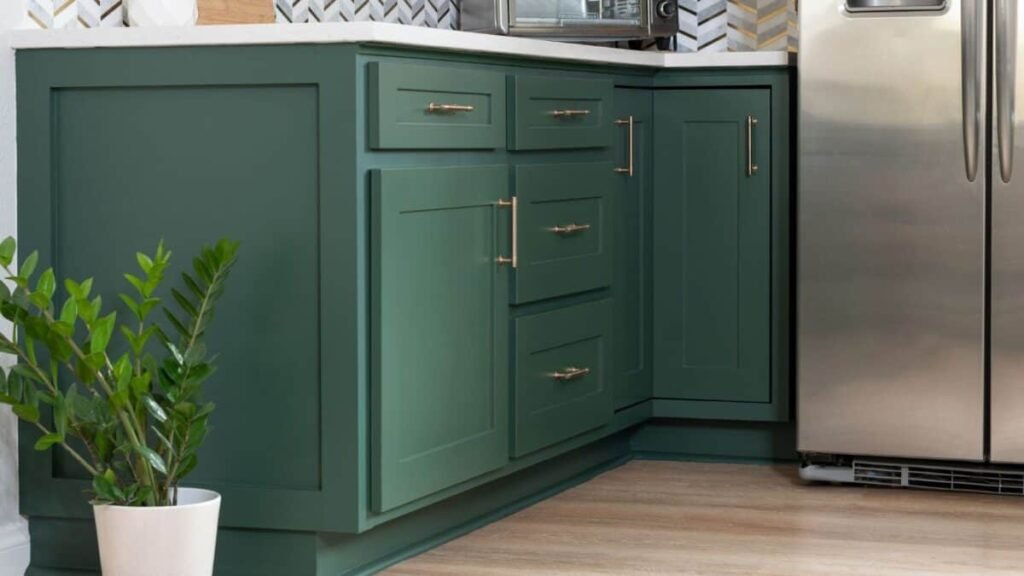
Color strategy: white and off-white are timeless and brighten everything; navy, forest green, or charcoal on lower cabinets with white uppers is current and sophisticated; two-tone (dark base, light uppers) adds visual interest without overwhelming. Our guide to painting like a professional covers technique fundamentals.
Option 2: Replace Doors and Drawer Fronts ($1,000–$3,000)
Cabinet refacing — new doors, drawer fronts, and veneer on the visible box frames — delivers 90 percent of the new-cabinet look at 40–50 percent of the cost. This works when you like the layout but hate the door style (arched cathedral doors scream 1990s; flat Shaker doors are timeless). Order unfinished doors and finish them yourself to save, or order pre-finished for convenience. Companies like Cabinet Door World and FastCabinetDoors ship custom sizes.
DIY refacing is very doable: measure carefully (measure twice, order once — custom doors aren’t returnable), attach with a concealed hinge jig ($20–$30) for professional-looking hinge boring, and apply peel-and-stick veneer ($50–$100 per roll) to the face frames. The result is genuinely indistinguishable from new cabinets.
Option 3: New Hardware ($50–$250)
Never underestimate hardware. Swapping dated brass knobs for matte black bar pulls or brushed gold knobs modernizes cabinets instantly — it’s the jewelry of the kitchen. Combine with paint for maximum effect, or do it alone for a quick win. Measure existing hole spacing (common: 3″, 3.75″, 5″) and buy pulls that match to avoid drilling. Soft-close hinges ($3–$5 each) are a luxury-feeling upgrade that’s cheap and easy to install.
Option 4: Remove Doors for Open Shelving (Free)
Removing the doors from a few upper cabinets creates open shelving — airy, modern, and free. It works best on 1–2 cabinets (not the whole kitchen), styled with matching dishes and minimal clutter. Paint the cabinet interiors first for a finished look. The commitment is low — you can always rehang the doors. This pairs beautifully with our tips for making a kitchen look bigger.
Option 5: Add Trim and Details ($50–$200)
Crown molding on top of wall cabinets ($2–$5 per linear foot) makes stock cabinets look custom and high-end. Under-cabinet light rail molding hides LED strips for a finished look. Decorative end panels dress up exposed cabinet sides. Furniture-style feet on the base cabinets (replacing the toe-kick look) creates a custom furniture feel. These carpentry details are what separate “$5,000 kitchen” from “$25,000 kitchen” in photos.
Option 6: Restain (For Wood Cabinets, $100–$200)
If the wood is good but the color is dated, restaining darker is easier than painting — no primer needed, and wood grain shows through beautifully. Clean, lightly sand, apply gel stain (easier than liquid stain for vertical surfaces — less dripping), and topcoat with polyurethane. Going darker is straightforward; going lighter requires stripping, which is labor-intensive enough that painting is usually smarter.
What About the Interiors?
Don’t neglect cabinet interiors — they’re what you actually use. Line shelves with washable liner ($10–$20), add pull-out organizers ($20–$50 each) to deep base cabinets (the single best functionality upgrade), install door-mounted racks for spices and lids, and add under-sink organizers around the plumbing. A $200 investment in interior organization makes old cabinets function like new ones.
When Replacement Actually Makes Sense
Be realistic: update when the boxes are solid and the layout works. Replace when: boxes are water-damaged or structurally failing, the layout is fundamentally dysfunctional (and you’re willing to pay to change it), or the cost of updating approaches 50 percent of replacement. For full budget context, our guide to the cheapest ways to update an old kitchen covers the whole-room picture.
Practical Takeaway
Paint for the biggest transformation ($100–$300), reface doors for the near-new look ($1,000–$3,000), swap hardware for the quick win ($50–$250), try open shelving for free, add trim details for the custom feel, and organize interiors for functionality. The cabinet boxes are almost always worth keeping — it’s the surfaces that need love. Update those, and the kitchen transforms for a tenth of replacement cost. This Old House’s cabinet refacing guides walk through the door-replacement process in detail.